

More Buybacks and Bigger Dividends
by Charles Rotblut | May 20, 2021
U.S. corporations are returning more money back to shareholders. Citing data from Goldman Sachs, The Wall Street Journal said companies have already authorized $504 billion worth of stock repurchases year to date (through May 7). Dividends are on pace to set another calendar-year record according to Howard Silverblatt at S&P Dow Jones Indices.
Coronavirus vaccinations and an improving economic outlook are both providing a shot in the arm. Corporations are also flush with cash after being more conservative last year. Financial companies, particularly banks, are benefiting from rising interest rates.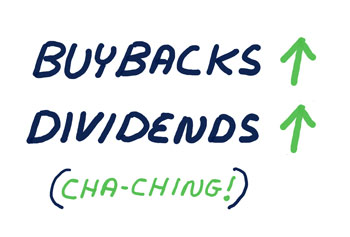
The spending on buybacks is the most through the first approximate four months of a calendar year in at least 22 years. The Wall Street Journal says these cumulative authorizations exceed the 2018 boost in share buybacks following the passage of the Tax Cuts and Jobs Act (TCJA). (The TCJA slashed corporate tax rates.)
Silverblatt thinks dividend payments from S&P 500 index member companies are on track to increase 5% this year. This could result in “a potential 10th consecutive year of record payments.” The aggregate increase in dividend payments during the first quarter was $20.3 billion, wrote The Wall Street Journal using data from the S&P Dow Jones Indices.
The headline numbers do not tell the full story.
Cumulative spending on share buybacks has been driven by a relatively small number of companies. Silverblatt says the top 20 largest repurchasers accounted for 57% of the buybacks reported for the first quarter of 2021. This is above the 47% average. Still, more companies are open to doing buybacks even if it’s not having a significant impact on the number of their shares outstanding. (Some buyback programs merely offset the issuance of employee stock options.)
The research on share buybacks shows an advantage to buying companies with net decreases in the number of shares outstanding. It’s not just buybacks that matter but rather whether those repurchases increase the proportionate ownership each share represents.
Dividends are stickier than buybacks. Investors expect to receive their quarterly payments from companies. All shareholders receive dividend payments proportionate to the number of shares they own. Investors tend to reward companies for raising their dividends with higher stock prices. When companies move to reduce or suspend their dividends, there’s often a penalty to be paid with worsening performance for the underlying stock.
In contrast, there is rarely a penalty to be paid when a company does not use its full share repurchase authorization. This gives companies greater flexibility when it comes to buybacks but also makes repurchase programs less reliable for shareholders to depend upon. Share buybacks only immediately put money back in the pockets of shareholders who sell the shares back to the company. The benefit from the reduction in the number of shares outstanding occurs over time.
Is there an argument to be made about companies redirecting some of this money toward raising salaries and hiring back workers? There certainly is, but that’s beyond the scope of this newsletter. What I will say is that it’s better for companies to return capital back to shareholders—be it through buybacks or dividends—than it is to waste the money on mergers or projects that will not build value over the long term.

- Shareholder yield combines stock buybacks and dividend payments. I compared and contrasted shareholder yield and dividend yield in this the 2016 AAII Journal article.
- Shareholder friendly actions, such as paying dividends and buying back stock, were among the key traits Patrick O’Shaughnessy suggested millennial investors should seek in a stock.
- This month’s AAII Journal also discusses how the world’s greatest investors think.
- The latest Model Shadow Stock Portfolio update explains why you may not want to sell in May and go away.
- Tune in on Wednesday for our latest Individual Investor Show. We’ll discuss how to find dividend stocks, leisure stocks showing signs of life and more.
AAII Sentiment Survey
Neutral sentiment among individual investors about the short-term direction of the stock market rose to its highest level since January 2020. The latest AAII Sentiment Survey also shows an increase in bullish sentiment and a decrease in bearish sentiment.
Bullish sentiment, expectations that stock prices will rise over the next six months, rose 0.5 percentage points to 37.0%. Optimism is below its historical average of 38.0% for the second time in 15 weeks.
Neutral sentiment, expectations that stock prices will stay essentially unchanged over the next six months, rose 0.2 percentage points to 36.7%. Neutral sentiment was last higher on January 8, 2020 (37.0%). Neutral sentiment remains above its historical average of 31.5% for the fourth consecutive week and the fifth time this year.
Bearish sentiment, expectations that stock prices will fall over the next six months, declined 0.7 percentage points to 26.3%. Bearish sentiment remains below its historical average of 30.5% for the 15th time this year.
At current levels, all three sentiment readings are within their typical historical ranges.
The return to normalcy from the coronavirus pandemic, monetary and fiscal stimulus and inflationary pressures are influencing individual investors’ outlook for stocks. Other factors include earnings, the Biden administration’s initiatives and valuations.
In this week’s special question, we asked AAII members how inflation is influencing their sentiment about the stock market.
Almost two out of five respondents (39%) say that inflation is having little to no impact on their market sentiment. Many within this group also say that they expect the inflation to be temporary due to confidence related to coming out of the pandemic. This compares to 32% of respondents who say that they are more cautious and shifting to a more defensive strategy, as they expect the market to experience a correction. In addition, about 11% of respondents say that they are shifting away from stock investments and more toward safe-haven investments like bonds, certificates of deposit (CDs) and other investments that should benefit from rising interest rates. About 9% of respondents say that they think hikes in inflation will cause the market to go up and that they are in favor of equities.
Here is a sampling of the responses:
- “Given that the government stimulus increased, inflation is inevitable. This increase will cause a flow of cash out of equities into bonds. This will result in a +20% market correction.”
- “It makes me reluctant to invest more money in the near future. I would like to know more about whether the inflation is transitory or more permanent.”
- “I believe that all the chatter about rapidly rising inflation is way overblown. I think inflation will be modest and within the ranges forecast by the Federal Reserve.”
- “Not much. I think inflation has the potential to push stock prices up, or down, depending on the company and depending on investor sentiment. Since I have no ability to predict how that will pan out, I don’t factor it heavily into my sentiment.”
Bullish: 37.0%, up 0.5 points
Neutral: 36.7%, up 0.2 points
Bearish: 26.3%, down 0.7 points
Bullish: 38.0%
Neutral: 31.5%
Bearish: 30.5%
See more Sentiment Survey results.

May 13, 2021 Inflationary Signals Continue to Point Upward
May 6, 2021 Financial Problems Can Foreshadow Alzheimer's Disease
April 29, 2021 A Quick Way to Analyze a Stock
April 22, 2021 I Rebalanced My 403(b) Account This Week

Discussion
No comments have been added yet. Add your thoughts to the discussion!
You need to log in as a registered AAII user before commenting.
Create an account