

Inflationary Signals Continue to Point Upward
by Charles Rotblut | May 13, 2021
Inflation in April was reported to be stronger than expected. The consumer price index (CPI) rose 4.2% before seasonal adjustment on a 12-month basis. This was the largest 12-month increase since September 2008.
Used motor vehicle prices were a notable standout, rising in price by 10% last month. Low inventories for new and used vehicles are driving up prices for both. The U.S. Bureau of Labor Statistics (BLS) described the increase in used car prices as the largest on record with data going back to 1953. Used vehicles accounted for more than one-third of the increase in seasonally adjusted consumer prices for all items.
It would be easy to solely blame the shortages of chips for new cars and the avoidance of public transit for driving up used car prices and therefore higher inflation. This is not the case with the CPI. The BLS wrote in yesterday’s release, “Nearly all major components [of the core CPI, which excludes food and energy] indexes increased in April.”
An obvious question coming out of the report is whether the Federal Reserve will be forced to take action to control inflation sooner than expected. Supply issues are certainly driving up prices. We’re also seeing rising demand as coronavirus-related restrictions are rescinded and a return to normalcy continues. Activities such as “revenge shopping” and “revenge travel” are being talked about.
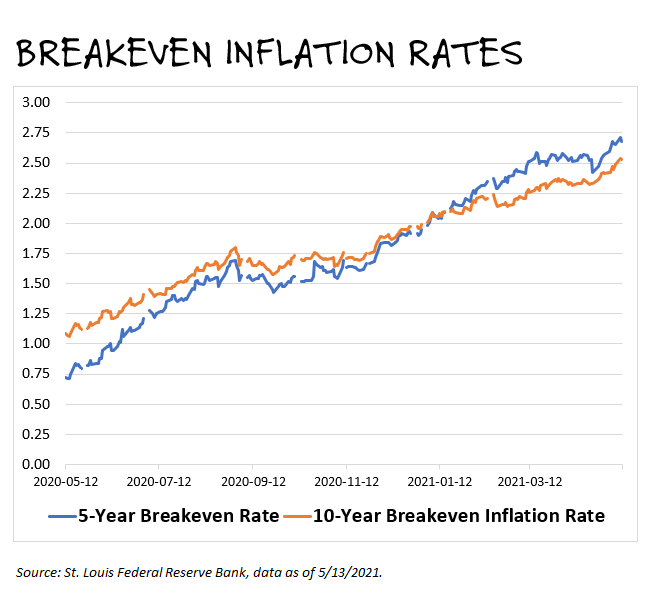
One way to measure expectations for how sticky higher inflation will be is to look at breakeven inflation rates. These rates reflect what bond traders expect the future rate of inflation to be. The more that traders believe inflation will be higher or at least stay at higher levels, the more they’re going to demand higher yields as compensation.
I wrote about the breakeven rate in late February. At the time, the five-year breakeven inflation rate was 2.38%. The 10-year breakeven rate was at 2.17%. As of yesterday, the five-year breakeven rate was 2.72% and the 10-year breakeven rate was 2.54%. The five-year rate is now at its highest level since 2008. The 10-year rate is at an eight-year high. Both still signal a below-historical-average level of inflation.
Federal Reserve chairman Jerome Powell has previously expressed a willingness to let inflation run above his 2% target for a period of time before taking action. Whether Powell’s or the other Federal Open Market Committee (FOMC) voting members’ expectations of when interest rates should start being raised remains to be seen. The next FOMC meeting will be held on June 15 and 16. The CME’s FedWatch Tool currently shows the futures markets only placing a 9% chance on interest rates being raised at all this year.
There are options for those of you who are fearful about inflation but do not want to stray far from your longer-term strategy. Dividends, over time, have grown at rates faster than inflation. Stock prices tend to rise during periods of lower inflation, which we remain in. Real estate investment trusts (REITs) can also work in a rising inflation environment as long as interest rates stay within a reasonable range. Laddering the maturity of bonds helps to reduce timing risk. (The same can be done with certificates of deposit, or CDs.) Treasury inflation-protected securities (TIPS) are an alternative. Gold, though often bandied about as a hedge against inflation, does not always live up to its reputation.
While smaller tactical changes may help you sleep better at night, it’s prudent not to make large portfolio changes. We do not know what inflation will look like 12 months from now, let alone five or 10 years from now. There’s also the uncertainty about how the stock market and/or the bond market will react to future inflation data. When you try to make a big portfolio change based on future inflation data, you’re trying to both project what future inflation will be and how the market will react to it.

- Over time, dividends have been effective at helping portfolios combat inflation.
- Before reacting to the latest inflation data, consider that selling topped the list of investing mistakes AAII members have made in the latest Big Question survey.
- If you’re looking to play off the reopening of the economy, the May AAII Journal lists 20 leisure stocks with signs of life.
- The deadline for filing 2020 federal taxes and making 2020 contributions to IRAs and related accounts is Monday. If you have not filed yet, our tax guide may be of help.
- Have questions about the AAII model stock portfolios? Tune in to hear my colleague Wayne Thorp compare and contrast them in our latest live webinar.
AAII Sentiment Survey
Bullish sentiment among individual investors about the short-term direction of the stock market fell to its lowest level since October 2020. The latest AAII Sentiment Survey also shows an increase in both bearish and neutral sentiment.
Bullish sentiment, expectations that stock prices will rise over the next six months, fell 7.8 percentage points to 36.5%. Bullish sentiment was last lower on October 28, 2020 (35.3%). Optimism is below its historical average of 38.0% for the first time in 14 weeks.
Neutral sentiment, expectations that stock prices will stay essentially unchanged over the next six months, rose 4.0 percentage points to 36.5%. Neutral sentiment was last higher on January 8, 2020 (37.0%). Neutral sentiment remains above its historical average of 31.5% for the third consecutive week and the fourth time this year.
Bearish sentiment, expectations that stock prices will fall over the next six months, increased 3.8 percentage points to 27.0%. Pessimism was last higher on February 3, 2021 (35.6%). Even with this week’s increase, bearish sentiment remains below its historical average of 30.5% for the 14th time this year.
At current levels, all three sentiment readings are within their typical historical ranges.
The return to normalcy from the coronavirus pandemic, monetary and fiscal stimulus and inflationary pressures are influencing individual investors’ outlook for stocks. Other factors include earnings, the Biden administration’s initiatives and valuations.
For this week’s special question, we asked AAII members to share their opinions of the current valuation of stocks. Nearly three out of five respondents (59%) say that the current valuation of stocks is too high at this time. Many within this group view valuations as too pricey to be sustainable and will likely lead to a correction. This compares to 15% of respondents who say that they think there is a mixture of overvalued and undervalued stocks in the market.
In addition, about 11% of respondents say that they think that the current valuations reflect a frothy market and pent-up demand. About 10% of respondents say that they think the current valuations are relatively reasonable given the pace of recovery and recent earnings results.
Here is a sampling of the responses:
- “Valuations are generally high compared to historical levels, especially in the technology growth area, but with interest rates generally low and many cyclical stocks in precarious financial conditions due to the pandemic, what are you going to do but pay up?”
- “This has been the best quarter for earnings in a long time. Thus, I don’t feel the market is overvalued. It should be going up as the nation recovers from the coronavirus.”
- “The valuations are a little high but are based on results from a rather unusual past 12 months. The forward-looking valuations seem a bit more reasonable.”
- “The stock market thinks the economy will get back to pre-pandemic numbers in the near future. With President Biden wanting to increase taxes on corporations, the return to pre-pandemic will be very slow.”
- “Depends on the sector. Some, like technology stocks that have done well in the past year, are overvalued. Stocks that are in sectors recovering from the pandemic are much more reasonable.”
Bullish: 36.5%, down 7.8 points
Neutral: 36.5%, up 4.0 points
Bearish: 27.0%, up 3.8 points
Bullish: 38.0%
Neutral: 31.5%
Bearish: 30.5%
See more Sentiment Survey results.

May 6, 2021 Financial Problems Can Foreshadow Alzheimer's Disease
April 29, 2021 A Quick Way to Analyze a Stock
April 22, 2021 I Rebalanced My 403(b) Account This Week
April 15, 2021 The Big Impact the Calendar Is Having

Discussion
John Barclay from CA posted over 5 years ago:
A thoughtful and timely Investor Update,
Barry J from TX posted over 5 years ago:
This is the most helpful article I have read on how to read leading inflation signals and how to respond among the 6 or so sources I read, including some well-known sources. Thank you for sharing your expertise.
John Dyess Sr from South Carolina posted over 5 years ago:
Inflation is for real. I do not believe it is temporary. With the FED dumping billions and likely trillions of money into the system for all the Democrat VOTE BUYING, inflation will continue at a very high rate: likely 5% or more this year and for the foreseeable future. I think the FED is deliberately misleading everyone.
You need to log in as a registered AAII user before commenting.
Create an account