

The Big Impact the Calendar Is Having
by Charles Rotblut | April 15, 2021
Featured Tickers: PBW
XRT
PBW
XRT
Confirmation of strengthening inflation was given this week. The consumer price index (CPI) registered a 2.6% increase in prices for the 12-month period ending in March. The core index, which excludes food and energy, is up 1.6% over the past 12 months.
Part of the big increase was due to the calendar. One year ago, shelter-in-place orders were in place for much of the U.S. and the rest of the world. The impact can be seen in categories such as hotels and motels. Last month, prices rose by 4.4% on a seasonally adjusted basis. Prices for this category fell by 7.7% in March 2020.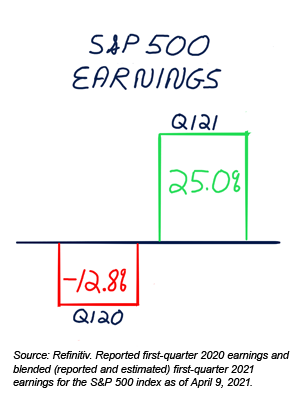
There are other factors that also warrant an asterisk. Energy prices have risen over the past several weeks because of disruptions caused by the bad winter storms in Texas. Hotel room prices are rising because more people are vaccinated. Coronavirus fatigue is also likely playing a role.
Looking beyond economic data, we can find other numbers being impacted by the calendar shift.
Exchange-traded funds (ETFs) and mutual funds along with any investment strategy reporting one-year returns have just gotten a big boost. The coronavirus bear market bottomed on March 23, 2020. Any returns reported with a starting date of April 1, 2020, benefit from the then still low stock prices.
To show you the extent of the effect the calendar shift is having, I used AAII’s ETF Screener to gather data on domestic, sector and international stock funds. Leveraged funds were excluded, given their much higher volatility. Out of the 1,297 remaining ETFs, 151 had one-year returns of 100% or more.
It’s easy to look good when the year-ago numbers were low.
The best-performing stock-focused ETF was Invesco WilderHill Clean Energy ETF (PBW) with a one-year gain of 267.1%. Coming in 10th place was SPDR S&P Retail ETF (XRT) with a 202.1% gain. Many stores were closed by state and local mandates a year ago. Now, more and more people are venturing out and spending money. In between, there have been three rounds of stimulus checks sent out.
We should also see many companies report big increases in revenues and earnings over the course of the next few weeks. Refinitiv projects S&P 500 index companies to have grown earnings by 25.0% during the recently completed first quarter. (The blended projection includes both reported and estimated earnings.) A year ago—first quarter of 2020—reported earnings fell by 12.8%.
This quarter will look even better. Earnings growth for the second quarter of 2021 is projected at 54.9%. Reported earnings declined by 30.6% in the second quarter of 2020.
It won’t just be earnings that will be affected. As I explained in last week’s VMQ Stocks commentary, sales, earnings, cash flow and earnings before interest, taxes, depreciation and amortization (EBITDA), among other valuation measures, will also be impacted. Any valuation multiple or financial ratio using four quarters of data could experience a noticeable change simply because of the shift in the calendar.
Given all this, be prepared to consider the impact the calendar may have had when looking at data. At the same time, be prepared to consider some of the other factors that could be skewing the numbers—including ones that are or may turn out to be transitory.

- Those of you who wish to dig into the inflation data or see other economic data will find helpful resources in this article about economic tea leaves.
- AAII contributing editor Paul Merriman explains the most important ways investors should look at performance in the current AAII Journal.
- Speaking of returns, I’ll explain how to analyze a fund using the tools on AAII.com in next week’s Webinar Wednesday.
- Yesterday’s death of Bernie Madoff serves as a reminder of the importance of protecting yourself from investment scams.
- The latest Model Shadow Stock Portfolio update is now live.
AAII Sentiment Survey
The percentage of individual investors describing their short-term outlook as “neutral” reached a five-month low in the latest AAII Sentiment Survey. At the same time, optimism is above 50% for the third time in four weeks.
Bullish sentiment, expectations that stock prices will rise over the next six months, fell 3.1 percentage points to 53.8%. Optimism is above its historical average of 38.0% for the 20th week out of the past 22 weeks.
Neutral sentiment, expectations that stock prices will stay essentially unchanged over the next six months, declined 1.1 percentage points to 21.6%. Neutral sentiment was last lower on November 11, 2020 (19.3%). Neutral sentiment remains below its historical average of 31.5% for the 61st time out of the past 65 weeks.
Bearish sentiment, expectations that stock prices will fall over the next six months, rose 4.2 percentage points to 24.6%. Bearish sentiment was last higher on March 3, 2021 (25.3%). Bearish sentiment is below its historical average of 30.5% for the 10th time this year.
At current levels, bullish sentiment is unusually high and neutral sentiment is unusually low. Historically, both above-average readings for bullish sentiment and below-average readings for neutral sentiment have been followed by below-average six- and 12-month returns for the S&P 500 index. Bearish sentiment is back within its typical historical range.
The ongoing coronavirus pandemic, including the distribution of vaccines, continues to have a big influence on individual investors’ outlook for the stock market. Other factors include the new administration’s policies, economic trends, the current level of valuations and economic stimulus.
This week’s special question asked AAII members how they would describe the current state of the economy.
More than one-third of respondents (36%) think the economy is showing signs of a strong recovery as more people are being vaccinated and are going back to work. This compares to 25% of respondents who say that the economy is being propelled by stimulus payments and too much monetary stimulus. They fear that the economy will pay the price in the future as a result. Many within this category also express their concerns about the possibility of a market correction resulting from rising interest rates, taxes and government spending.
About 16% of respondents say that they think while the economy is showing signs of recovery, the market is over-extended and too optimistic. Another 16% of respondents say that they think the economy is very fragile. Many are also uncertain and cautious about the market in the future.
Here is a sampling of the responses:
- “The economy is overstimulated, and it appears that stimulation policy will continue for the foreseeable future. Pick your own outcome but be prepared to be surprised.”
- “Overinflated due to low interest rates and proposed massive federal giveaway/pork barrel programs. When the well runs dry, beware of the crash ... and the current level of pie-in-the-sky unrestrained spending is unsustainable.”
- “Recovering, but has a way to go. The market has gotten ahead of itself.”
- “Poised to take off. Spending on restaurants, travel and entertainment is likely to steadily increase until things return to normal, with perhaps some acceleration when we approach herd immunity.”
Bullish: 53.8%, down 3.1 points
Neutral: 21.6%, down 1.1 points
Bearish: 24.6%, up 4.2 points
Bullish: 38.0%
Neutral: 31.5%
Bearish: 30.5%
See more Sentiment Survey results.

April 8, 2021 Don't Judge an Index Fund by Its Cover
April 1, 2021 Some Valuations Are Too High
March 25, 2021 One Year Later: Seven Lessons From the Coronavirus Bear Market
March 18, 2021 A Quick Tax Update, Plus a Look at Projected Earnings for 2021

Discussion
No comments have been added yet. Add your thoughts to the discussion!
You need to log in as a registered AAII user before commenting.
Create an account