

I Rebalanced My 403(b) Account This Week
by Charles Rotblut | April 22, 2021
Earlier this week I rebalanced my 403(b) workplace retirement account. I reduced my exposure to stocks—particularly domestic large-cap and small-cap stocks—while increasing my exposure to real estate investments trusts (REITs) and bonds.
The change is being done at a time that stock valuations are elevated. Optimism in the AAII Sentiment Survey is unusually high, and pessimism is unusually low. Bond yields, though having risen considerably over the past eight months, appear to have stabilized. There are also expectations for workers to begin returning back to offices in some fashion over the summer and fall as more and more Americans get vaccinated.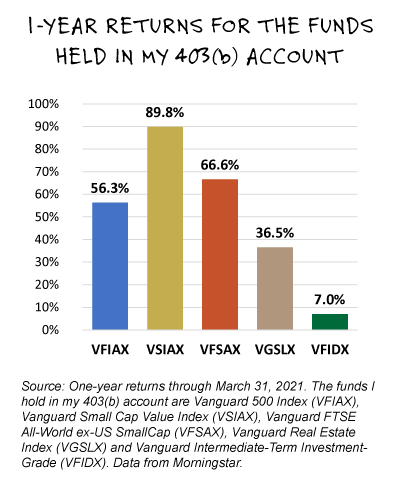
Any or all of these factors could play into one’s tactical decisions with how they allocate their portfolios. None of them had any influence on my decision to rebalance.
I simply rebalanced because my allocation weightings were too much off-target. The target allocation for my 403(b) account is 20% in each fund. I allow a margin equivalent to five percentage points in either direction before making adjustments. I check the portfolio twice a year, near the end of October and near the end of April. When I looked at my 403(b) account last weekend (for the first time in approximately six months), I noticed my bond allocation had fallen to approximately 14% and the small-cap value allocation was close to 25%. This was the sole reason I chose to rebalance.
You can see the funds I hold in the chart to the right. I’ve maintained this allocation for many years. It reflects my long-term goals of being able to afford retirement, my own personal tolerance for risk and long-term return and diversification data. (This allocation may or may not be appropriate for you. The Individual Investor Wealth-Building Process can help you determine what is the appropriate approach for you.)
It’s very possible that my decision to rebalance now could look very smart or quite silly over the short term. I am not worried about it. I am more concerned with maintaining a disciplined process and managing my portfolio than I am with where the financial markets are headed. I cannot control whether stocks or bond yields will rise or fall. I can control my process. If I follow a good process, then I will get the best possible return given the allocation I’ve chosen.
I’ll admit that rebalancing now has the appearance of being a contrarian move. Rebalancing requires one to sell what has been doing well and put it into asset class groups that have not done as well. The goal is to maintain an allocation and not to time the market. There will be times when rebalancing will lead to moves that appear tactical on the surface. This occurs because rebalancing pulls the pendulum back to the center when it has swung out too far.
There is a certain mindset that one must have when using this type of strategy. There can be reasons why you may look at your portfolio and decide that it’s not a good time to rebalance. That tug-of-war between following your long-term strategy and feeling the sway of the current economic and market headlines always exists. Investing would be easier if we were able to tune out all external stimulus and only focus on a simple process. Unfortunately, that is not reality.
If you find it hard not to react to what’s happening in the market and economy, realize that shades of gray do exist. You can use a long-term strategy to manage most of your portfolio, while allowing tactical changes to be made in a small portion of the portfolio. This would allow you to stick with a long-term strategy while giving you an outlet to channel your emotions through. Ultimately, the optimal strategy is the one you can stick to no matter what the market is doing.

- I shared updated data about the long-term performance of rebalancing last month.
- A big reason to diversify is that it reduces the odds of being wrong as I explained in this month’s AAII Journal.
- Since today is Earth Day, here are 26 socially responsible exchange-traded funds (ETFs) and 26 socially responsible mutual funds passing our First Cut screens.
- Tune in next Wednesday for our latest episode of The Individual Investor Show. We’ll discuss ways to view portfolio performance and provide more insights into socially responsible mutual funds and ETFs.
AAII Sentiment Survey
Optimism among individual investors about the short-term direction of the stock market extended its streak of staying above 50%. The latest AAII Sentiment Survey also shows a decline in bearish sentiment and higher levels of neutral sentiment.
Bullish sentiment, expectations that stock prices will rise over the next six months, fell 1.1 percentage points to 52.7%. Optimism is above its historical average of 38.0% for the 21st week out of the past 23 weeks.
Neutral sentiment, expectations that stock prices will stay essentially unchanged over the next six months, rose 5.2 percentage points to 26.8%. Neutral sentiment remains below its historical average of 31.5% for the 62nd time out of the past 66 weeks.
Bearish sentiment, expectations that stock prices will fall over the next six months, fell 4.1 percentage points to 20.5%. Bearish sentiment is below its historical average of 30.5% for the 11th time this year.
Bullish sentiment is above 50% for the fourth time in five weeks. Bearish sentiment is in a range of 20.4% to 20.6% for the third time in five weeks. At current levels, optimism is unusually high, and pessimism is unusually low. Historically, both above-average readings for bullish sentiment and below-average readings for bearish sentiment have been followed by below-average six- and 12-month returns for the S&P 500 index. Neutral sentiment is back within its typical historical range.
The ongoing coronavirus pandemic, including the distribution of vaccines, continues to have a big influence on individual investors’ outlook for the stock market. Other factors include the new administration’s policies, economic trends, the current level of valuations and economic stimulus.
In this week’s special question, we asked AAII members how they would describe the current state of the housing market.
Just under half of respondents (45%) say that they think an overpriced bubble situation has hit the housing market. They believe housing is becoming overheated. This compares to 33% of respondents who say that it is currently a seller’s market due to pent-up demand and short housing supply. About 11% of respondents say that they think the current state of the housing market is causing material and labor inflation, especially for lumber prices. Another 8% of respondents say that they think the housing market will continue to move upward through at least the end of the year.
Here is a sampling of the responses:
- “Prices have increased due to limited supply and increased demand throughout the U.S.”
- “I believe it is too hot and will cool down within the next year. Housing can’t go up this much in the long term.”
- “Due to the pandemic, many people are reconsidering their housing situation and want to move. Demand has greatly increased, but supply is limited due to the pandemic, as well as construction time and labor. Thus, prices are jumping.”
- “Basic supply and demand combined with low interest rates. I don’t think it is a bubble. It makes sense when you look at the conditions.”
- “A high price bubble situation has hit the housing market again this time due to the coronavirus pandemic.”
Bullish: 52.7%, down 1.1 points
Neutral: 26.8%, up 5.2 points
Bearish: 20.5%, down 4.1 points
Bullish: 38.0%
Neutral: 31.5%
Bearish: 30.5%
See more Sentiment Survey results.

April 15, 2021 The Big Impact the Calendar Is Having
April 8, 2021 Don't Judge an Index Fund by Its Cover
April 1, 2021 Some Valuations Are Too High
March 25, 2021 One Year Later: Seven Lessons From the Coronavirus Bear Market

Discussion
Mike Broderick from VA posted over 5 years ago:
Have you read Level III Investing? It must be somewhat bogus if you continue to invest the way you are especially the rebalancing. Maybe a back check to see where you would be in your 403B is in order?
Greg from TN posted over 5 years ago:
This paragraph is a wonderful distillation of a rules-based approach: "It’s very possible that my decision to rebalance now could look very smart or quite silly over the short term. I am not worried about it. I am more concerned with maintaining a disciplined process and managing my portfolio than I am with where the financial markets are headed. I cannot control whether stocks or bond yields will rise or fall. I can control my process. If I follow a good process, then I will get the best possible return given the allocation I’ve chosen." I shall use it with glee (and attribution)!
Dean from AZ posted over 5 years ago:
Mike, I was wondering about Level 3 while reading this article as well. Of course the book offers some simplified methods of allocation. But I would be interested in Charles' thoughts as to how he developed this approach and how he feels in fits in with Level 3.
vic smyth from Illinois posted over 5 years ago:
I recently did some backtesting of portfolio rebalancing starting with 50% stock (IWM, QQQ or SPY) and 50% zero coupon US government bonds (EDV and a simulated 25 year zero coupon govt bond index), rebalancing at various percentages (55-45, 60-40, etc) and was shocked at the results! I did not expect so many periods of time when zero coupon bonds outperformed stocks, and the balanced portfolio outperforming 100% stock with greatly reduced volatility. Though I did not figure in rebalancing costs of slippage and taxes.
Claude from Georgia posted over 5 years ago:
I will forever remember Peter Lynch's admonition against cutting off one's flowers and watering one's weeds, which is pretty much what this re-allocation process looks like. Accounts (like the one involved here) with no tax consequences and (under current conditions) no discernible transaction fees allow more freedom to engage in churning activities undertaken for their own sake, but one must remember that this reallocation business was first promoted by brokers who stood to make money (in commissions and fees) from this activity. Of course, they did not disclose that aspect of following their advice. Competition and the passage of time now reduce their incentive to promote re-allocation as a mild form of fee-generating churning; nonetheless, these old "rules" must be viewed with considerable suspicion. Some people are more rule-bound than others, and it's good we live in a free country where folks can expose us to their reasoning on all these things and give us a chance to reassess our thinking. In the end, getting rich is always the best revenge. No matter how you do it.
Allan from Georgia posted over 5 years ago:
I couldn't help noticing that all the funds listed here are from Vanguard. While I get that Vanguard funds are stable and low cost, wouldn't it be wise to also diversify ACROSS financial institutions? What if an accounting scandal or other unexpected event comes out of nowhere?
TOM P from FLORIDA posted over 5 years ago:
The performance of the Vanguard funds you list does not match...even closely...the performance of the funds quoted in the February 2021 AAII Journal. The 2020 performance for VFIAX was 18.4 %..... your 1 year gain as of March 31, 2021on VFIAX states a gain of 56% 2020 performance of VSIAX was 5.8%....you state your gain was 90% as of March 31, 2021 2020 performance of VGSLX was negative 4.7%...you state your gain was 36% VFSAX and VFIDX are not even listed in the AAII Journal lists. I know Q1, 2020 was very good...but not that good to have such an extreme difference in performance. Can you explain the wide differences between your numbers and the Journals?
Charles Rotblut from Illinois posted over 5 years ago:
Mike and Dean--I did read Level3. There are some similarities such as my allocation to small stocks, There are also things Jim did with Level3 that I cannot do with my 403(b) plan. A big example is the inability to buy an equally weighted S&P 500 fund through Vanguard. As far as the fixed income allocation, including a bond fund fits into my personal tolerance for risk.
Allan--our 403(b) plan uses Vanguard. An investor holding an account outside of a workplace plan certainly has far more options to choose from.
Tom-What you are noticing is a shift in the calendar. The starting point for one-year returns is now March 31, 2020--about a week past the bottom of the coronavirus bear market. 151 non-leveraged equity ETFs had one-year returns an excess of 100% as of the end of March 2021.
-Charles
Charles Rotblut from Illinois posted over 5 years ago:
Mike and Dean--I did read Level3. There are some similarities such as my allocation to small stocks, There are also things Jim did with Level3 that I cannot do with my 403(b) plan. A big example is the inability to buy an equally weighted S&P 500 fund through Vanguard. As far as the fixed income allocation, including a bond fund fits into my personal tolerance for risk.
Allan--our 403(b) plan uses Vanguard. An investor holding an account outside of a workplace plan certainly has far more options to choose from.
Tom-What you are noticing is a shift in the calendar. The starting point for one-year returns is now March 31, 2020--about a week past the bottom of the coronavirus bear market. 151 non-leveraged equity ETFs had one-year returns an excess of 100% as of the end of March 2021.
-Charles
barry JC from T N posted over 5 years ago:
What about cash? Do you keep no cash?
You need to log in as a registered AAII user before commenting.
Create an account