

A Look at the Bond Market's Expectations for Inflation
by Charles Rotblut | February 25, 2021
The possibility of higher inflation has been the subject of recent commentary and scuttlebutt. Expectations for higher rates of inflation are being based on a return to normalcy as more vaccines are administered and the coronavirus pandemic turns into an endemic.
There are various measures used to gauge inflation. I’m going to share two forward-looking indicators. Both provide a reflection of market expectations. The first is the yield curve: the interest rates for Treasuries of different maturities. The second is the breakeven inflation rate. It signals what traders expect the rate of inflation to be.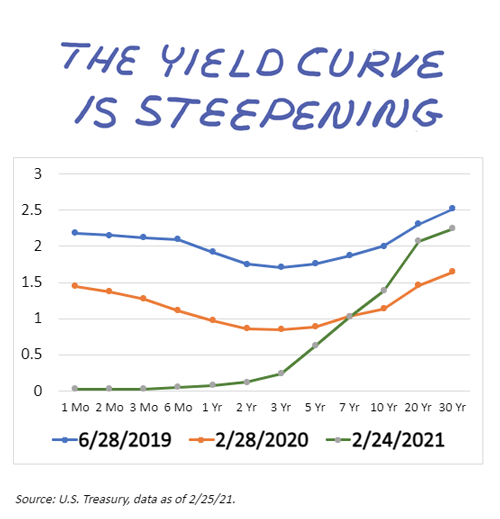
Prior to the pandemic, the yield curve had been inverted. An inverted yield curve occurs when longer-term rates are lower than shorter-term rates. This signals an expectation by traders for weaker economic conditions in the future and, thereby, lower interest rates. The yield curve was inverted in 2019. It was still inverted on the date of the first assumed coronavirus-related death in the U.S. (February 28, 2020—though estimates now put the first death earlier).
Since then, the yield curve has gone from flattening to steepening. An upward-sloping yield curve occurs when longer-term rates are higher than short-term rates. It signals expectations for economic growth to be maintained or strengthen. Traders want higher yields on longer-dated debt in exchange for the perceived possibility of inflation and/or interest rates being raised.
The change in the yield curve’s slope is what one would expect to see if the economy were expected to strengthen. A stronger economy equals more demand and potentially higher prices. I say “potentially” because there are other factors such as efficiencies in the supply chain and the willingness (or need) for businesses to continue competing on price.
The breakeven inflation chart provides a different look but paints a similar picture. Expectations for inflation plunged as shelter-in-place orders were issued for much of the U.S. almost a year ago. Then as businesses reopened, expectations rebounded. The breakout above 1.75% last fall occurred at about the same time there was positive news about the Pfizer-BioNTech and Moderna coronavirus vaccines.
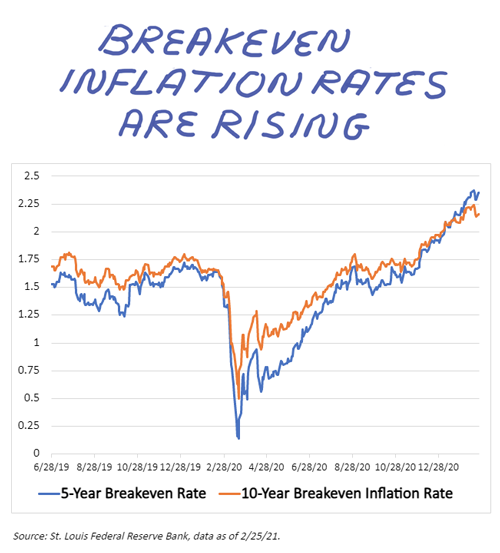
At first glance, the charts may create some concern about inflation. I would urge you to consider the levels of expected inflation. The five-year breakeven inflation rate is 2.38%. The 10-year breakeven rate is at 2.17%. Neither is significantly above the Federal Reserve’s target of 2%. More importantly, both breakeven rates are well below the levels of higher inflation that have caused concern in the past.
There are expectations for prices to rise during the second half of the year. As more people get vaccinated, the combination of returning to normalcy as well pent-up demand for spending is anticipated to lead to higher inflation. Fed chairman Jerome Powell doesn’t think such a bump in inflation will be sustained. There are also concerns about a larger (as opposed to smaller) stimulus package putting too much money into the economy in addition to increasing the federal debt.
Inflation, like other economic data, is hard to predict. A big increase in the number of people dining out, venturing into stores and traveling as the number of vaccinated people (both in the U.S. and elsewhere) increases seems likely. At the same time, the levels of unemployment and underemployment are predicted by economists to stay at higher levels for an extended period of time. In the background of all of this—as BlackRock’s global CIO of fixed income, Rick Rieder, put it in a note yesterday—are “powerful disinflationary forces, such as an aging demographic trend and technological innovations.”

- AAII contributing editor Brian Haughey shared key economic indicators you can use to judge the direction of the economy and inflation.
- The yield curve is watched by some as an indicator of where the economy may be headed. Past inverted yield curves have preceded economic downturns.
- As a result of the coronavirus pandemic, one-third of workers have either taken or plan to take money out of their retirement savings.
- As a reminder, this month’s AAII Journal features both our Mutual Fund and ETF guides.
- Be sure to tune in on Wednesday for the next episode of The Individual Investor Show. We’ll discuss dividend aristocrats and how to determine your tolerance for risk.
AAII Sentiment Survey
The percentage of individual investors describing their short-term outlook as “neutral” reached an eight-week high in the latest AAII Sentiment Survey. Meanwhile, pessimism fell to an eight-week low.
Bullish sentiment, expectations that stock prices will rise over the next six months, fell 1.1 percentage points to 45.9%. Optimism is above its historical average of 38.0% for the 13th week out of the past 15 weeks.
Neutral sentiment, expectations that stock prices will stay essentially unchanged over the next six months, rose 2.7 percentage points to 30.3%. Neutral sentiment was last higher on December 23, 2020 (34.4%). Nonetheless, neutral sentiment remains below its historical average of 31.5% for the 55th time out of the past 58 weeks.
Bearish sentiment, expectations that stock prices will fall over the next six months, declined 1.6 percentage points to 23.8%. Pessimism was last lower on December 23, 2020 (22.0%). Bearish sentiment is below its historical average of 30.5% for the third time this year.
At current levels, all three sentiment readings are within their typical historical ranges.
The ongoing coronavirus pandemic, including the distribution of vaccines, continues to have a big influence on individual investors’ outlook for the stock market. Other factors include the new administration’s policies, economic trends, the current level of valuations and economic stimulus.
For this week’s special question, we asked AAII members how the size of the next stimulus package would impact their outlook for stocks.
Nearly two out of five respondents (39%) say that the greater the size of the next stimulus package, the better their outlook for stocks would be. This compares to 27% of respondents who say that the size of the next stimulus package will have little to no impact on their outlook for stocks. Many within this group also say that they believe a significant stimulus package is probably already priced into the stock market, thus the impact will be nominal. About 15% of respondents say that they think the stimulus will have a short-term upward impact followed by a long-term downward impact. In addition, about 11% of respondents say that the size of the next stimulus package will have a negative impact on their outlook for stocks.
Here is a sampling of the responses:
- “The greater the size of the package, the better the outlook for stocks. The spending will pump up profits and share prices.”
- “Over the short term, a boost. However, the U.S. debt and our ability to pay off our debtors will continue to burden this nation, making us more dependent on China and other debt-holders and ultimately weaken our economy in the long term.”
- “Whether considered a good thing or not, I feel larger stimulus checks would be a factor in propping the markets up for a time. This assumes that the Fed does not elect to raise rates.”
- “The bigger, the better for stock prices. The more money in circulation, the more revenue companies are likely to make, which should eventually feed the bottom line of increased profits.”
- “They will go through the roof. Then we will have real bad inflation. Too much money chasing too few goods. It will be very bad.”
Bullish: 45.9%, down 1.1 points
Neutral: 30.3%, up 2.7 points
Bearish: 23.8%, down 1.6 points
Bullish: 38.0%
Neutral: 31.5%
Bearish: 30.5%
See more Sentiment Survey results.

February 18, 2021 Not Your Parent's Ma Bell
February 11, 2021 Investors' Timing Decisions Linked to Higher Volatility
February 4, 2021 Don't Fight the Hedge Funds, Invest Differently
January 28, 2021 Observations About and Lessons From GameStop's Big Rise

Discussion
bob from MI posted over 5 years ago:
So do we purchase TIPS or TIP funds?
Fred from Ca posted over 5 years ago:
I’ve owned a tips fund from Vanguard for years and have added to my position recently. I’m a retiree with a capital preservation approach.
Joe Betz from New York posted over 5 years ago:
I'm not sure I see how inflation is anywhere near on the horizon. Were not interest rates spectacularly low before the virus struck? If so why would a turn around of the economy to previous levels cause inflation? Millions of people across the country lost their jobs because of the pandemic and have in many cases racked up at least a year's worth of additional debt(unpaid mortgages, rents, car payments, credit cards, etc.). They get back to working and that might not be immediately, they're not necessarily going to be throwing money at too few goods. They're going to be doing a lot of catching up! Is this going to be everyone, no, but I suspect it will be enough that inflation will be pretty far down the road if it shows at all. Conservative economists have been looking for inflation to show itself at least for the last ten-eleven years and it has yet to happen. Could it show itself now, possibly, but I wouldn't put any money on it! I trust Powell, I think he and Yellen know what they're talking about.
doug from NC posted over 5 years ago:
I bought my first home when rates peaked at 18%. The early 1980's were challenging times. Since then interest have fallen for about 40 years and the market has risen with the fallen rates. Yes there were panics. Right now we are in a new zone 0 rates. Some countries have gone negative. It will cost $ to keep your $ in the bank. My concern is the printing of $, forgiving loans, free health insurance, etc. devalues are currency. Inflation comes in like a lion. Higher rates mean the cost of loans go up. Financing a home increases and the result is the housing market goes down. And the cost of goods increase. I think inflation will happen in the near future but at what rate depends on many variables such as our government, pandemic, technology, natural disasters, and the unknown. As one lady told me in Germany, her dad would run to the bank at lunch before it had no value. Yes diversity is the best prevention. And lets hope for the best and plan for the worst.
Rob from NC posted over 5 years ago:
Government debt going through the roof; interest rates "artificially" held near zero for a long time; increasing government regulation; cheap energy being discarded by the current administration; dependence on foreign energy sources increasing. Something is going to bust! It won't necessarily come in the form we expect, although it could be hyperinflation. Governmental tinkering can last only so long before the piper has to be paid.
You need to log in as a registered AAII user before commenting.
Create an account