

Observations About and Lessons From GameStop's Big Rise
by Charles Rotblut | January 28, 2021
Like many others, I’ve been watching shares of GameStop Corp. (GME) with a bit of disbelief. For those of you who have not seen the headlines, the stock’s price soared from a closing price of $19.95 on January 12 to an intraday high of $482.85 earlier today.
The chart on the right shows the price action. It’s a three-month chart. I could have used a six-month, one-year, three-year or five-year chart. None would have looked drastically different because of the magnitude of the recent surge. GameStop has taken off like a rocket after years of trading below $25 per share.
GameStop is a good example of a lottery stock. The term is used to describe highly risky stocks with a small chance of a big return. As the name implies, there is a big element of luck involved in hoping to realize a gain on them. The video game retailer’s revenues and net income have been on a downward trend for several years. This is why GameStop has an A+ Investor Growth Grade of D. The company’s business model is facing the existential threat of a growing number of digital downloads of games. (The base version of Sony’s new PlayStation 5 console only takes digital downloads, no discs.)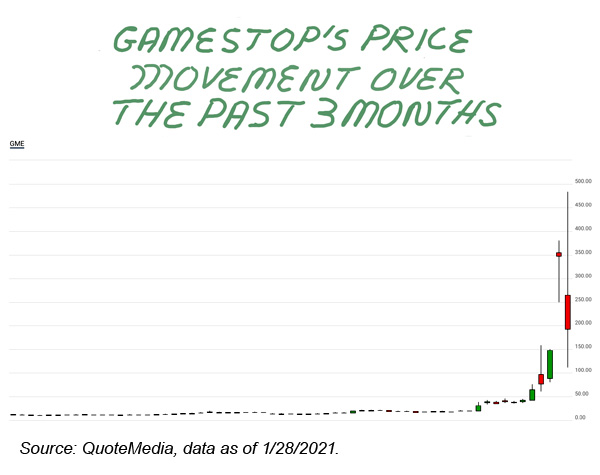
Despite this threat, shares of GameStop have jumped due to a combination of herd mentality and speculation. A stock-trading group on social media platform Reddit is being particularly singled out by the media for driving this mania. Posters encouraged each other to keep trading and making bold predictions of where the stock is heading. It can be very hard not to act when others are claiming to make money, and the stocks they are talking about are making huge gains over a short period of time. The fear of missing out (FOMO) frequently crowds out a person’s ability to stop and ask objective questions. These questions include (but are certainly not limited to): “If most people think they’ll know when to sell, what gives me the confidence to think I’ll know the right time to sell before they do?”
FOMO strikes when big gains occur. We remember the big upward moves we missed out on. What we don’t remember—and frequently don’t pay as much attention to—are the big losses we avoided. For every stock that has been able to hold onto a big gain, there are countless others that have plunged in price.
Beyond being cautious of FOMO, it’s important to be careful about what information you act on. There is no requirement on Reddit for others to tell the truth about their portfolio returns. Blindly taking tips from strangers you know very little—if anything—about is never a good investment strategy. Always do your own research by looking at credible sources.
There is also the role of luck to consider. Huge speculative gains realized over a short period of time are rarely attributable to skill. Luck—both good and bad—constantly plays a role in investing; knowing when returns are attributable to luck and when skill played a role will serve you well. Those who got in and out of GameStop with sizeable profits benefited from a bout of good luck.
Hedge fund Melvin Capital and investment firm Citron Research as well as others who had taken a bearish position on GameStop were hit with a large bout of bad luck on risky bets. The losses incurred by Melvin Capital are unknown. The Wall Street Journal says two other firms agreed to immediately invest $2.75 billion into Melvin Capital’s fund. The infusion is believed to help Melvin avoid margin calls. (A margin call is a requirement by a broker to put up more collateral. It happens when securities purchased with borrowed money, meaning by using margin, fall in value by a large enough magnitude.) What we do know is that the losses show the danger of shorting a stock and of selling uncovered (“naked”) options.
In simplistic terms, shorting a stock involves selling shares you don’t own. The short-seller then hopes to purchase the stock at a lower price to complete the transaction. Think of it as the opposite of buying a stock and then selling it. Since the price of stock can only fall to $0, the upside is limited. The maximum gain is the price the stock was sold at minus the price paid to close out the short sale. The maximum loss, however, is unlimited since a stock can technically keep rising in price. Someone who sold GameStop short when it was trading about $19 had a liability in excess of $460 per share this morning if they hadn’t previously closed their short position—a massive loss.
Selling uncovered call options has a similar risk/reward profile. A call option gives the buyer of the contract the right to purchase the stock at a set (“strike”) price. The seller is obligated to sell the stock at the strike price if the call option is exercised. The upside for the seller, if the stock doesn’t rise in price, is the premium received from selling the option contract. If the stock rises above the call price, the buyer can exercise the contract at the specified strike price. The seller of a naked call contract with a $20 strike price in GME could have technically been forced to buy shares of GameStop for as much as $482 per share to cover the options contract. Again, a massive loss.
While GameStop’s huge gains and volatility are surprising, the behavioral biases driving them is a case of history repeating. Manias within the financial markets have been documented ever since the Dutch tulip bubble nearly 400 years ago. It’s going to happen again. The human brain has yet to evolve enough to cope with the financial markets. Greed, FOMO, herd mentality and a sizeable list of other cognitive biases interfere with our collective ability to make rational decisions on a consistent basis. This is why we at AAII suggest that individual investors follow a disciplined, systematic, evidence-based approach to investing. It’s your best defense against the speculative desires that often lead to large losses.

- Michael Mauboussin explained the role luck and skill have in investing in this AAII Journal interview.
- The manager of a short-selling fund explains how short-selling works and how he identifies stocks that are at greater risk of falling in price.
- If a stock you own has big gains, watch out for negative sentiment in earnings news. It can precede a big drop in the stock’s price.
- Considering changing your broker or just want to see how yours compares? Our annual discount broker guide can help.
- Tune in next week for our latest Individual Investor Show. We’ll discuss mutual funds and exchange-traded funds (ETFs) as well as give suggestions for finding high-quality stocks.
AAII Sentiment Survey
Pessimism among individual investors about the short-term direction of the stock market rose to its highest level in 15 weeks. The latest AAII Sentiment Survey also shows optimism declining to its lowest level in 11 weeks.
Bullish sentiment, expectations that stock prices will rise over the next six months, declined 4.9 percentage points to 37.7%. Optimism is below its historical average of 38.0% for the first time this year.
Neutral sentiment, expectations that stock prices will stay essentially unchanged over the next six months, rebounded 1.0 percentage points to 24.0%. Neutral sentiment remains below its historical average of 31.5% for the 51st time out of the past 54 weeks.
Bearish sentiment, expectations that stock prices will fall over the next six months, rose 3.8 percentage points to 38.3%. Pessimism was last higher on October 7, 2020 (39.0%). Pessimism is above its historical average of 30.5% for the third time this year.
This week’s special question asked AAII members which factors are most influencing their six-month outlook for stocks.
Approximately 28% of respondents say that the country’s ability to manage the coronavirus pandemic and distribute the vaccine in the near future are the biggest influential factors on their market outlook. This compares to 22% of respondents who say that the new administration and its policies are the most influential factors. About 15% of respondents say that economic trends are influencing their sentiment. In addition, about 15% of respondents mention extremely high valuations. Other factors named include earnings reports (named by 7% of respondents) and economic stimulus efforts (named by 6% of respondents).
Here is a sampling of the responses:
- “A new president committed to solving pressing national problems, including normalizing international relations and standing.”
- “Bearish. Extremely high valuation, especially of the top tier technology companies that make up a large portion of the capitalization-weighted S&P 500 index, are likely to stage a correction in the first quarter of 2021.”
- “The market is definitely overbought. Stock valuations are too high. The only reason the market is up because there is nowhere else to put money.”
- “Expecting coronavirus vaccinations will allow the economy to get back-on-track results in optimistic conditions.”
- “The pandemic with respect to the extent of those who have received a vaccination, and its effect on the service economy. Increase in expectation of inflation and lack of spending.”
- “Valuations are crazy high, and they don’t reflect the pandemic weakness in the economy. Eventually, fundamentals are going to matter.”
Bullish: 37.7%, down 4.9 points
Neutral: 24.0%, up 1.0 points
Bearish: 38.3%, up 3.8 points
Bullish: 38.5%
Neutral: 30.5%
Bearish: 31.0%
See more Sentiment Survey results.

January 21, 2021 Pessimism Was High in 2020, but Investors Stayed With Stocks
January 14, 2021 How Much Are Mega Millions and Powerball Lottery Tickets Worth?
January 7, 2021 11 More Financial and Investing Resolutions for 2021
December 31, 2020 Financial and Investing Resolutions for 2021, Part 1

Discussion
robert beseke from WI posted over 5 years ago:
Wall Street got beat at there own game. Hedge funds have no problem taking profits from naked shorts. Yet when a group of people beat them at there own game, Wall Street cries foul. The average person will be regulated. The regulators will tell us that we need protection from ourselves. Yet nothing happens to point 72, Citadel etc. Any wonder why people have lost faith in this country.
robert beseke from WI posted over 5 years ago:
Wall Street got beat at there own game. Hedge funds have no problem taking profits from naked shorts. Yet when a group of people beat them at there own game, Wall Street cries foul. The average person will be regulated. The regulators will tell us that we need protection from ourselves. Yet nothing happens to point 72, Citadel etc. Any wonder why people have lost faith in this country.
robert beseke from WI posted over 5 years ago:
Wall Street got beat at there own game. Hedge funds have no problem taking profits from naked shorts. Yet when a group of people beat them at there own game, Wall Street cries foul. The average person will be regulated. The regulators will tell us that we need protection from ourselves. Yet nothing happens to point 72, Citadel etc. Any wonder why people have lost faith in this country.
Mark N from NV posted over 5 years ago:
Exactly, author misses at least 50% of the point here. Most investors are aware of (some version) of Tulip Mania...what isnt so obvious in the one-sided game played by hedge funds that can technically short any given equity into oblivion PUTTING UP ZERO CAPITAL by merely having the borrowing capability to cover anyone brave enough to go long on the stock. It works out super tidy if the hedge fund holds debt on target and stands to gain assets at a discount as the company folds. Hedge funds are mafia of market, playground bullies that can throttle any given equity merely thru access to more capital. Rigged game...and then the brokerages collude to restrict free trading? What about Zoom and Tesla? Are those Tulips too? Who's making the rules in this "free market"? SEC needs to address, immediately.
Joe B from New York posted over 5 years ago:
Mark N. is right you are missing half the point here! The Market is slanted to the big money player. There was absolutely no ethical reason why the market should have been closed to the small investors today in these stocks! Short selling has always been an abomination to me anyway. Some big player like a hedge fund gets to "Borrow" stocks from someone who has no opportunity to agree or disagree with the transaction. In other words it's just taken The big guy makes a profit on the transaction, but doesn't have to share the proceeds with the owner of the stock and then more often than not leaves the owner with a stock that's lost value. I've yet to meet anybody who can explain to me either the ethics or legality of this type of stock hooliganism!
Catherine I from Michigan posted over 5 years ago:
This article is time-honored, cautious investing knowledge, and it misses the bigger points that make the GameStop story so compelling. Hedge funds and other market players took company- and job-destroying short positions on GameStop, and a bunch of individual traders said “not this company, not this time.” These individuals created a short squeeze, forcing shorts to come up with a whole lot of money yesterday and today. Today, Robinhood and others limited trading on GameStop and this demands investigation. AAII is all individual investors, and we are playing at known disadvantages to the institutions. If institutions can effectively halt trading to a stock when their bets are not working out, that is a new disadvantage that individuals need to factor in to our investment and even market participation decisions.
Darrell T from Missouri posted over 5 years ago:
Unfortunately INVESTORS who buy stock based on their analysis of a company and its executives to market their product for increasing sales and profits are at the mercy of huge funds (TRADERS) that that buy, sell and trade stocks as instruments for profit and bonuses, with maybe a passing regard to company P&L statements. I do not believe short sales should be allowed. A check of the previous day short sales usually shows they are over 40% of all trades, does anyone believe 40% of the stocks should go down every day? I feel the same about trading commodities where brokers buy and sell with the only goal of profits, adding nothing of value to the item (livestock, sugar, OJ, corn, soybeans, et), instead they just drive the raw material prices up and add to the cost of the final product.
John Lambert from NJ posted over 5 years ago:
GameStop stock is cornered much like the Erie Railroad was by Cornelius Vanderbilt in 1868. This is not about a group of little heroes taking on the big bad hedge funds and shorts. This is about speculators causing the market to fail to set a price that reflects GameStop's value. The real damage will occur when the hero speculators try and convert their paper profits into cash. These events always end ugly.
William H. from MI posted over 5 years ago:
This article COMPLETELY misses the point of the GameStop spike.
Stefan-Georg Fuchs from Germany posted over 5 years ago:
While I sympathize with a lot of the comments here, I would like to convey a word of caution on pre-mature conclusions or final verdicts. The saga of the small guys with little knowledge vs. the greedy hedgefund managers sounds pleasing, greetings from Robin Hood, but is not true. There are many sheeps on this redditsub, but the moderators and some of those who pushed the thing know exactly what they do. To my knowledge, they didn't call for direct purchase of the stock but for using certain options...which implies they are at least as knowledgeable as HF managers as they knew what hurts the latter most and how to play the game on their terms. This shows, the problem with redditsub traders ( and alike ) is much more complex then people think . HFs , representing the establishment in the finanxe world, draw their money not out of thin air but mainly from wealthy individuals.These have no desire to loose their money in gambles. As the name 'Hedgefund' implies, the majority of these funds are typically NOT taking a lot of risk but rather hedge it by taking counterpositions to riskier strategies. So in order to hedge their exposure on , indeed, risky, option bets, they are often using quality investments, futures or ETFs on established indices, such as stocks from top tier companies. Being short a bad stock while being long a good one at the same time make money with little risk almost all the time... What we have seen this week in the selloff of the top names of 2020, was mainly driven by said hedgefunds forced to sell 'Quality' to setoff adverse effects from risky GameStop ( and similar stocks ) option bets they had open. If everything went according to plan, the bad stocks would have dropped further und the market would have done what the market does and the HFs had silentlyxwithdrawn from their positions they built up over years... Thanks to the sudden, unexpected redditsub actions, in parts caused by arrogant and outright dumb comments from certain HF managers, amplified by similar actions of traders around the globe in the same stocks, several HF went into imbalance and had to correct this by selling the good stocks on which they amassed already tons of money after the Covid events. We all felt this briefly in our portfolios. Now this was a comparably small event, involving only single digit billions, considering the overall size of the stockmarket. But it showed clearly, how vulnerable financial markets can be for such 'distortions'...with riple effects on all our portfolios of quality stocks. What seemed to be a low-risk money making machine for the HFs and individual investors alike for years, shorting stocks of low quality or one trick pony companies, while being long good and growing companies, begins to turn now into total gambling. I am sure, there are already Hedgefunds out there, picking up the RedditSubs theme and searching for stocks heavily shorted , speculating on and even forcing themselves with their money, a dramatic, albeit unfounded, rebound. Thereby squeezing out the shorts ( other HFsi.e.) ...at least for a couple days. Traders and investors alike will jump on the bandwaggon as lots of money can be made easier and quicker then waiting years for an annual 10% return plus some meager dividends. ... And to give you some taste on what may come in the coming weeks and months while people have nothing to do but playing the stockmarkets thanks to Covid restrictions.... : this whole Gamestop story has already spilled over to the markets here in Europe, but more so in Asia, India, Australia , Latin America and many other markets. Gamestop was yesterday one of the most heavily traded stocks on some german exchanges until the trading was halted by major brokerages such as IB. Now the poor emerging markets people, who can setup a cellphone based brokeraccount in India for small change can trade CFDs or Options globally for little money. Social media groups around the globe will pump and dump stocks or commodities they like or hate at will. Imagine just 200 Million young people with a 1000$ account trading the global stockmarkets but focussing maybe on 20-30 different, smaller float stocks of the new economies, internet, e-cars etc...all at the same time. Of course, most of them will loose money because not all can sell at the high price..Thatsxhow markets work.But we will certainly notice higher volatility/ risk due to the implications explained above. Imho, regulators IN ALL MARKETS have to pick up the whole matter of shortselling in stocks and all directly related financial derivatives like options, cfds, short-etfs etc... Naked options, which were the root cause for the Gamestop event, should simply not be allowed anymore. There is already enough risk in investing in equities. Investors have no interest in additional risks created by abuse of already questionable financial instruments. Be it through hedgefunds or so called social investing...in former times simply called 'pump and dump'. The redditsub traders are no less greedy then the hedgefund managers they condemn.
ibe from ny posted over 5 years ago:
AAII your politics are showing by your disregard of the nuances inherent in this saga.....this was an expression of frustration
Monk Monk from Texas posted over 5 years ago:
Seriously Charles, we are all investors. The real problem is that Wall Street has been playing the crooked roulette game on our back for decades. Why is it kosher for institutional investors to sell shares they don't own and drive businesses to the ground. The B.S. about short sellers make the market efficient and is good for placing the price correctly is pure B.S. A stock that is doing badly will not have many investors willing to buy it, and those who need to liquidate will be forced to liquidate at market prices. What the short sellers do is to act as blood suckers who deprive the companies that run into a rough patch from accessing the capital markets and thereby assuring the destruction of legitimate businesses. For example, GameStop indeed has an outdated business model, but they also have a footprint that can be retargeted to do something else. To do so, they need cash. But they will not be able to tap the markets to do a turnaround, the short sellers have condemned them to death while making money over the poor souls that invested in this thing. The reaction by the SEC and the brokerages yesterdays provides an undeniable proof that this market is rigged against individuals, however foolish they are, and that the whole thing is a big damned roulette that we are forced into because of the immoral interest rates set by an unelected feds. And so that you know, I personally know two people who are playing the GameStop game knowing full well that they will lose money. They are doing it to get back at Wall Street. The SEC better reign in Wall Street or else we should all put our money in FDIC-insured accounts!
Dr Clueless from TX posted over 5 years ago:
As other commenters have expressed, Mr. Rotblut stepped up to the plate, took a swing and missed by a country mile. Is short selling part of the problem? Absolutely. Will banning short selling end the problem? Absolutely not. A bigger issue than arguing about short selling being "right" or "wrong" is what are the rules and regulations around short selling. In particular for Gamestop, the short interest is insanely high. How did it get that way? The answer is manifold, but understanding the mechanics of short selling and the risks hedge funds are allowed to take with short selling is more enlightening. The same hubris that brought down Long Term Capital Management is now at play; wrt GME, the biggest risk of short selling is getting caught in a short-squeeze which some hedge funds clearly underestimated. Additionally, modern finance has created a monster wrt to financial derivatives. As Warren Buffett stated, "derivatives are financial weapons of mass destruction, carrying dangers that, while now latent, are potentially lethal". Just a quick read of the reddit on GME shows that these folks are digging into the rules of options and understanding the mechanics of how options are traded and how risk is managed by the companies that make up the options industry. This has allowed these small traders to further magnify the effects of their "investments" on price and volatility of GME through option trades. Given the trading volume, there are likely some wall street firms profiting off the on-going short-squeeze. This is not FOMO, but rather a piling-on effect. Another contributing issue is some of the reddit traders are fully aware that they are likely to lose their "investments" in GME. THEY DON'T CARE. I reached out to some Millennial investors in a Discord chat and they are giddy with putting the screws to the fat cats on wall street. They believe they are making a social statement about a rigged game. I could go on, but rather than belabor the point, the GME short-squeeze is a watershed event for the modern finance industry. The reactions of wall street and governmental regulators so far (as of Jan 28, 2021) are not helping the situation IMHO.
Clarence from TN posted over 5 years ago:
For another view on Gamestop, you might read Matt Taibbi's article here: https://taibbi.substack.com/p/suck-it-wall-street
Jerry from NY posted over 5 years ago:
This is not "investment" but indeed, "speculation" , which may or may not have a proper place in anyone's portfolio. The GME phenomenon is an old fashioned bull raid on the public positions of hedge funds which had not only shorted the stock but taken derivative positions AGAINST GME, resulting in a more than 100% short relative to the float situation. Naked short sales are allegedly illegal (but the SEC is lazy). Sounds like an interesting speculation to me. So the Large Actors, having large short positions, are to be taken to the cleaners by the retail trade bulls, UNLESS exchanges and regulators bend the rules to "bail out" said Larger Actors. This is ALL PUBLIC INFORMATION that the Market of retailers is now acting upon. There was an old Wall Street ditty, "Them that sells what isn't his'n Buys it back or goes to prison." Some famous politicians have said that "No one is above the law." Remember LTCM and Drexel Burnham Lambert? Bear Stearns and Leahman Bros? Market discipline.
Barry J from TX posted over 5 years ago:
I love my fellow AAII lifers. They are a fountain of wisdom. They bring together such interesting perspectives from their broad and varied life experiences and geographic diversity. The agree on only one thing. This hasty article doesn't share their perspectives. Of all the speculations I have read recently on what is happening and what it means, the one like best compares the Reddit uprising to the French Revolution. The similarities are that a mob is seeking to "guillotine" the elites. The mob leaders did so, then the mob guillotined their leaders. This episode in history says to me (1) a mob is a mob is a mob, and (2) whoever leads or encourages THIS mob could attract their bloodlust after they destroy the "elite capitalists" for whatever mob-based reason. In his memoirs about the trip to China in 1972 with Pres NIxon, Kissinger said, that when sharing a "relief" break with Chairman Mao in the palace garden, he asked Mao what he though about the 1789 French Revolution to probe Mao's openness to the concept of reform, and Mao said, "It is too soon to tell." I think Mao was saying: be careful what you wish for.
Jerry from NY posted over 5 years ago:
My memory tells me that "gaming the shorts" has been a Wall Street past time for decades, played (usually) by portfolio managers. Or even harassing the longs; see George Graham ("Adam Smith") in his 1970's book "The Money Game" ("The Stukas were out over Raytheon..."). As Barry J points out, this action is today a populist "mob" going after one of the Larger Actors; no different than what funds have been doing to each other (and smaller investors) for decades. Who should we cheer for, if anyone? Should we feel sorry for someone who did not practice good risk management? Market discipline.
Chuck from OH posted over 5 years ago:
I don't see anything wrong with shorting the market. Anyone with a margin account can do it. What I have a problem with is a group of people conspiring together to intentionally and vindictively cause harm first regardless if they profit from the transaction or not. The spirt of the market is to try and make money, not screw over other people because you don't like or understand what they are doing. This is a dangerous president being set. The last thing we need is for the "woke" culture to turn their evil attentions onto the markets.
William Mitchell from Alaska posted over 5 years ago:
First, I loved the input by Stefan-Georg Fuchs... very insightful thoughts on the current disruption in the markets. Second, I've been investing since the late 60's. Things were simpler back then and it took a phone call to place an order with your broker. Technology short sighted regulation has enabled a lot of wolves to take full time advantage of companies and we who invest in them. I would like to either see investing on margin outlawed, and the same with puts and calls. Buy and sell stock, that should be enough where corporate stock is concerned. Also, because technology allows for machine trades by the millions every day, there might ought to be a minimum on how long you have to hold the position... like 5 days or so. In the early years it actually seemed like I was investing and supporting our economy; providing jobs by under girding corporations with my money. For quite some time now it seems to me that the markets have become one big out of control casino, poorly regulated with wolves on the prowl everywhere you turn. I'd like to see some sanity return to the markets.
William from California posted over 5 years ago:
I'm concerned for what the regulators will do to us now that they have their attention focused on retail investors. I make my living day trading and don't have enough money to buy influence with the people sitting on committees and changing rules. But the big hedge funds do have the money to buy whatever changes they want. And now they want to put you and me out of business. Better to let sleeping dogs lie but now that the big guys are mad at us, what can we do to make sure we don't end up living under a bridge and eating out of garbage cans when the SEC and such are through with us?
Dilbert from CA posted over 5 years ago:
This whole thing is a soap opera and it's not over by any means. Zero commission trading, stock 'slices', Robinhood, and the 'stay-at-home' economy brought on by the China virus have done their share to level the playing field when it comes to Wall $treet. The most drama may be yet to come. Stay tuned.
You need to log in as a registered AAII user before commenting.
Create an account