

Not Your Parent's Ma Bell
by Derek J. Hageman | February 18, 2021
Featured Tickers: AAPL
AMGN
DLN
MSFT
NKE
TGT
TXN
AAPL
AMGN
DLN
MSFT
NKE
TGT
TXN

There are some widespread misconceptions and myths about dividend investing and dividend-paying stocks. One of my favorites is that dividend-paying stocks are the slow, boring way to invest. There was a time when being a “dividend investor” was practically synonymous with being a shareholder in public utilities—companies like Ma Bell and Standard Oil. But not anymore.
Stocks like Microsoft Corp. (MSFT), Texas Instruments (TXN), Target Corp. (TGT), Amgen Inc. (AMGN), even Nike Inc. (NKE) all pay dividends. Even tech superstar Apple Inc. (AAPL) pays a dividend.
Once you get past some of the myths, it’s easy to see that a dividend growth and income investing strategy can generate attractive total returns, a steady income stream for life and protection in market downturns.
My name is Derek Hageman and I’m the financial analyst and editor for AAII’s Dividend Investing premium service. I’m subbing in for Charles this week to share some insights on income investing, specifically on dividend growth and income-focused exchange-traded funds (ETFs).
Generally, dividend funds can be segmented into four groups: growth, income, growth and income and other. Dividend growth ETFs generally focus on finding high-quality companies that not only pay dividends but are also reasonably expected to grow their dividend each year. These funds are less focused on finding the highest dividend-yielding stocks. On the other hand, dividend income ETFs typically employ different strategies to seek stocks with higher yields. Dividend growth and income ETFs use a balance of these two strategies. They seek companies that both have higher-than-average dividend yields and grow their dividends.
Dividend-seeking investors who prefer ETFs may find one or more of these funds to be suitable investments. Deciding which dividend ETF to invest in depends on the characteristics being sought and the willingness to look closely at the strategy a fund is designed to follow.
Spotlight on a Dividend Growth & Income Focused ETF
If the goal is to satisfy demand for balance between potential dividend growth and higher-than-average yield, then dividend growth and income ETFs are what should be considered.
An example is the WisdomTree U.S. LargeCap Dividend ETF (DLN), which seeks to satisfy demand for growth potential and income focus—a growth and income dividend strategy. The fund is classified as a large-cap value equity style. As of February 17, 2021, it held 295 dividend-paying stocks. Qualifying stocks must have an expected regular cash dividend, have a market capitalization greater than $100 million and meet trading liquidity requirements. Unlike some dividend growth focused ETFs, stocks in this fund do not need a long history of dividend payments to qualify for inclusion.
Although the fund doesn’t screen for quality and may own some firms with weak fundamentals, it has limited exposure to firm-specific risk. The top three sectors that make up the WisdomTree U.S. LargeCap Dividend ETF are: technology (20.8%), consumer defensive (15.8%) and health care (15.5%).
The fund weights its holdings by the proportion of dividend payments that each firm is expected to make among all dividend-paying stocks, which tilts it toward larger and more profitable stocks. At the fund’s yearly rebalance, it increases its exposure to stocks that have become cheaper relative to their dividends and trims positions that have become more expensive.
Every stock has a unique profile of value, and its dividend yield (calculated by dividing the indicated annual dividend by the current stock price) can help investors determine how relatively undervalued or overvalued its share price is. Undervaluation is not synonymous with low price; rather, undervaluation occurs when a stock’s price is low in relation to the expected future cash return to shareholders. But there’s an important caveat to be aware of: A stock isn’t necessarily undervalued solely because its yield is high on an absolute basis or even in relation to its historical average. An investor must verify the sustainability of the dividend payment and the financial health of the company.

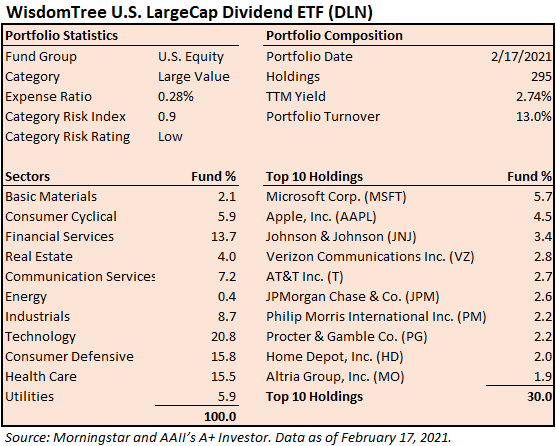
As you can see in the performance table, the WisdomTree U.S. LargeCap Dividend ETF has a five-year and 10-year annualized return of 12.9% and 11.6%, respectively. The average dividend yield of the stocks in the fund over the last 12 months is 2.74%.
High-yielding stocks can do well in a low-interest-rate, risk-on environment as investors find higher-yielding stocks to be an attractive alternative to bonds. But high yield is also synonymous with higher risk and lower quality in the dividend world, as well as lower expected dividend growth. It is expected that over the long term, dividend growth strategies will outperform high-yield strategies on a risk-adjusted basis.
Successful dividend-paying stocks must possess good business models, strong balance sheets, growth in sales and earnings, positive free cash flow, attractive valuations and a history of rising dividend payments.
The top two holdings in the WisdomTree fund are in the technology sector: Microsoft and Apple. All of the stocks mentioned at the beginning of my commentary are included in this fund.
One of the disadvantages of investing in an ETF is that you have less control of selling (and buying) when circumstances suit you the most. While mutual funds and ETFs afford investors easy diversification, buy and sell decisions are based on money flowing in and out of the fund. Often, that means buying high and selling low. In other words, funds tend to see greater inflows at the top of the market and greater demands for redemptions when the market is falling. However, these actions are counterintuitive, especially for investors who prefer to dollar-cost average. When managing your own portfolio of stocks, you have the flexibility of adjusting your portfolio to better fit your investment strategy and financial needs.
Invitation to AAII’s Income Investing Facebook Group
As investors search for yield in today’s low-interest-rate environment, many are flocking to dividend stocks and ETFs. It’s important to stay informed to maximize your chances at success, and I hope I was able to give you something valuable to think about.
Now, let’s take this conversation to the next level. I have just started up an online club of like-minded income investors, organized to share ideas and advance our collective information and education.
Please do me a big favor and accept my invite to AAII’s Facebook group, Income Investing. Then, introduce yourself and give me your best dividend stock or dividend-focused ETF success story! Or ... tell us what you’ve learned (or would like to learn) as a dividend investor.
Remember ... investing doesn’t need to be a solitary pursuit, and we are all in this together. The AAII Income Investing Community is here to help. See you there.

- Our Mutual Fund and ETF guides can help you find other fund with higher yields.
- Financial strength is an important characteristic of dividend-paying stocks. Wayne Thorp explains the criteria used in the A+ Quality Grade in the February AAII Journal.
- For those you who are following our Model Shadow Stock Portfolio, the latest monthly update is now available.
- On Wednesday, AAII president John Bajkowski will show you how to identify promising companies with our stock screens.
AAII Sentiment Survey
The percentage of individual investors describing their short-term outlook as “bullish” is at a nine-week high in the latest AAII Sentiment Survey. Both pessimism and neutral sentiment declined.
Bullish sentiment, expectations that stock prices will rise over the next six months, rose 1.6 percentage points to 47.1%. Optimism was last higher on December 9, 2020 (48.1%). Bullish sentiment is above its historical average of 38.0% for the 12th week out of the past 14 weeks.
Neutral sentiment, expectations that stock prices will stay essentially unchanged over the next six months, fell 0.7 percentage points to 27.6%. Neutral sentiment remains below its historical average of 31.5% for the 54th time out of the past 57 weeks.
Bearish sentiment, expectations that stock prices will fall over the next six months, declined 0.9 percentage points to 25.4%. The historical average is 30.5%.
Bullish sentiment is near the upper end of its typical historical average. Readings above 48.0% are considered to be unusually high. Both neutral and bearish sentiment are well within their typical ranges.
The ongoing coronavirus pandemic, including the distribution of vaccines, continues to have a big influence on individual investors’ outlook for the stock market. Other factors include the new administration’s policies, economic trends, the current level of valuations, economic stimulus and the possibility of inflation.
This week’s special question asked AAII members how big of a concern they think the possibility of inflation growing stronger in the future is.
More than half of all respondents (56%) say that they are very concerned about the possibility of inflation growing stronger in the near future. This compares to 30% of respondents who say that they are moderately concerned about inflation growing in the future, but do not think it will be a major impact. In addition, about 12% of respondents say that they are less concerned about the near future but highly concerned about inflation in the long term.
Here is a sampling of the responses:
- “Without a doubt inflation will grow in the future. However, the impact of the coronavirus pandemic is difficult to predict as it has already had a significant overall negative affect on the world’s economies. I wonder how the borrowings by the nation’s banks and resource shortages due to supply-chain issues will push up inflation.”
- “Very big concern. With 0% rates, huge government spending and money printing, it will start kicking in over the next six to 12 months.”
- “Low concern for the next year or so. Huge, huge for the long-term future, primarily because of global monetary policy by many governments. The advent of bitcoin-type currencies will probably make inflation worse.”
- “As long as the Federal Reserve keeps printing money, it will be low. However, once the presses stop, watch out.”
- “Absolutely none for the foreseeable future ... going on over 12 years with no consequences for the Fed’s massive printing of money ... but some day there will be hyperinflation galore.”
- “With commodities prices rising, that is the first sign it is going up. I believe we will see that within six months after the majority of the U.S. is vaccinated.”
Bullish: 47.1%, up 1.6 points
Neutral: 27.6%, down 0.7 points
Bearish: 25.4%, down 0.9 points
Bullish: 38.0%
Neutral: 31.5%
Bearish: 30.5%
See more Sentiment Survey results.

February 11, 2021 Investors' Timing Decisions Linked to Higher Volatility
February 4, 2021 Don't Fight the Hedge Funds, Invest Differently
January 28, 2021 Observations About and Lessons From GameStop's Big Rise
January 21, 2021 Pessimism Was High in 2020, but Investors Stayed With Stocks

Discussion
Jim from California posted over 5 years ago:
The emphasis on dividend stocks seems like sophomore level investing. The Modigliani Miller Theorem suggests we should be neutral towards dividends if risk adjusted, after tax total returns were the same between dividend and non-dividend stocks. In practice, taxes are worse for dividend paying stocks. In a taxable account, you’re forced to incur a taxable event whether you’d like to or not. While some investors might like how the dividend gives them permission to spend in retirement, you can declare your own dividend by selling a portion of your non-dividend paying stock and pay the more favorable long term capital gains rate instead. Heck, if you really need permission to spend, use a portion of your portfolio to buy a single premium immediate annuity. (I wouldn’t, but it’s one way to scratch that itch.) Nothing wrong with high quality dividend paying stocks, especially as part of a broad based, low churn, low tax index fund like VTSAX, but no need to seek out individual stocks because they are “dividend aristocrats” or some other label.
Steve from Overseas posted over 5 years ago:
Jim, I have to disagree with you. A person filing married-joint can earn roughly $100K annually in dividends without paying any taxes even in a taxable account. Exact value depends on your annual income limits. Whereas any capital gains will be taxed at 20% which will probably rise once the new administration gets its new budget approved. Additionally selling your shares reduces your overall portfolio value and in bad economic times you might have to sell shares at a loss as well. Steve
Bud from Washington posted over 5 years ago:
Steve, I more inclined to agree with Jim... without having more specific information from you regarding your numbers. Your post indicates that you are "Overseas", but your comment "implies" that your tax return is in the U.S. If that is the case, unless that $100K annual dividend is your only source of income, or you have a very large—and I mean VERY large—amount of deductions, then I must be missing something. Even then, I am not aware of any situation (in the U.S.) where one would pay 20% capital gains with no tax on dividends. And "qualified" dividends are taxed similarly to capital gains, whereas non-qualified dividends are taxed at one's regular rate. Would you care to enlighten me just a little? Or, better yet, send me a business card from your CPA or tax attorney.
You need to log in as a registered AAII user before commenting.
Create an account