

Financial Problems Can Foreshadow Alzheimer's Disease
by Charles Rotblut | May 06, 2021
One of the big threats to retirees’ financial well-being is not among the usual suspects of interest rates, the economy, stock market volatility, etc. Rather, it’s impaired cognitive abilities. There’s a small but growing amount of research showing a strong link between problems with managing one’s finances and Alzheimer’s disease and other related dementias (ADRD).
A study published in JAMA Internal Medicine found deteriorating financial capabilities to be among the earliest signs of cognitive decline. The research focused on Medicare beneficiaries living in single households. Single-beneficiary households were specifically chosen so that the presence of a spouse without cognitive decline—or less severe impairment—would not impact the data. Married couples may avoid showing signs of financial problems if the unimpaired or less impaired spouse steps in and takes over responsibilities, such as paying the bills.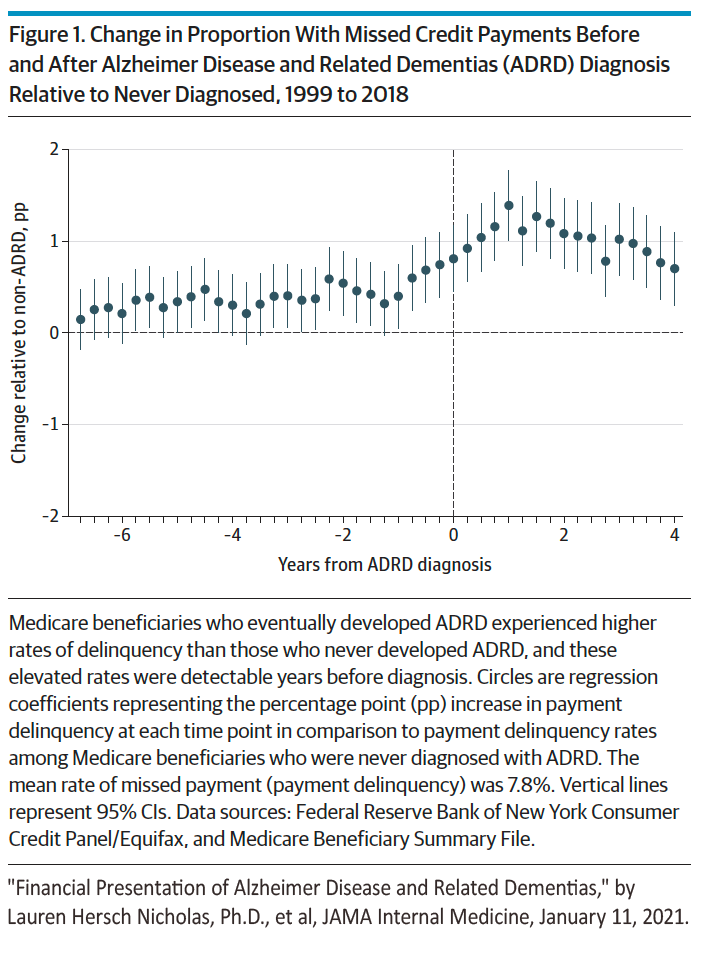
The study looked at a period of seven years prior to diagnosis and four years after diagnosis. More than 81,000 Medicare beneficiaries were included in the study. Approximately 27,000 of that group received a diagnosis of Alzheimer’s disease or related dementia for at least one quarter of observation. The average age of those with a diagnosis was 79.4.
“After adjusting for demographic and health characteristics, we found important differences in adverse financial events among Medicare beneficiaries who did versus did not develop ADRD that emerged prior to clinical diagnosis,” observed the study’s authors. Beneficiaries who developed ADRD were at significantly higher risk of payment delinquency compared with similar beneficiaries who never developed ADRD beginning six years prior to diagnosis.”
As you can see in the chart located to the right, there is a noticeable increase in the portion of beneficiaries with missed credit payments before and soon after being diagnosed. In an email, corresponding author Lauren Hersch Nicholas explained, “Not only does the magnitude of the effect increase substantially as we get closer to diagnosis, but the share of missed payments and subprime credit attributed to dementia reaches nearly 20% of all such events in our sample. While the majority of households with and without dementia never experience these adverse financial events, the heightened risk of these and related financial problems among those with early-stage and undiagnosed dementia is important to watch out for.”
Impaired cognitive abilities not only impact one’s ability to manage finances, but they also put one at greater risk of being scammed. Fraudsters commonly target retirees, hoping to take advantage of those who are less willing to ask questions or otherwise are easily conned due to impaired cognitive abilities.
This study has implications for those who are retired, as well as for those with older parents or other family members who are older. As one moves through their later years in life, it’s important to ensure backstops are in place such as keeping a spouse informed about recurring bills and other financial decisions (something that’s important for younger couples as well) and working with a trusted financial professional. Those with older relatives may want to consider periodically discussing finances as well as keeping an eye open for things such as unopened bills when visiting. It may also make sense to monitor accounts if there is concern about cognitive decline occurring. Listing someone as a trusted agent on financial accounts is another way of providing a layer of safety against fraud.

- The link between kinds of impairments and financial problems is not new. In 2011, the Journal of the American Medical Association listed five steps physicians can take to start a conversation with your older patients about financial issues.
- It’s important to plan ahead for transferring your financial decision-making to someone you trust. This AAII Journal article provides suggestions for how to do so.
- Speaking of retirement, spending on basic needs tends to fall more than spending on nonessential needs as households age.
- The new May AAII Journal also contains our latest quarterly mutual fund update and quarterly ETF update.
- Tune in on Wednesday for our latest episode of The Individual Investor Show. We’ll discuss how famous investors invest as well as share some of the mistakes AAII members say they have made.
AAII Sentiment Survey
Neutral sentiment among individual investors about the short-term direction of the stock market rose to its highest level in nine weeks. The latest AAII Sentiment Survey also shows an increase in bullish sentiment and lower levels of bearish sentiment.
Bullish sentiment, expectations that stock prices will rise over the next six months, increased 1.7 percentage points to 44.3%. Bullish sentiment was last lower on March 3, 2021 (40.3%). Optimism is above its historical average of 38.0% for the 23rd week out of the past 25 weeks.
Neutral sentiment, expectations that stock prices will stay essentially unchanged over the next six months, rose 0.8 percentage points to 32.5%. Neutral sentiment was last higher on March 3, 2021 (34.4%). Neutral sentiment remains below its historical average of 31.5% for the 64th time out of the past 68 weeks.
Bearish sentiment, expectations that stock prices will fall over the next six months, declined 2.5 percentage points to 23.1%. Bearish sentiment is below its historical average of 30.5% for the 13th time this year.
At current levels, all three sentiment readings are within their typical historical ranges.
This week special question asked AAII members to share their thoughts about the Federal Reserve’s willingness to let inflation run moderately above 2% for a period of time without raising interest rates. Slightly more than a third of respondents (35%) said that they agree with the Federal Reserve’s decision.
This compares to 24% of respondents who said that they think this is a bad decision and that they don’t think that the Fed will be able to keep a cap on inflation once it starts climbing. About 11% of respondents said that they disagree with this decision because it hurts savers and bondholders. In addition, about 11% of respondents said that they disagree with this decision because it encourages borrowing and the excessive printing of money.
Here is a sampling of the responses:
- “I’m alright with this, I suppose I’ll take a ‘wait and see’ approach. These are unprecedented times and I think some patience is warranted.
- “It is already over 2% for most Americans and the Fed should taper bond purchases slowly until zero at the end of year.
- “It sounds like a logical move with the current situation.
- “Not a good idea. It encourages too much borrowing on the part of people who really get hurt when inflation finally catches up and interest rates have to rise.
- “Dumb idea. Only a fool believes they have the power to manage the economy.
Bullish: 44.3%, up 1.7 points
Neutral: 32.5%, up 0.8 points
Bearish: 23.1%, down 2.5 points
Bullish: 38.0%
Neutral: 31.5%
Bearish: 30.5%
See more Sentiment Survey results.

AAII Asset Allocation Survey
Individual investors’ exposure to equities set a new three-year high in April according to the latest AAII Asset Allocation Survey. Fixed-income allocations, meanwhile, declined to a 30-month low.
Stock and stock fund allocations increased by 0.3 percentage points to 70.3%, marking the 11th consecutive month equity allocations are above the historical average of 61.0%. Equity allocations were last higher in January 2018 (71.2%).
Bond and bond fund allocations pulled back by 0.2 percentage points to 15.1%, staying below their historical average of 16.0% for the second consecutive month. Fixed-income allocations were last lower in October 2018 (13.3%).
Cash allocations were essentially unchanged at 14.7%. Cash allocations were last lower in January 2020 (13.8%). April was the 12th consecutive month cash allocations have been below their historical average of 23.0%.
Equity allocations are at an unusually high level for the second consecutive month. The strong rebound in the stock market has increased the value of equities and in individual investors’ portfolios relative to other assets. We also saw a continuation of unusually high levels of optimism being registered by our weekly AAII Sentiment Survey throughout much of April.
- Stocks and Stock Funds: 70.3%, up 0.3 percentage points
- Bonds and Bond Funds: 15.1%, down 0.3 percentage points
- Cash: 14.7%, down 0.1 percentage points
- Stocks: 31.5%, up 0.7 percentage points
- Stocks Funds: 38.8%, down 0.4 percentage points
- Bonds: 2.4%, up 0.1 percentage points
- Bond Funds: 12.6%, down 0.3 percentage points
- Stocks/Stock Funds: 62.0%
- Bonds/Bond Funds: 16.0%
- Cash: 22.0%
Take the Asset Allocation Survey.
April 29, 2021 A Quick Way to Analyze a Stock
April 22, 2021 I Rebalanced My 403(b) Account This Week
April 15, 2021 The Big Impact the Calendar Is Having
April 8, 2021 Don't Judge an Index Fund by Its Cover

Discussion
Barry J from TX posted over 5 years ago:
Interesting article. Is the sampled population - Medicaid recipients - used in this study representative of the greater US population -- and AAII members -- across these age groups?
George Purvis from Florida posted over 5 years ago:
There have been a number of articles around lately on this topic. The sample population was Medicare (not Medicaid) participants, which essentially means almost everyone over 65 and certainly all AAII members, again over 65. I personally know two friends/colleagues, both in their late 70's/early 80's who fell into the ADRD trap (so to speak) and before the spouses (or children) could figure out what happened, the money was essentially gone. They were left with just SSI which is not enough to live on, and children had to help them out. The process for both of them started in their 70's when they made mistakes in investing, took out reversible mortgages, or were taken advantage of by unscrupulous brokers or con men. This is a real problem as we age and everyone over 70 needs someone whom they trust to watch over them and their finances.
Charles Rotblut from Illinois posted over 5 years ago:
Hi Barry,
They looked at Medicare beneficiaries living in single-person households. They excluded those living with a spouse or significant other as well as those living in some type of retirement community such as assisted living facility. Medicare Advantage participants were also excluded.
-Charles
You need to log in as a registered AAII user before commenting.
Create an account