

Portfolio Reviews Can Often Lead to Doing Nothing
by Charles Rotblut | November 04, 2021
Featured Tickers: VFIAX
VFIDX
VFSAX
VGSLX
VSIAX
VFIAX
VFIDX
VFSAX
VGSLX
VSIAX
An oft-overlooked part of successful investing is knowing when not to act.
Very often, especially when a long-term approach to investing is followed, no investments will meet a sell rule. Similarly, allocations will frequently remain within an allowable range of fluctuation. In such situations, doing nothing is the smartest thing you can do. 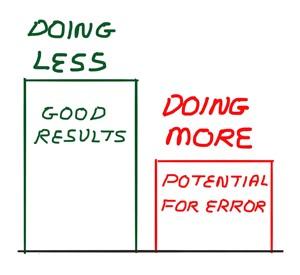
This was the case when I looked at my 403(b) account over the weekend. As long-term readers of this weekly newsletter know, I check my workplace retirement plan account twice a year to see if the allocations are within an acceptable range. As of the end of the last week, the five funds held in the account were fairly close to my desired allocation.
Each of the five funds represents a different asset class or asset class category. They and their allocations are:
-
Vanguard S&P 500 Index Admiral
 (VFIAX)—20.8%;
 -
Vanguard FTSE All-World ex-US Small-Cap Index Admiral (VFSAX)—19.4%;
-
Vanguard Intermediate-Term Investment-Grade Admiral (VFIDX)—18.8%;
-
Vanguard Real Estate Index Admiral (VGSLX)—21.4%; and
-
Vanguard Small-Cap Value Index Admiral (VSIAX)—19.6%.
The reason the allocation for each fund is close to my 20% per fund target is that I rebalanced the account in April. At the time, my bond allocation had fallen to approximately 14% while the small-cap value allocation was close to 25%. My portfolio strategy calls for rebalancing the account whenever the portfolio weight of any of the five funds falls below 15% or rises above 25%. If the portfolio weight for each of the five funds is within the range of fluctuation I allow, I do nothing.
The weighting of the bond fund has declined since rebalancing. This is because its share price was about even at the end of October relative to where it was at the end of April. Meanwhile, the other four funds all gained in value.
I’m fine with that. Each fund was chosen based on the asset classes they target, the long-term average returns for each asset class, how each works together from a diversification standpoint, my financial and psychological tolerance for risk (which may be different than yours) and a desire to keep the portfolio relatively simple.
Since my goal of funding retirement is long-term, so is my strategy and my approach to managing the portfolio. Long-term strategies, by definition, call for looking past the short-term headlines and temptations to act. Action is only taken when the process calls for it. Otherwise, not acting is the best thing an investor can do.

- Doing less has another benefit, it can boost your aftertax returns as this article from our archives explains.
- The November AAII Journal is now online.
- In the new issue, I provide suggestions for analyzing mutual fund and ETF performance.
- Knowing how much you need to save for a goal like retirement can help you make better decisions. In our PRISM Wealth-Building Academy, we help you determine how much you need to save.
- Next Wednesday there will be a new episode of the Individual Investor Show on Thanksgiving stocks passing a First Cut list.
AAII Sentiment Survey
The results from the latest AAII Sentiment Survey saw bullish sentiment continue its trend from last week, rising further above its historical average. In addition, the number of investors that described their outlook for stocks as “bearish” decreased.
Bullish sentiment, expectations that stock prices will rise over the next six months, rose 1.7 percentage points to 41.5%. This is the third consecutive week out of the last eight weeks that bullish sentiment is above the historical average of 38.0%.
Neutral sentiment, expectations that stock prices will stay essentially unchanged over the next six months, grew by 1.8 percentage points to 32.5%. This is the second time in five weeks that neutral sentiment is above the historical average of 31.5%.
Bearish sentiment, expectations that stock prices will fall over the next six months, decreased by 3.4 percentage points to 26.0%. This week marks the third consecutive week that bearish sentiment is below the historical average of 30.5%.
The return to normalcy from the coronavirus pandemic, monetary and fiscal stimulus and inflationary pressures are influencing individual investors’ outlook for stocks. Other factors include earnings, valuations and the Biden administration’s initiatives.
Bullish: 41.5%, up 1.7 points
Neutral: 32.5%, up 1.8 points
Bearish: 26.0%, down 3.4 points
Bullish: 38.0%
Neutral: 31.5%
Bearish: 30.5%
See more Sentiment Survey results.

AAII Asset Allocation Survey
Cash allocations among individual investors reached a five-month high in October. The latest AAII Allocation Survey also shows a decline in fixed-income exposure.
Stock and stock fund allocations stayed at 70.2% for the second consecutive month. October marked the eighth consecutive month that equity allocations were at or above 70%. Last month was also the 17th consecutive month AAII members’ exposure to equities was above the historical average of 61.0%.
Bond and bond fund allocations pulled back by 0.4 percentage points to 15.1%. The reversal of September’s increase keeps fixed-income exposure below its historical average of 16.0% for the eighth consecutive month.
Cash allocations increased by 0.4 percentage points to 14.7%. Cash allocations were last higher in May 2021 (15.1%). October was the 18th consecutive month that cash allocations have been below their historical average of 23.0%.
Equity allocations stayed at an unusually high level (above 69%). Stocks rebounded throughout October, sending the S&P 500 index to new record highs. Optimism among individual investors about the short-term direction of the stock market rose during the first three weeks of October, according to our weekly Sentiment Survey. Bullish sentiment pulled back during the final week of the month but ended October at an above-average level of 39.8%.
- Stocks and Stock Funds: 70.2%, up 0.0 percentage points
- Bonds and Bond Funds: 15.1%, down 0.4 percentage points
- Cash: 14.7%, up 0.4 percentage points
- Stocks: 31.6%, down 0.0 percentage points
- Stocks Funds: 38.6%, up 0.1 percentage points
- Bonds: 2.3%, down 0.1 percentage points
- Bond Funds: 12.7%, down 0.3 percentage points
- Stocks/Stock Funds: 62.0%
- Bonds/Bond Funds: 16.0%
- Cash: 22.0%
Take the Asset Allocation Survey.
October 28, 2021 Small-Cap Stocks Are Cheap Relative to Large-Cap Stocks
October 21, 2021 Don't Judge a Bitcoin ETF by Its Name
October 14, 2021 Two New AAII Member Benefits
October 7, 2021 Seven Pitfalls Dividend Investors Should Avoid

Discussion
Rob from NC posted over 4 years ago:
I agree that doing nothing is usually the best option. However, I am irked at the implied conventional wisdom that I believe to be wrongheaded (it's smart to include bonds, or bond funds, in a retirement -- or any long-term -- portfolio; periodic rebalancing based on arbitrary percentages is a good thing; volatility is risk). I wish the Journal would have more articles questioning such "wisdom" and demonstrating its folly.
John Lambert from New Jersey posted over 4 years ago:
I could not agree more with Rob's comment. Investing in Bonds that have an interest rate less than inflation is a sure way to destroy wealth. With interest rates this low and inflation rising, the future is more likely to look like 1940 to 1980 (higher inflation, rising interest rates, and negative real Bond returns) than 1980 to the present (lower inflation, falling interest rates, and healthy real Bond returns). Instead of blindly following allocations and methods that worked in the recent past; the Journal should question if this conventional wisdom is appropriate.
Jean from Belgium posted over 4 years ago:
I just read Roger Gibson's book on Asset Allocation. I especially learnt from it the suggestion to also include in a Strategic Asset Allocation a certain percentage dedicated to Commodities. Any suggestions/ideas about this point ?
You need to log in as a registered AAII user before commenting.
Create an account