

The Size of Withdrawals Relative to Wealth Influences Risk Tolerance
by Charles Rotblut | December 16, 2021
Last week, I discussed risk from the standpoint of investing time horizons. The longer the period between now and when you need to take withdrawals, the more important time in the market becomes. The big risks for long-term investors are the deterioration of purchasing power due to inflation and longevity (longer life-spans are more expensive).
This week, I want to address risk from a different standpoint: planned spending. What source(s) is the money you plan on spending going to come from? 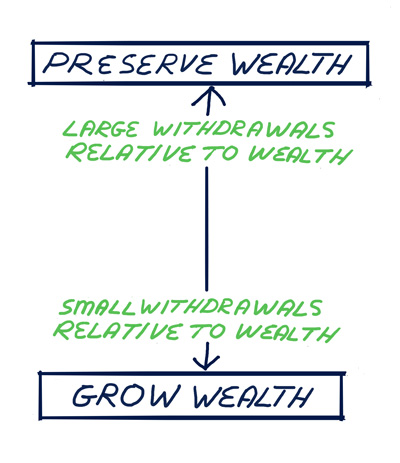
While the subject of withdrawals is often discussed within the context of retirement, retirees aren’t the only ones who may need to take portfolio withdrawals. Investors at all age groups can have goals that require significant spending. It could be someone from Generation Z or a millennial paying for their wedding. Middle-aged parents could incur college expenses for their children. And so on …
The source of the cash to cover such spending matters from the standpoint of assessing risk tolerance. It can be described as an inverse relationship. A higher dependence on portfolio withdrawals for covering planned spending leads to a lower tolerance for risk. A lower dependence on withdrawals to cover planned spending leads to a higher tolerance for risk.
Simply put, the less you need to withdraw, the more immune you are to swings in the value of your portfolio and the higher your tolerance for risk is from a financial standpoint.
A retiree whose living expenses are covered by Social Security and pension benefits could ignore the conventional wisdom of adopting a more conservative allocation. They don’t need to take withdrawals unless there are other shorter-term goals they want to spend on (e.g., helping family members, taking vacations, etc.).
Adults in their 20s or 30s are generally considered to have a high tolerance for risk. They will not need to take any withdrawals from their retirement savings for years. But, for other goals or situations, their tolerance for risk can be much lower. Shorter-term expenditures like a wedding, a down payment on a house or starting a family (especially if infertility treatments or adoption are considerations) will require an outflow from savings.
The relationship can be thought of in terms of which is more important: preservation of capital or growth of capital? Larger planned withdrawals over shorter periods of time place an emphasis on preserving capital. An ill-timed drop in the market could leave you short of funding your goal. Not needing any withdrawals or only needing to withdraw a proportionately small amount relative to your wealth over the next few years shifts the emphasis toward growing capital.
Many people will find themselves at more than one spot along the preservation of wealth versus growth of wealth spectrum. This occurs when there are different goals. In such cases, it can be helpful to separate savings by goal or to incorporate a bucket-like approach with assets segmented for short-, intermediate- and long-term spending.

- For more about the financial aspects of risk tolerance, watch the latest video I’ve posted to our PRISM Wealth-Building Academy.
- The December Model Shadow Stock Portfolio Update has been posted.
- Nearly 800 mutual funds have announced 2021 capital gains distributions equivalent to at least 10% of their net asset value. In the latest AAII Journal, I explain how you tell whether your fund is costly from a tax standpoint.
- Speaking of taxes, our latest tax guide features useful information for 2021 and 2022 tax planning.
- AAII assistant editor Anine Sus explains how she evaluated socially responsible ETFs in her My Investing Discoveries blog.
AAII Sentiment Survey
The results from the latest AAII Sentiment Survey show bullish sentiment falling to its lowest level in three months. In addition, the number of investors describing their outlook for stocks as “bearish” rose to the upper end of its typical historical range.
Bullish sentiment, expectations that stock prices will rise over the next six months, decreased 4.5 percentage points to 25.2%. This is the fourth consecutive week that bullish sentiment remains below the historical average of 38.0%. Bullish sentiment was last lower on September 16, 2021 (22.4%).
Neutral sentiment, expectations that stock prices will stay essentially unchanged over the next six months, decreased by 4.3 percentage points to 35.4%. This is the second consecutive week that neutral sentiment is above the historical average of 31.5%.
Bearish sentiment, expectations that stock prices will fall over the next six months, increased by 8.8 percentage points to 39.3%. This is bearish sentiment’s fourth consecutive week above the historical average of 30.5%.
Bullish sentiment is at an unusually low level. Historically, unusually low levels of optimism have been followed by better-than-average and better-than-median returns for the S&P 500 index over the following six- and 12-month periods. Bearish sentiment is near the top end of its typical range, as noted above. The breakpoint between typical and unusually high levels of pessimism is currently 40.1%.
Bullish sentiment has remained below average since the new coronavirus omicron variant began spreading. The return to normalcy from the coronavirus pandemic, monetary and fiscal stimulus and inflationary pressures also continue to influence individual investors’ outlook for stocks. Additional factors include earnings, valuations and the Biden administration’s initiatives.
In this week’s special question, we asked AAII members what they thought about the weakness that small-cap stocks have experienced over the past four weeks.
Three out of 10 respondents (30%) say that they attributed their poor performance to a volatile and inflationary market, with small-cap stocks being more sensitive to macroeconomic trends. Meanwhile, 24% of respondents have a neutral or unfazed point of view, with respondents saying they don’t invest in small-cap stocks. About 15% of respondents mention seeking a safer investment in large-cap stocks, as larger companies can absorb the higher costs and protect their profits better. Conversely, 14% of respondents attribute small-cap weakness to ongoing factors of the coronavirus, such as the new omicron variant. Lastly, 11% of respondents have a positive outlook on the situation, indicating that this could be a buying opportunity for those who invest in small-cap stocks.
Here is a sampling of the responses:
- “I think inflation is holding them down and will continue to do so for the next year.”
- “I am not concerned. I do not generally invest in small-cap stocks as it is hard for me to clearly understand their business position.”
- “It’s difficult to compete with larger companies that can absorb the increased salaries (competition for skilled workers) as well as financing costs. The supply chain has a negative impact on both types of companies, but again most large caps can absorb this better than small caps.”
- “Uncertain times with the omicron variant and the Federal Reserve’s tapering causing a shift toward large stable stock choices rather than small caps or mid caps.”
- “It’s because of year-end selling and correction; it’s an opportunity to buy quality small-cap value.”
Bullish: 25.2%, down 4.5 points
Neutral: 35.4%, down 4.3 points
Bearish: 39.3%, up 8.8 points
Bullish: 38.0%
Neutral: 31.5%
Bearish: 30.5%
See more Sentiment Survey results.

December 9, 2021 Financial Goals and Time in the Market
December 2, 2021 How You React to Volatility Matters
November 25, 2021 Reasons for Individual Investors to Be Grateful in 2021
November 18, 2021 The Tax Implications for Investors of Corporate Splits

Discussion
Rob from NC posted over 4 years ago:
Another way to look at this is that if a person plans to take large withdrawals that threaten the long-term growth of their portfolio, then maybe they ought to tell themselves they simply cannot afford whatever it is that induces them to make the large withdrawals. Of course, life throws unexpected things at you, but a wedding, college, and so on are things that can be planned -- and kept within a reasonable budget. If a planned expense causes you to change your investment allocation out of fear of losing capital, then you cannot afford that expense. Rule #1: Live below your means.
Barry J from TX posted over 4 years ago:
This article provides a BEHAVIORAL based approach to risk assessment. Now we're getting somewhere. In my posts to other articles, I have beat on the theme of how unreliable self-assessment of risk tolerance is when assessed on a subjective, unanchored 5 or 7 point scale or through amateur diagnosis via questions from a financial advisor, which is the industry standard approach. The article makes another important point: risk tolerance changes over time. A significant missing point is that risk tolerance is NOT a linear function; risk tolerance is an asymmetrical, sigmoid ("S curve) variable function. Behavioral experiments leading up to Dan Kahneman's Prospect Theory addresses all these issues. People tolerate HIGHER risk when they expect GAINS and LOWER risk tolerance when they expect LOSSES. These beliefs are anchored in at a neutral reference point. People have a much higher preference for gains over losses. They have a "loss aversion ratio" and they display a diminishing sensitivity to risk seeking. People also evaluate choices separately and independently when making [investment] decisions. People experience regret when they experience a "loss" on an option they could have adopted but chose otherwise. This series of articles points to the ability of AAII to seize the opportunity to become a financial industry leader on applied BEHAVIORAL RISK TOLERANCE ASSESSMENT.
John Lambert from NJ posted over 4 years ago:
Another good reason to invest 100% in equities in preparation for retirement. The much greater returns over 30 - 40 years will mean a larger nest egg at retirement. And then the smaller withdraws in retirement in comparison to the nest egg will allow a much higher if not 100% equity portfolio in retirement. Which will eventually lead to your children referring to you in awe as they inherit enough money to buy a beach block house in Ocean City. Or you could pay a financial advisor 1% and follow their conventional wisdom. Have a smaller nest egg at retirement. Be advised by your Tesla driving financial advisor to heavily invest in annuities to minimize risk and spend your retirement cutting corners and taking bus trips for vacation. Your children are likely to refer to you as poor mom and dad.
Rob from NC posted over 4 years ago:
John from New Jersey is right again! Young people should heed his advice! I'd add that maximizing Roth contributions along with the 100% equity investment will greatly reduce the age at which you can retire comfortably.
You need to log in as a registered AAII user before commenting.
Create an account