

Guidelines for Selecting an Allocation Strategy
by Charles Rotblut | December 23, 2021
Special Note: Our offices will be closed on Friday, December 24, as well on December 31 and January 3. On behalf of everyone at AAII, have a Merry Christmas and a happy holiday season.
With 2021 coming to an end, many investors will be looking at their portfolios and deciding what moves to make next. I think this is a good time to stop and ask yourself whether your current portfolio allocation is the right one for you.
Our asset allocation models are separated into aggressive, moderate and conservative. The aggressive investor model is almost entirely comprised of equities. Our conservative investor model incorporates a large allocation to bonds to dampen volatility. Where you fit on the aggressive-moderate-conservative spectrum depends on your goals and tolerance for risk.
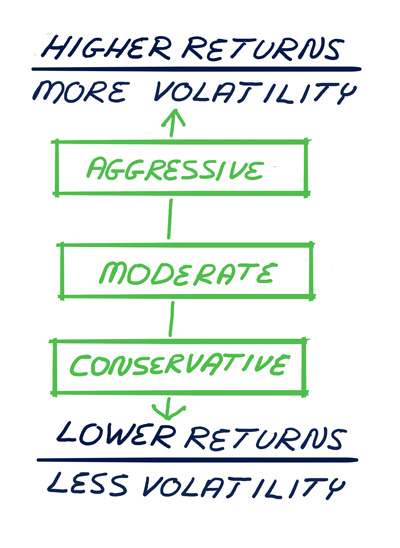
This week, I’m going to share some guidelines that may help you determine the correct allocation for your needs.
Aggressive: The aggressive investor model places a priority on long-term growth of capital. This model is meant for investors with long-term goals or goals with long spending durations. Investors following such an approach must have the psychological and financial ability to withstand large swings in the value of their portfolios. Examples of such investors include a Gen-Zer or a millennial who is saving for retirement or a recent retiree who is both in good health and only needs to withdraw a proportionately small amount from their portfolios. The mix is 90% diversified stocks and 10% bonds or other safe assets.
Moderate: The moderate investor model seeks growth of capital but with less volatility than the aggressive model. Investors opting for this type of allocation tend to have shorter- or intermediate-term spending needs in addition to long-term goals and/or are not comfortable with the volatility of a mostly equity portfolio. Examples include parents with college-bound children entering high school, older workers transitioning toward retirement and investors who have reduced their exposure to stocks during past downturns. The mix is 60% diversified stocks and 40% diversified bonds or other safe assets.
Conservative: The conservative investor model places a greater emphasis on the preservation of capital, while still incorporating a growth component. It is a shorter/intermediate-term allocation model. (A true short-term conservative allocation would place an even larger emphasis on preserving wealth.) Investors opting for this type of allocation may need to spend a large proportion of wealth on a goal or otherwise have limited ability to tolerate downside market volatility. Examples include a retiree heavily reliant on portfolio withdrawals with a shorter (as opposed to a longer) life expectancy or a younger investor with shorter-term goals they cannot fall short of funding. The mix is 40% diversified stocks and 60% diversified bonds or other safe assets.
There are two things to keep in mind. First, allocation is a personal decision. While our allocation models provide useful guidelines, they should be adjusted to fit your personal situation. Second, you have a few options on the bond side. You can ladder bonds, use defined-maturity bond funds, and/or opt for certificates of deposit (CDs) or money market funds if you are concerned about future interest rates. The primary goal of the defensive assets is to dampen the volatility of stock holdings while providing a stream of income.

- On our Asset Allocation Models page, you’ll find a breakdown of each model’s components along with the mutual funds and ETFs we use to track each model.
- If you are getting together with family this weekend, our PRISM Wealth-Building Process can be a great catalyst for discussing your investment strategy and goals.
- There is still time to make these year-end tax moves.
- If you want to get an early jump on tax season, our 2021 individual investor’s tax guide can be read on AAII.com.
AAII Sentiment Survey
Optimism rebounded into its typical historical range this week after falling to an unusually low level last week. The latest AAII Sentiment Survey also shows a decrease in the number of investors who describe their outlook for stocks as “bearish.”
Bullish sentiment, expectations that stock prices will rise over the next six months, increased 4.3 percentage points to 29.6%. This is the fifth consecutive week that bullish sentiment remains below the historical average of 38.0%.
Neutral sentiment, expectations that stock prices will stay essentially unchanged over the next six months, increased by 1.1 percentage points to 36.6%. This is the third consecutive week that neutral sentiment is above its historical average of 31.5%.
Bearish sentiment, expectations that stock prices will fall over the next six months, decreased by 5.4 percentage points to 33.9%. Even with the decrease, this is the fifth consecutive week that pessimism is above its historical average of 30.5%.
All three sentiment indicators are currently within their typical historical ranges.
Bullish sentiment has remained below average since the new coronavirus omicron variant began spreading. The progress toward returning to normalcy from the coronavirus pandemic, monetary and fiscal stimulus and inflationary pressures also continue to influence individual investors’ outlook for stocks. Additional factors include earnings, valuations and the Biden administration’s initiatives.
In this week’s special question, we asked AAII members if the Federal Reserve should raise interest rates three times in the next year.
More than half of respondents (55%) say that raising interest rates three times in 2022 is the right thing to do to curb inflation and slow consumer spending. Conversely, 27% of respondents disagree with raising the rate three times. Many of these respondents think raising interest rates just twice is a better option. Additionally, 7% of respondents have a neutral or mixed outlook, while 6% of respondents have a conditional response, with rate hikes warranted if certain factors arise.
Here is a sampling of the responses:
- “Yes. Inflation is out of control.“
- “No, once should be enough, two only if inflation rises rapidly.”
- “No idea; what is the purpose? If they are trying to control inflation, then it might backfire.”
- “Whether it is once or thrice needs to be determined at the time.”
Bullish: 29.6%, up 4.3 points
Neutral: 36.6%, up 1.1 points
Bearish: 33.9%, down 5.4 points
Bullish: 38.0%
Neutral: 31.5%
Bearish: 30.5%
See more Sentiment Survey results.

December 16, 2021 The Size of Withdrawals Relative to Wealth Influences Risk Tolerance
December 9, 2021 Financial Goals and Time in the Market
December 2, 2021 How You React to Volatility Matters
November 25, 2021 Reasons for Individual Investors to Be Grateful in 2021

Discussion
John Lambert from NJ posted over 4 years ago:
This stratification from Aggressive to Conservative would have worked well starting in the late 1980's until recently. But with inflation much higher than interest rates, it is hard to understand how anyone would call losing purchasing power on 60% of their portfolio a "conservative" strategy.
Gene Howe from AL posted over 4 years ago:
Your allocation strategy does not mention the asset class currently in vogue with Gen-Zer's and millennials, crypto currencies like Bitcoin, and non- fungible tokens (NFT's). What percent of an aggressive, diversified portfolio should that asset class represent? Gold and precious metals are also absent from your asset classes. Do you believe an investor's only investment options are stocks, bonds, or cash?
Bob Scott from Missouri posted over 4 years ago:
As an investor for over sixty years have seen many fads come and go. Have been through the inflation of the 1970's and the long periods in market of low or no real returns. It takes nerves of steel at times to hold to your investment program and the bull market we have seen since the financial crisis unfortunately will lead many into not realizing that serious declines happen from time to time and you have to ride those out. As result no matter your strategy down markets hurt but have to be planned for. For those who have new money to add continuing to invest as market declines averages down as well as taking tax losses in taxable accounts can help. For retirees a down market might give chance to move to a Roth IRA vs traditional IRA and reduce the RMD requirements. . Also selling stocks that hold up for those that have been beaten down in bear markets but have recovery potential can pay be dividends for the next bull market. But above all most investors need to be sure they have plenty of cash reserve (even if inflation eating away at it) so they are not forced to sell into a bear market. No matter whether your strategy is aggressive or conservative this is a good time to review your strategy. Fortunately staying with my investment plan has paid big dividends (and capital gains) for me over the years. The biggest mistake I see investors make is panic selling into a down market or thinking they know where markets are going. That is why planning a sound strategy is important and diversification will help in both up and down markets. So reviewing your balance of asset classes at least twice a year is also important.
Barry J from TX posted over 4 years ago:
As John and Bob have stated, this model is much too simple for an increasingly complex investing environment. I remember when I first encountered this allocation model when I decided I would seek professional advice with my growing accumulation of wealth. The company I reached out to ask me to pick one of these TRADEOFF "strategies. I felt like I was a contestant on Monty Hall who could not trade for Door #2. I could not make sense of how this decision fit with my SUCCESSFUL lifelong "strategy" of TAKING RISKS AND GROWING wealth. When I encountered this logic with EVERY advisor I contacted, I realized that this model was an "industry standard practice" whose main purpose was to insulate brokers/advisors from legal liability when the "strategy" I "selected" does not produce the level of results expected. I guess this model it is a gross simplification derived from infamous "Beta" the 3rd factor in the CAPM formula. If so, then the use of a linear "integer" scale instead of a curve based on the distribution of the standard deviation of "Beta" means it is useless when configured as a Monty Hall 3-door problem Yep, the current version of Mr. Market has evolved and mutated similarly to CoViD-19 and now is one bad hombre. The mission you accept by being an independent investor is best summed up by the inscription on the Texas Ranger statue in the lobby at Love Filed Dallas terminal -- "One riot. One Ranger."
Rob from NC posted over 4 years ago:
As I see it, volatility only matters to short-term investors – or short-term thinkers. If a 25-year-old puts 100% of his Roth assets in a single low-expense-ratio ETF (say SCHG, or VGT) and leaves it there for 40 years, why is volatility an issue? The only things that should matter are entry and exit point. If you are “investing” money that you expect to need within a year, then by all means you should consider volatility. But the longer your horizon, the less volatility becomes an issue. I don’t care what your “risk tolerance” is, it is ALWAYS risky to apply short-term thinking to long-term investing. There is absolutely no reason for a young person to put money into fixed income just to “smooth” out the ride. They would be trading long-term gain for what, emotional satisfaction? Emotion has no part in investing. If you let emotions dictate your investment strategy, you are going to pay for it. There is no getting around that rule.
Rob from NC posted over 4 years ago:
I have to add to my earlier post that although volatility might be an issue in the short term, I learned a hard lesson about pulling money out of equities. Back in January 2012, I sold stock to fund a year's worth of expenses, thinking that was the "smart" thing to do. Volatility, or at least downside volatility, was the very thing I was concerned about then. The stock I sold went up more than 150% that year. If I had sold it off piecemeal during the year, I would have gained enough to fund the following year's expenses and then some. Since then, I only keep a couple of months' worth of expenses in cash. The rest stays 100% in equities (and equity ETFs). My new rationale is that I am always more likely to see an increase in asset values than a decrease during any given year. If my assets are decreasing as I sell them to fund expenses, then at least my capital gains tax bill will be lower.
You need to log in as a registered AAII user before commenting.
Create an account