

Time to Embrace Instead of Abandon Value?
by Charles Rotblut | February 10, 2022
Special note: Our VMQ Stocks portfolio identifies stocks at the intersection of value, momentum and quality. I like to describe it as finding fundamentally sound value stocks that other investors recognize as being bargains too. Right now, you can try out VMQ for just $99!
This week, a couple of tweets about value caught my eye. One referenced a decision by robo-adviser Wealthfront to drop the value factor from its smart beta approaches. The second linked to a post from Larry Swedroe discussing the possibility that a “regime shift” from growth to value could be at hand.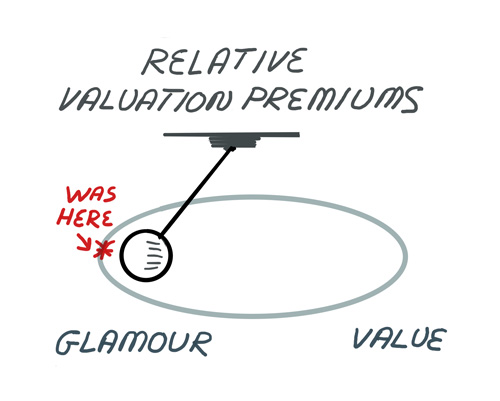
Wealthfront explained its logic by saying, “research suggests [value] is no longer as effective as it once was. Value is measured using a company’s book equity to market value ratio, which doesn’t account for a company’s investment in intangible assets like research and development, brand value, and patents—all of which are becoming increasingly important in today’s economy.” The robo-adviser says it will include profitability as a factor in its smart beta approaches instead.
Value investors may question the timing of Wealthfront’s decision, especially given the current valuation spread between value and growth stocks. A recently updated chart from investment firm AQR Capital Management showed that the spread between value and growth (aka, “glamour”) stocks is currently at its highest 98th percentile. (The chart depicting the spread is included at the end of today’s commentary.)
This leads me to the study Swedroe discussed in a recent post on the Evidenced-Based Investor blog: “Value versus Glamour Stocks: The Return of Irrational Exuberance?” The study looked at the value factor’s underperformance for the period of 2017 through 2020.
Value and glamour stocks were categorized by their “book equity-to-price, tangible book equity-to-price, free cash flow yield (excluding financials), EBITDA-to-enterprise value (excluding financials) and forward earnings-to-price” ratios. The study’s authors calculated a spread—the difference between the valuation ratios for value stocks and glamour stocks—to track how close or how far apart their relative valuations were. (As a quick aside, both our VMQ Stocks and A+ Investor Value Grades also categorize valuations based on several ratios.)
According to Swedroe, the study’s authors identified three major periods of value spread expansions (1998–2000, 2007–2009 and 2018–2020). A value spread expansion occurs when investors are willing to accept far higher relative valuations for glamour stocks relative to value stocks than they previously have. Put another way, valuation spreads expand when investors are willing to pay a higher relative premium for glamour stocks and/or demand a deeper discount for value stocks.
Between 2018 and 2020, value spreads reached extreme levels (three standard deviations above average). This “expansion shock” was “comparable only to the tech bubble of the late 1990s.”
Value spreads are not a timing indicator (a point Swedroe also makes). They can shift to and stay at extreme levels long enough to cause many investors and firms to throw in the towel. Still, paying attention to the odds has worked well for long-term investors with the patience to wait out shorter-term trends.
Value led growth last year. To the extent that the combination of higher interest rates and earnings disappointments for some glamour stocks leads to a revaluation of how much investors are willing to pay up for strong expected growth, it’s possible that we could see the pendulum swing further back in favor of value and away from growth. Of course, the breakdown of historical relationships is always a possibility. Presuming historical realtionships hold, then there is still the tendency of reversion to the mean (in this case, a shift back to average valuation spreads) to be a pain—both for those caught off guard by it and for those waiting for extremes to move back toward their historical averages.

Source: AQR Capital Management. Footnotes for the chart can be read by clicking on the “Download” link in AQR’s blog post.

- Tilting your portfolio toward value allows you to strike a balance between increasing your exposure to value while still tracking the broader market.
- Interested in a good value fund? Our Mutual Fund Guide and ETF Guide can help you find one.
- Next Thursday, I’ll explain how being clear about your investment management preferences can help you find the right investment.
- Whether you are just beginning to build your portfolio or are looking to diversify an existing one, it’s important to consider how choosing to invest in funds versus individual securities will impact your wealth management preferences.
AAII Sentiment Survey
In the latest AAII Sentiment Survey, neutral sentiment rose to its highest level in more than two years. In addition, the percentage of individual investors describing their outlook for stocks as “bullish” or “bearish” both decreased.
Bullish sentiment, expectations that stock prices will rise over the next six months, decreased 2.1 percentage points to 24.4%, staying well below the historical average of 38.0%. Bullish sentiment levels are unusually low for the fifth consecutive week and below the historical average for the 12th consecutive week.
Neutral sentiment, expectations that stock prices will stay essentially unchanged over the next six months, rose sharply by 10.3 percentage points to 40.2%. Neutral sentiment was last higher on January 1, 2020 (40.9%). Neutral sentiment is also above its historical average of 31.5% for the eighth time in 10 weeks.
Bearish sentiment, expectations that stock prices will fall over the next six months, decreased by 8.2 percentage points to 35.5%. This is the 12th consecutive week with pessimism above its historical average of 30.5%. However, it is also the third consecutive week that bearish sentiment has incurred a weekly decline of five percentage points or more.
As noted above, bullish sentiment is at an unusually low level for the fifth consecutive week. Historically, the S&P 500 index has gone on to realize above-average and above-median returns during the six- and 12-month periods following an unusually low reading for bullish sentiment.
Neutral sentiment is now at an unusually high level. Such readings have previously been followed by slightly below-average and below-median six-month returns, but above-average and above-median 12-month returns for the S&P 500.
Inflation, interest rates, the coronavirus pandemic and politics are all influencing individual investors’ outlook for stocks. Other factors include the economy and corporate earnings. The ongoing volatility in the stock market is likely also playing a role.
For this week’s special question, we asked AAII members to share their thoughts about how the prospect of four interest rate hikes in 2022 is impacting their portfolio allocation decisions.
Nearly two out of five respondents (38%) say that the proposed rate hikes have no impact on their portfolio allocation decisions, as many are already expecting them. Conversely, 25% of respondents say that their stock allocation would be impacted. Some of these respondents say they are shifting more toward growth stocks, while others say they are favoring value stocks. About 13% of respondents say that their bond allocation would be impacted, with many pivoting away from the fixed-income securities.
Around 9% of respondents remain uncertain as to how the rate hikes would impact their portfolios. Roughly 5% of respondents believe that the proposed rate hikes would have a positive impact and 5% foresee a negative impact.
Here is a sampling of the responses:
- “None. Inflation will be controlled with higher interest rates. Neutral effect on the equity markets.”
- “I am rebalancing toward value stocks and large growth stocks.”
- “Holding off on buying any fixed-income instruments except very short-term (less than one-year) ones.”
- “It depends on the magnitude of the hike. A small hike, 0.25% per hike (three or four for the year), will not have an impact. Larger hikes may have a dampening effect.”
- “The closer we get to actual market rates the better off the country will be. As long as the Federal Reserve doesn’t lose its head and go off the deep end, a gradual increase in rates should help stem inflation in the long run. Short-run pain for long-run gain.”
- “Bad for stocks.”
Bullish: 24.4%, down 2.1 points
Neutral: 40.2%, up 10.3 points
Bearish: 35.5%, down 8.2 points
Bullish: 38.0%
Neutral: 31.5%
Bearish: 30.5%
See more Sentiment Survey results.

February 3, 2022 A Sign of Light for Value Investors
January 27, 2022 Smart Investing Steps You Can Take During the Current Bout of Volatility
January 20, 2022 Portfolio Allocations Often Do Not Follow Shifts in Sentiment
January 13, 2022 Seven Dividend Warning Signs to Watch Out For

Discussion
John Lambert from NJ posted over 4 years ago:
Someday value will again outperform growth. But why pick sides in the value - growth debate. Buy a cheap index fund and own both. Only someone who is heavily invested in value would care that value was under performing. Someone who is selling a $99 VMQ newsletter.
Josh D from PA posted over 4 years ago:
John Lambert why bother with AAII membership or reading articles if you're satisfied with "cheap index funds" and the resulting measly returns or losses? A cheap 10% loss so far this year for S&P500 index funds. Or a cheap 14% loss for a Nasdaq index fund. You're way at the other end of the spectrum from typical AAII members, I would think.
John Lambert from NJ posted over 4 years ago:
Josh - Many years ago I purchased a lifetime membership. Then I discovered index funds and the Standard & Poor's Active Versus Index research. In the long term, index funds beat most active funds. Over 20 year periods, approximately 90% of active funds fall short of their benchmark index. And sadly there is no way to determine in advance which active funds will outperform. The long term odds are definitely stacked in favor of cheap index funds. Investing is long term. If you are focused on one year or less results and wanting positive stock returns over every period you are not investing - you are speculating. Sadly there are many who sell newsletters and even more sad that AAII has decided to expand into this area. I am certain that there are a few newsletters that have market beating results but like active mutual funds they are few and there is no way to pick the winners in advance. I may be incorrect but based on subscriber comments I believe that the AAII VMQ newsletter has under performed it's index for the last four years since inception. I read AAII articles and comment because I would like to help others from making the mistakes I made. And because I believe the AAII can be much better.
You need to log in as a registered AAII user before commenting.
Create an account