

Portfolio Allocations Often Do Not Follow Shifts in Sentiment
by Charles Rotblut | January 20, 2022
Special note: You can still get access to every premium newsletter (future ones, too!) and A+ Investor for at least $300 off. AAII Platinum leverages seven model portfolios, their daily-updated watchlists, an exclusive dashboard, our trove of special reports and detailed analysis exploring different investing niches to help you build, handle and thrive in any market condition. Click here to learn more about AAII Platinum.
Bullish sentiment in our AAII Sentiment Survey fell this week to its lowest level since July 2020. Bearish sentiment, meanwhile, rose to its highest level since September 20. Bullish sentiment measures the percentage of individual investors that expect stock prices to rise over the next six months. Bearish measures the percentage of individual investors that expect stock prices to fall over the next six months. Optimism is at 21.0% and pessimism is at 46.7%. The timing of these unusually low and unusually high readings is apropos as I wrote most of this week’s commentary yesterday before the latest survey results were tabulated.
We at AAII have long observed that individual investors’ short-term outlook for the stock market and how they allocate their portfolios frequently do not go hand in hand. While there are periods when sentiment does influence allocation decisions—particularly during severe downturns—AAII members frequently make fewer portfolio moves than the weekly fluctuations in our Sentiment Survey would suggest. 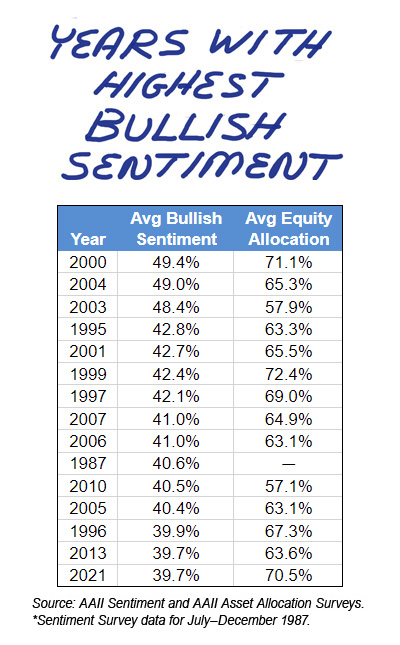
Last year was a good example: Average equity allocations were at their fourth-highest level on record. The average combined allocation to stocks and stock funds recorded by our AAII Asset Allocation Survey was 70.5% in 2021. Only 1999 (72.4%), 1998 (71.5%) and 2000 (71.1%) saw greater exposure to equities. This monthly survey was started in November 1987.
The average percentage of individual investors expecting stock prices to rise over the next six months (“bullish”) was closer to the middle. Bullish sentiment averaged 39.7% in 2021. This ranked 15 out of the 35 annual average readings we have. The weekly AAII Sentiment Survey started in July 1987. (We include the second half of 1987 in our calculations of average calendar-year sentiment.)
Readings of sentiment from other sources painted a mixed picture of how institutional, professional and individual investors felt last year:
- Investor’s Intelligence survey of newsletter writers showed a historically high level of bulls relative to bears, based on data compiled by Yardeni Research.
- The Investment Company Institute’s data on mutual fund flows showed individual investors pulling $364 billion out of stock mutual funds and putting $397 billion into bond mutual funds.
- Margin debt ended 2021 up nearly 17% from where it was at the end of December 2020. Scale matters here though. Barron’s noted that October 2021’s margin debt high of $936 million equated to 2.4% of the S&P 500 index’s then market capitalization. The high was 3.5% of the S&P 500’s market cap, reached around the time of the financial crisis in 2008 and 2009.
- The CBOE’s equity put/call ratio ended 2021 at 0.55, signaling more traders were seeking gains than protection against drops. Charts of the ratio show lower high values (indicative of less pessimism) than in previous years.
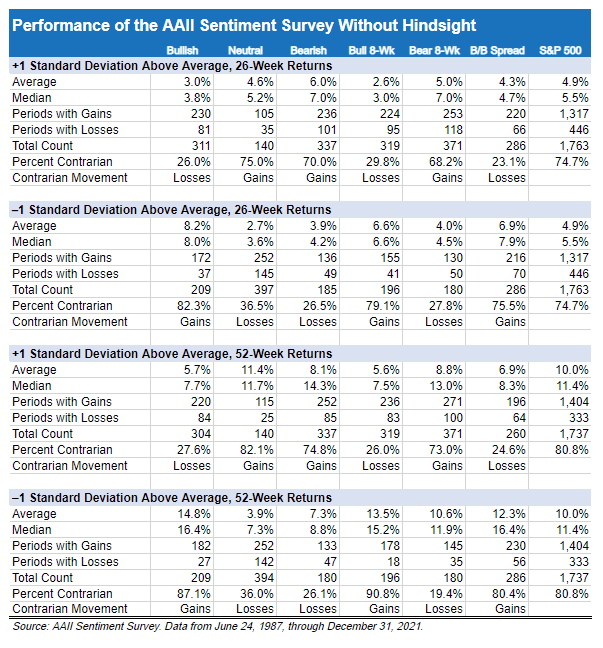
Our historical analysis of the AAII Sentiment Survey shows that unusually low levels of optimism are a key measure for contrarian investors to keep an eye out for. Since July 1987, when the level of bullishness in our survey was more than one standard deviation below its historical average, the S&P 500 has realized six-month average and median gains of 8.2% and 8.0%, respectively. These returns compare to the respective historical average and median S&P 500 returns of 4.9% and 5.5% for all six-month periods since the survey was started. The S&P 500 has risen 82% of the time following an unusually low bullish sentiment reading versus 75% for all six-month periods.
The relationship holds at 12-month periods as well. Following unusually low bullish sentiment readings, the S&P 500 has risen by an average of 14.8% and by a median of 16.4%. For all 12-month periods, the S&P 500 rose by an average of 10.0% and a median of 11.4%.
Currently, bullish sentiment readings below 28.0% are considered unusually low.
When bullish sentiment falls below this level, we suggest stopping to consider the broader market and economic mosaic. Ask what is occurring that would give individual investors reason to feel unusually cautious. The answer may reveal whether it makes sense to check your allocation to see if it is still approximately in line with your goals, if any presently held investments are meeting your sell rules or if it is time to see if there are investments that have been put on sale because of prevailing market conditions.
We do not view unusually low bullish sentiment as a “buy” signal nor do we view unusually high bullish sentiment as a “sell” signal. Sentiment does not have a causal impact on future market performance. It can, however, alert you to consider whether other market indicators are lining up in the same direction.

- We shared a list of contrarian sentiment indicators in this 2012 Computerized Investing article, which is open to all members.
- If you notice the sentiment indicators going to unusually high or low levels, it may make sense to see if your portfolio needs rebalancing. Here’s how to do it.
- Setting aside how you feel about prevailing market conditions and instead simply focusing on the process of saving can help you build a nice nest egg for retirement, even if you are starting out late.
- I explain the benefits of diversification and choosing the right allocation in our PRISM Wealth-Building Academy. For a deeper dive, watch a replay of my recent webinar about recognizing your personal tolerance for risk and how it determines the right allocation for you.
AAII Sentiment Survey
The results from the latest AAII Sentiment Survey show bullish sentiment falling to an 18-month low. At the same time, bearish sentiment jumped to a 16-month high.
Bullish sentiment, expectations that stock prices will rise over the next six months, decreased 3.9 percentage points to 21.0%. Optimism was last lower on July 29, 2020 (20.2%). This is the ninth consecutive week that bullish sentiment is below its historical average of 38.0%.
Neutral sentiment, expectations that stock prices will stay essentially unchanged over the next six months, decreased by 4.5 percentage points to 32.3%. This is the seventh consecutive week that neutral sentiment is above its historical average of 31.5%.
Bearish sentiment, expectations that stock prices will fall over the next six months, increased by 8.4 percentage points to 46.7%, staying above the historical average of 30.5% for the ninth consecutive week. This is the highest level of pessimism since September 9, 2020 (48.5%).
The bull-bear spread (bullish sentiment minus bearish sentiment) is at –25.8. This is the most negative the spread has been since July 29, 2020 (–28.2).
At current levels, bullish sentiment is unusually low and bearish sentiment is unusually high. Since July 1987, when the level of bullishness in the Sentiment Survey was more than one standard deviation below its historical average (currently readings below 28.0%), the S&P 500 index has realized six-month average and median gains of 8.2% and 8.0%, respectively.
In this week’s special question, we asked AAII members which factors are most influencing their six-month outlook for stocks. Many respondents list multiple factors.
Inflation topped the list as a key factor, with 29% of respondents mentioning it. About 20% cite interest rate hikes as another factor vital to their outlook. Additionally, 15% of respondents list both the coronavirus, including the omicron variant, and/or political challenges as considerations. About 9% of respondents cite economic concerns such as employment levels and the labor participation rate, while 7% of respondents say they will be paying attention to company earnings in 2022. Monetary policy and the Federal Reserve were named by 7% of respondents. Roughly 4% of respondents mention supply chain issues.
Here is a sampling of the responses:
- “The market is factoring in interest rate increases. Inflation is expected to stabilize and remain high, and we will learn to live with omicron.”
- “Bull markets do not usually end until well after the Fed begins hiking interest rates.”
- “Our strong economy, and the fact that we are hopefully nearing the end of the coronavirus pandemic.”
- “Although strong jobs demand will create inflation, it will also provide a base for strong consumer demand. I expect inflation to be elevated due to labor and housing but to get a respite from goods inflation as supply chain pressures ease.”
Bullish: 21.0%, down 3.9 points
Neutral: 32.3%, down 4.5 points
Bearish: 46.7%, up 8.4 points
Bullish: 38.0%
Neutral: 31.5%
Bearish: 30.5%
See more Sentiment Survey results.

January 13, 2022 Seven Dividend Warning Signs to Watch Out For
January 6, 2022 2022 Brings New Life Expectancy Tables for Calculating RMDs
December 30, 2021 Eight Individual Investor New Year's Resolutions for 2022
December 23, 2021 Guidelines for Selecting an Allocation Strategy

Discussion
Barry J from TX posted over 4 years ago:
I followed the suggested links to articles on other indicators of market sentiment, the VIX, and call/put options. They were very informative. As usual I gleaned a lot of useful tips and pointers to useful tools from the AAII member comments on those "old" article. Running down links to earlier AAII articles is a valuable AAII membership benefit. Like some, if not many, AAII members, just because something is old doesn't mean can't learn from them.
Rob from NC posted over 4 years ago:
I'm one of the bears, but I'm still 100% invested in stocks, just as I've always been, and I plan to stay that way for the rest of my life. I don't believe anyone can time the market (I gave up trying in my 20s), so the only reasonable choice is to ride the waves. It's no fun to watch your net worth cut in half, but I've been there before. If you anticipate it, it becomes "bear"-able. As long as you hold good stocks (and low-expense-ratio index equity funds) and stay the course, you lose nothing and will gain enormously in the long run. Over about 40 years, this pattern of investing has put me in a position where I can withstand a 50% market drop without changing my retired lifestyle. My portfolio value declined by 1.59% today and about 6.5% for the week, but I'm already thinking about what it will look like on the other side of the valley. Against conventional advice, I enjoy watching my equity values daily (often several times a day). It steels me against fear of downturns and exercises my self-discipline to do nothing. I'm anticipating that 50% drop and hoping it will hurry up and get here so we can start climbing again. Message to young investors: Be skeptical about conventional wisdom! Analyze what works and doesn't work; never take anyone else's word for it. Ignore the catchphrases and complex formulae proffered by investment "professionals," including many of the authors that write for AAII. Read words of wisdom from successful investors (AAII authors are NOT always included in that group) like Warren Buffet. And study market history! Market history does paraphrase itself over and over.
Barry Bachschmid from TX posted over 4 years ago:
I WANT TO TALK TO SOMEONE ABOUT GIVING 3 MEMBERSHIPS TO FRIENDS. UNFORTUNATELY, AAII DOES NOT HAVE A PHONE NUMBER. THEY EVIDENTLY DON'T WANT TO BE BOTHERED HAVING TO ANSWER PHONE CALLS. HOW SAD! IF FOR SOME REASON THEY DO WANT TO SELL 3 MEMBERSHIPS, THEN THEY CAN CALL ME. 956 744-9269.
Rob from NC posted over 4 years ago:
Hi Barry, it's on the website, but you have to really dig to find it: "Please call Member Services at 312-676-4300 to order gift subscriptions." Hope this helps.
Charles Rotblut from Illinois posted over 4 years ago:
Hi Barry,
Contact information can be found on this page. I have passed along your message to member services and they will be contacting you.
-Charles
Charles Rotblut from Illinois posted over 4 years ago:
Hi Barry,
Contact information can be found on this page. I have passed along your message to member services and they will be contacting you.
-Charles
Charles Rotblut from Illinois posted over 4 years ago:
Hi Barry,
Contact information can be found on this page. I have passed along your message to member services and they will be contacting you.
-Charles
You need to log in as a registered AAII user before commenting.
Create an account