

Eight Individual Investor New Year's Resolutions for 2022
by Charles Rotblut | December 30, 2021
Special Note: Our offices will be closed on Friday and Monday but to help you start the New Year with great investing tools, we are running a special holiday promotion on A+ Investor. You’ll get access to our stock, mutual fund and ETF grades, our brand-new custom stock screener, advanced portfolio analytics and more. Click here to take advantage of the special 12-month rate of $97.
I’ve been sharing a list of new year’s resolutions for investors since 2011. Over the past few years, the list grew to a size that was admittedly too long. So, for 2022, I’ve revised it to make the list of resolutions shorter and more focused. Long-time readers will notice some new additions as well.
The list is written from the perspective of long-term investing. In doing so, I’ve taken a holistic view of actionable steps you can take to be a more successful investor. 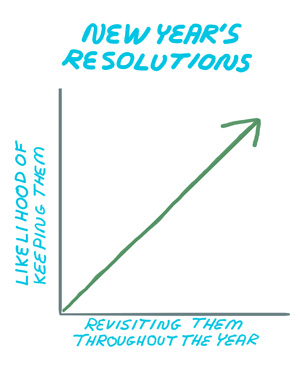
As you make your personal resolutions, set up calendar reminders to check the progress you are making toward them throughout the year. Are you sticking to them? If not, what can you do to get yourself back on track? Resolutions requiring a lasting change won’t be fulfilled with one step. They require ongoing effort and attention. So, pull out your calendar or smartphone and add reminders to revisit your resolutions. Doing so will increase your odds of fulfilling them.
Here are my 2022 New Year’s resolutions for individual investors.
1. Don’t make big bets on uncertain outcomes. It is reasonable to expect the Federal Reserve to raise interest rates, new coronavirus treatments (and possibly modified vaccines) to be made available and supply chain constraints to ease in 2022. None of this tells us what pace of expansion the economy will experience, what rate of inflation we’ll see, how the stock market will perform in the new year or where interest rates will be 12 months from now. Accepting this uncertainty allows you to focus more on your process than on forecasts—a recipe for success.
2. Invest based on your goals. Your goals determine the amount of wealth you need. They also determine your investing time horizon, the duration over which you will spend on the goal and how much you will need to withdraw from your portfolio relative to overall wealth. These factors should drive your investment decisions. Our PRISM Wealth-Building Process aligns your investing decisions with your goals.
3. Focus on your process, not on your goals. Mr. Market couldn’t care less about your goals or timelines. He does as he pleases. The only thing you can control is your process for allocating your portfolio, choosing investments to buy and determining when it’s time to sell. Focus on getting the process right for these three things and you will get the best possible return relative to the returns of the financial markets and your personal tolerance for risk.
4. Look at your portfolio less often. This may seem like heresy, but it ranks among the best things you can do. Your perception of volatility will decrease. You will be less tempted to make changes. You will better align your focus with the potentially lengthy time frame of your goals.
How often should you look? A weekly check of news and the A+ Investor Grades works well for stocks. Actively managed and sector mutual funds and exchange-traded funds (ETFs) can be checked quarterly or semiannually. Mutual funds and ETFs tracking broad market indexes can be looked at annually.
5. Automate when possible. In late December of each year, I plan out the contributions to my and my wife’s retirement for the following calendar year and start to set them up. Doing so takes advantage of what is known as a Ulysses contract. It binds my actions in advance before I’m in a situation where I might be tempted to spend the dollars I should be saving.
There are many actions you can automate. Contributions to savings, retirement and brokerage accounts can be directly taken from your paycheck or from your checking account. (If the latter, have the money pulled out on the same day you get paid or the following business day.) Most mutual funds will automatically invest the contributions for you. Required minimum distributions (RMDs) can be automated to avoid missing deadlines and provide a monthly stream of income. You can also have bills set up to be paid automatically to avoid incurring late fees.
6. Take care of your health. Regular exercise, a proper diet (eat your vegetables!) and adequate amounts of sleep have been shown to prevent, reduce the risk of or lessen the severity of many diseases and ailments. All three are also good for your mental and emotional state. Combined, they help you make better investing decisions and can lower your lifetime medical costs. (Wearing a mask and getting both vaccinated and boosted will help you avoid getting seriously ill from the coronavirus.)
Regular hearing tests are also important. Hearing loss has been strongly linked to cognitive decline. Cognitive decline impairs your ability to make even basic financial decisions.
7. Talk to your family about investing and your finances. If you’re reading this, you likely have some passion for, or at least interest in, investing. Share it with your family members by having a conversation with them. Talk about how you invest, what you’ve learned and even the mistakes you’ve made. It’s a great way to pass along a legacy to those younger than you and to maintain a strong bond with those older than you.
While you are having these discussions, tell your family members where they can find important documents and which professionals you work with. Having this information will better empower them to step in on your behalf when the time comes.
8. Take advantage of being an individual investor. Perhaps the greatest benefit of being an individual investor is the flexibility you are afforded. As AAII founder James Cloonan wrote: “The individual investor has a distinct advantage over the institution in terms of flexibility. They can move more quickly, have a wider range of opportunities and can tailor their program more effectively. They have only themselves to answer to.”
Not only are we as individual investors not restricted by market capitalization or investment style, but we also never have to report quarterly or annual performance. This means we can invest in a completely different manner than institutional investors can. Take advantage of this flexibility, because doing so gives you more opportunity to achieve your financial goals.

- Our My Portfolio tool can help you track your investments.
- Part of aligning your investment decisions with your goals is ensuring you are taking an appropriate level of risk. Our PRISM Academy will help you determine what that level of risk is.
- Carl Richards offered suggestions for gaining control of your investments in this 2013 AAII Journal article.
- Our updated tax guide will help prepare for the upcoming tax season and plan for 2021.
AAII Sentiment Survey
Optimism among individual investors about the short-term direction of the stock market rebounded during the final week of 2021. At the same time, both neutral and bearish sentiment pulled back.
Bullish sentiment, expectations that stock prices will rise over the next six months, jumped 8.1 percentage points to 37.7%. This is a six-week high. Even with the increase, optimism remains below its historical average of 38.0% for the sixth consecutive week.
Neutral sentiment, expectations that stock prices will be unchanged over the next six months, fell 4.8 percentage points to 31.8%. Neutral sentiment is above its historical average of 31.5% for the fourth consecutive week.
Bearish sentiment, expectations that stock prices will fall over the next six months, declined by 3.3 percentage points to 30.5%. Pessimism was last lower on November 18, 2021 (27.2%). Bearish sentiment currently matches its historical average of 30.5%.
Since falling to an unusually low level of 25.2% two weeks ago, bullish sentiment has rebounded by a cumulative 12.4 percentage points. The improvement has occurred as the S&P 500 index rose to new highs and the Russell 2000 index rebounded.
The progress toward returning to normalcy from the coronavirus pandemic, monetary and fiscal stimulus and inflationary pressures also continue to influence individual investors’ outlook for stocks. Reports of the omicron variant not being as severe as the delta variant may also be playing a role. Additional factors include earnings, valuations and the Biden administration’s initiatives.
This week’s special question asked AAII members how their portfolios performed this year relative to their expectations at the start of 2021. Nearly three out of five respondents (57%) describe their returns as being better than expected. This group includes those who said their returns were much better than expected (slightly more than 10% of all responses).
Approximately 7% of respondents describe their portfolios as having performed close to their expectations while 11% use words such as “well,” “average” or “satisfactory.” About 12% of respondents say their portfolios underperformed relative to their expectations.
Here is a sampling of the responses:
- “Due to COVID, my expectations were that my portfolio would bounce around and close the year slightly up. My actual performance far exceeded that. In fact, 2021 was my best single year ever!”
- “Portfolio did better than expected because the market did better than I expected.”
- “Performed above exceptions. I was pleasantly surprised by the brief outperformance of value, especially small-cap value. More of that please.”
- “Below average as I was too conservative during the year waiting for the next big correction to occur, which never did.”
- “Less than anticipated, but still a double-digit return.”
Bullish: 37.7%, up 8.1 points
Neutral: 31.8%, down 4.8 points
Bearish: 30.5%, down 3.3 points
Bullish: 38.0%
Neutral: 31.5%
Bearish: 30.5%
See more Sentiment Survey results.

December 23, 2021 Guidelines for Selecting an Allocation Strategy
December 16, 2021 The Size of Withdrawals Relative to Wealth Influences Risk Tolerance
December 9, 2021 Financial Goals and Time in the Market
December 2, 2021 How You React to Volatility Matters

Discussion
Rob from NC posted over 4 years ago:
A healthy suspicion of conventional wisdom is appropriate in all areas of life. If all the mask-wearing, vaccines, and boosters were as effective as they're made out to be, we wouldn't have a COVID problem. There are side-effects to following the experts' "wisdom," and ignoring or glossing over those side-effects can be perilous. For example, I'm afraid the mask hysteria's effects on children are going to manifest themselves for decades to come -- and not in a good way. I sure wish we could have a rational, public debate about such things instead of government mandates and persistent regurgitation of the government mantra.
You need to log in as a registered AAII user before commenting.
Create an account