

How I Picked a New Fund for My 403(b)
by Charles Rotblut | October 31, 2024
Featured Tickers: VFIAX
VFSAX
VFWAX
VTIAX
VTMGX
VZICX
VFIAX
VFSAX
VFWAX
VTIAX
VTMGX
VZICX
I replaced a mutual fund in my 403(b) account, which is similar to a 401(k) plan. This was the first such change I’ve made to my workplace retirement plan in over a decade. I replaced the Vanguard FTSE All-World ex-U.S. Small-Cap Index Admiral fund  (VFSAX) with the Vanguard Total International Stock Index Admiral fund (VTIAX).
Long-term relative performance is the reason why. I’ll show you what factors I looked at to demonstrate my decision-making process.
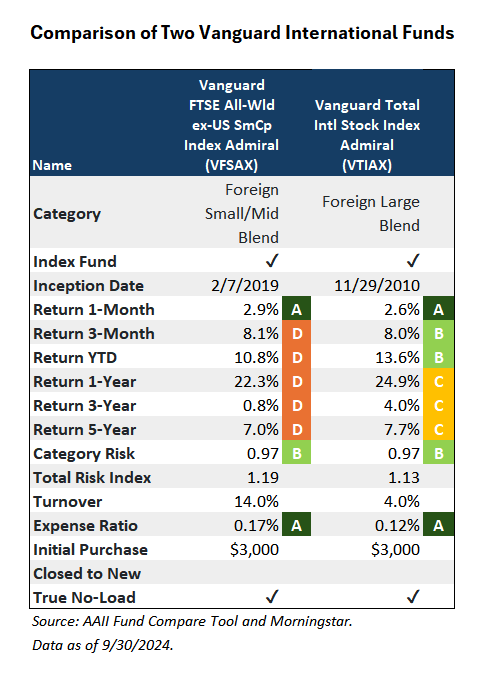 I used three tools on AAII.com, as well as Vanguard’s website, to analyze my options. The first was our Mutual Fund Evaluator. This provides a detailed snapshot of each mutual fund, including annualized and annual performance. You can access it by typing a fund’s name or ticker symbol into the search box at the top of the site. The Compare Funds page enables you to make side-by-side comparisons of two or more mutual funds. Both tools are available to all members. The third was our Mutual Fund Screener. It is available to A+ Investor and Platinum subscribers. I used Vanguard’s website to get more insight into the specific geographic allocations and the fund holdings.
The Vanguard FTSE All-World ex-U.S. Small-Cap Index Admiral has underperformed its foreign small/mid blend category peers over the past three-, five- and 10-year periods. On an annual basis, it has underperformed the category average during six out of the last 10 full calendar years. It is underperforming the category average year to date as of the end of September. If the year-to-date trend continues, it would be seven out of 11 years with underperformance. (Prior to 2019, the fund was only available as an investor class fund.)
The Vanguard Total International Stock Index Admiral provides similar geographic exposure, though with larger-cap stocks. Its performance has been closer to its category average—besting its foreign large blend category peers during five out of the past 10 years. It is also on pace to outperform this year.
Comparing the two funds, the large-cap Vanguard Total International Stock Index Admiral has outperformed the small-cap fund Vanguard FTSE All-World ex-U.S. Small-Cap Index Admiral over the past three-, five- and 10 years. Vanguard Total International Stock Index Admiral also has a slightly lower expense ratio: 0.12% versus 0.17%. To be fair, this was more of a cherry on top since five basis points (bps)—$0.50 per every $1,000 invested—is a small difference relative to all the other factors that influence returns.
My choices are limited to Vanguard mutual funds because that is what AAII’s 403(b) plan offers. Vanguard has only five admiral class funds in the foreign small/mid blend and foreign large blend categories. I passed on the Vanguard Developed Markets Index Admiral fund (VTMGX) because I wanted broader exposure. The Vanguard International Core Stock Admiral fund (VZICX) was not launched until 2019. In addition, it is actively managed and, most importantly, not available in my 403(b) account.
I strongly considered the Vanguard FTSE All-World ex-U.S. Index Admiral fund (VFWAX). It has a similar concentration in its top 10 holdings (11.3% versus 10.1%) as the Vanguard Total International Stock Index Admiral. Unfortunately, it was also not available in my 403(b) plan.
No Rebalancing This Month
I check my 403(b) allocation at the end of October and the end of April to determine if any rebalancing is needed. The threshold for rebalancing is having one or more funds accounting for either less than 15% or more than 25% of the account’s value.
The Vanguard 500 Index Admiral fund (VFIAX) was right at the boundary with a weight of 24.9%. Because investing is messy and the difference between a 24.9% allocation and a 25.1% allocation is meaningless over the long term, the choice to rebalance or not was a judgment call. I chose to hold off since the best six-month period for the S&P 500 index is between November and April.
If I am wrong, the market will bring the portfolio’s allocations back toward the target of 20% per fund. If I am right and the S&P 500 continues to outperform, I’ll rebalance the account during the first half of 2025.

-
How Rebalancing Helps When Downturns Strike Early
Retirees making withdrawals from diversified portfolios who rebalanced had a better outcome than those who did little to preserve their allocation weightings. -
How to Find Funds Suitable for You
Tips and tools to help you define your needs and make more informed decisions when looking at funds. -
Striking the Right Balance Between Growth and Value Stocks
In the October 2024 AAII Journal, Craig Israelsen takes a look at historical performance to shed light on whether favoring growth or value stocks makes a difference.
AAII Sentiment Survey
Neutral sentiment among individual investors about the short-term outlook for stocks decreased in the latest AAII Sentiment Survey. Meanwhile, both optimism and pessimism increased.
Bullish sentiment, expectations that stock prices will rise over the next six months, increased 1.8 percentage points to 39.5%. Bullish sentiment is above its historical average of 37.5% for the 51st time in 52 weeks.
Neutral sentiment, expectations that stock prices will stay essentially unchanged over the next six months, decreased 2.8 percentage points to 29.6%. Neutral sentiment is below its historical average of 31.5% for the 16th time in 17 weeks.
Bearish sentiment, expectations that stock prices will fall over the next six months, increased 1.0 percentage points to 30.9%. Bearish sentiment is below its historical average of 31.0% for the 11th time in 12 weeks.
The bull-bear spread (bullish minus bearish sentiment) increased 0.8 percentage points to 8.6%. The bull-bear spread is above its historical average of 6.5% for the 25th time in 26 weeks.
This week’s special question asked AAII members which asset class they think will realize the highest returns over the next five years.
Here is how they responded:
- Stocks: 74.7%
- Precious metals: 10.1%
- Bonds: 5.1%
- Cash: 2.8%
- Other/not sure: 7.4%
Bullish: 39.5%, up 1.8 points
Neutral: 29.6%, down 2.8 points
Bearish: 30.9%, up 1.0 points
Bullish: 37.5%
Neutral: 31.5%
Bearish: 31.0%
See more Sentiment Survey results.

October 24, 2024 Analyzing the Metrics of Stocks Advertised on CNBC
October 17, 2024 October Charts of Interest: Happy Second Birthday, Bull Market
October 10, 2024 The Lessons We Learned From Caregiving and Estate Settlement
October 3, 2024 Our New Data Feed and Its Impact on Your Investments

Discussion
Eliot Nierman from New York posted almost 2 years ago:
This approach seems to be a market timing approach rather than a portfolio design. Recently small caps have done less well than large caps. If you believe however, that they should be a part of your portfolio, you should not switch from a small cap to a large cap just because they have done less well recently. On the other hand, if you are just choosing an international fund without regard to size than this approach makes perfect sense.
Charles Rotblut from Illinois posted almost 2 years ago:
Eliot, had there been another international small-cap fund available, I would have considered it. Unfortunately, the choices for international funds in our 403(b) are limited. I still have the Vanguard Small-Cap Value Index Fund (VSIAX), which holds domestic stocks, in my account.
Robert C Hewitt from North Carolina posted almost 2 years ago:
What is the asset allocation of your 403(b) account? How does the asset allocation for your 403(b) compare with the suggestions in AAII for the three types of investor?
You need to log in as a registered AAII user before commenting.
Create an account