

Five Smart Strategies to Reduce Your 2024 Capital Gains Taxes
by Charles Rotblut | December 05, 2024
This year has been very good for investors. The S&P 500 index has gained nearly 30%. The small-cap Russell 2000 index is up more than 20%. Growth, value and dividend indexes also have realized double-digit gains. Bitcoin is hovering near the $100,000 mark.
Though gains are always welcome, they bring the prospect of capital gains taxes. If you realized capital gains this year in a taxable account or anticipate doing so before year-end, you still have time to reduce your 2024 tax bill. Here are five tax-savvy strategies that you, as an investor, can use:
1. Offset Gains With Losses
Realized capital gains can be offset by realized losses in the same calendar year. Begin by matching long-term losses to long-term gains and short-term losses to short-term gains. Excess short-term capital losses can then be applied to long-term gains, and vice versa. In addition, you can apply any capital losses carried over from past years (such as 2022) to gains you realized this year.
The maximum net loss you can claim is $3,000 per year. Any net losses above this level can be carried over to future years. Net capital gains exceeding these offsets are taxable in the year they are realized.
2. Consider Tax-Loss Harvesting
 While we don’t advocate letting the tax tail wag the portfolio dog, harvesting losses for tax purposes can make strategic sense. Tax-loss harvesting is purposely selling an investment at a loss to realize a tax loss. It makes the most sense when an investment is already under consideration for removal from your portfolio—be it for triggering a sell rule or because you are seeking to reduce the number investments you hold.
If you are solely selling to realize a loss and plan to repurchase the investment, be careful not to violate the wash-sale rule (discussed below).
3. Donate Appreciated Investments to Charity
The higher standard deduction ($29,200 for married couples filing jointly and $14,600 for singles in 2024) has made it harder for many taxpayers to itemize, but donating appreciated investments to charity can get you over the hump. Bundling the donation of appreciated investments with other planned charitable contributions can be a highly effective tax strategy. When you gift an appreciated investment, you avoid paying capital gains taxes on it and can claim a charitable deduction for its full market value.
Investments that have fallen in value can be donated too, but you are better off selling them and then donating the proceeds. This gives you a loss to offset capital gains and a separate charitable deduction that can be used if you itemize.
4. Gift Appreciated Investments
Gifting an investment can be a win-win for you and the gift recipient if certain conditions exist. You avoid paying any capital gains taxes. The giftee receives the investment and your cost basis. This is most beneficial when the person making the gift is in the 20% capital gains bracket and/or subject to the 3.8% net investment income (NII) surcharge and the giftee is in the 0% capital gains tax bracket. (Married joint filers and single filers with taxable income up to $94,050/$47,025 qualify for the 0% capital gains rate in 2024.)
Be cognizant of the gift tax exclusion when gifting stocks, exchange-traded funds (ETFs) or other investments. The annual exclusion for 2024 is $18,000. It doubles to $36,000 for consenting couples.
5. Avoid the Wash-Sale Rule
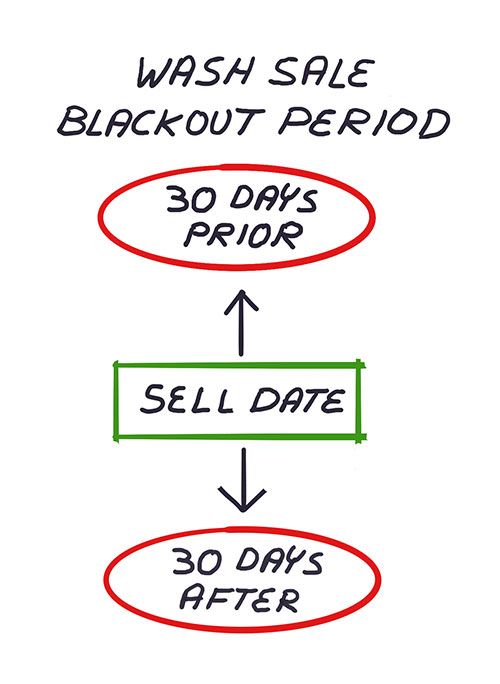
Violating the wash-sale rule delays your ability to claim a loss for tax purposes. A wash sale occurs when you sell a stock, ETF or other security at a loss and repurchase a “substantially identical” investment within 30 days before or after the sale. Substantially identical investments include option contracts on the same security. You cannot add the investment to another account—e.g., an individual retirement account (IRA)—within 30 days and still claim the loss.
If you violate this rule, the loss on the investment you sold is then used to adjust the cost basis of the substantially identical investment.
You can navigate this rule by purchasing a similar but different investment. Examples include shares of a close competitor to the company whose stock you sold or a different ETF whose returns are close to the fund you sold. (An example might be selling an S&P 500 index fund and buying a Russell 1000 index fund instead.)
Your portfolio rules and withdrawal strategy should always be the determining factor when it comes to deciding whether to sell an investment.

-
Capital Pains: Rules for Capital Losses
The tax code limits the deduction that can be taken for net capital losses, but it also allows losses to be offset by gains from assets other than investment securities. -
Online Exclusive: What Are Donor-Advised Funds?
Donor-advised funds allow donors to take an immediate tax deduction on their contributions now without the need to decide at the same time where the funds will ultimately be gifted. -
Year-End 2024 Tax Planning: Maximizing Your Savings
A supplement to our just-released tax guide with end-of-year suggestions that focus on areas applicable to large numbers of investors.
AAII Sentiment Survey
Optimism among individual investors about the short-term outlook for stocks increased in the latest AAII Sentiment Survey. Meanwhile, neutral sentiment and pessimism decreased.
Bullish sentiment, expectations that stock prices will rise over the next six months, increased 11.3 percentage points to 48.3%. Optimism is unusually high and is above its historical average of 37.5% for the 55th time in 57 weeks. Bullish sentiment fell just below the historical average during Thanksgiving week.
Neutral sentiment, expectations that stock prices will stay essentially unchanged over the next six months, decreased 3.3 percentage points to 21.0%. Neutral sentiment is below its historical average of 31.5% for the 21st time in 22 weeks.
Bearish sentiment, expectations that stock prices will fall over the next six months, decreased 8.0 percentage points to 30.7%. Pessimism is below its historical average of 31.0% for the first time in three weeks.
The bull-bear spread (bullish minus bearish sentiment) increased 19.3 percentage points to 17.7%. (It fell to –1.6% last week.) The bull-bear spread is above its historical average of 6.5% for the 29th time in 31 weeks.
Over the holiday week, we asked AAII members what their favorite thing was to eat on Thanksgiving. Turkey was the most popular, followed by stuffing and desserts.
Bullish: 48.3%, up 11.3 points
Neutral: 21.0%, down 3.3 points
Bearish: 30.7%, down 8.0 points
Bullish: 37.5%
Neutral: 31.5%
Bearish: 31.0%
See more Sentiment Survey results.

AAII Asset Allocation Survey
Individual investors’ allocations to bonds increased while stock and cash allocations decreased in the November Asset Allocation Survey.
Stock and stock fund allocations decreased 0.2 percentage points to 68.7%. Stock and stock fund allocations are above their historical average of 61.5% for the 54th consecutive month.
Bond and bond fund allocations increased 0.7 percentage points to 15.3%. Bond and bond fund allocations are below their historical average of 16.0% for the 10th consecutive month.
Cash allocations decreased 0.4 percentage points to 16.0%. Cash allocations are below their historical average of 22.5% for the 24th consecutive month.
- Stocks and Stock Funds: 68.7%, down 0.3 percentage points
- Bonds and Bond Funds: 15.3%, up 0.7 percentage points
- Cash: 16.0%, down 0.4 percentage points
- Stocks: 31.5%, up 0.6 percentage points
- Stocks Funds: 37.2%, down 0.9 percentage points
- Bonds: 4.8%, up 0.1 percentage points
- Bond Funds: 10.6%, up 0.6 percentage points
- Stocks/Stock Funds: 62.0%
- Bonds/Bond Funds: 16.0%
- Cash: 22.0%
Take the Asset Allocation Survey.
November 28, 2024 Thanksgiving Conversations: Planning for the Future
November 21, 2024 November Charts of Interest: The S&P 500 Returns Under Republican Control
November 14, 2024 Unawareness of Cognitive Impairment Reduces Your Wealth
November 7, 2024 TCJA Tax Cuts Ending in 2025

Discussion
Barry J from TX posted almost 2 years ago:
Charles, although everything discussed here is “legal,” this update tiptoes very close to the red line on “diddling.” This is an Area 51 where only very experienced people with an investing "security clearance" of "Cleared for Weird" should venture. Two metaphors might help with your decisions here. Metaphor #1 Odysseus/Ulyssess was renowned for his intellectual brilliance and guile and was known as "the Cunning." He is most famous for his "homecoming" AFTER the 10-year Trojan War (the negotiations with the IRS) AND AFTER another 10 very “weird” and eventful years (the restitution/payback period). This is similar to what happens to someone who “displeases” that IRS gods. Stream any version of “Ulyssess” and then ask your version of the long-suffering, loyal, and loving Penelope if she can do without you for 20 years and if she will visit you at Club Fed. Be very careful here; you may not get the answer you expect. Metaphor #2 If you take too long a lead off the base to get a “jump” on the IRS pitcher, you better be as good as the all-time leader, Ricky Henderson. The major league average success rates is 80.1%. Stream “Bull Durham” again and then ask your Annie Savoy if you are ready to play in the Majors. The question we always ask before trying to “outsmart” 90,000 IRS agents is, “Do we need the money that bad?” The answer is always, “No.”
You need to log in as a registered AAII user before commenting.
Create an account