

Thanksgiving Conversations: Planning for the Future
by Charles Rotblut | November 28, 2024
Unlock the ultimate investment toolkit with the AAII Dividend Investing, Retirement Investing and A+ Investor bundle—now available at an exclusive discounted price! This powerful combination pairs expert newsletter insights with a robust data suite, offering everything you need to build a reliable income stream, secure your retirement and identify top investment opportunities. Enhance your strategy with advanced tools and expert guidance, all at an unbeatable value for the enterprising investor.
Over the course of the past two months, I’ve had discussions with my wife, parents and sister about advance directives. We’ve also discussed our family’s medical history and both their and my own seemingly growing list of medical “ologists.”
 The impetuses for these conversations were the deaths of my mother-in-law and uncle. We lost both over the span of the last two months. Three other couples we’re friends with also recently lost a parent. Another couple recently lost their cat. I’m hoping the Grim Reaper takes a break and binges Netflix for a while.
Rather than waiting for a similar event to happen, I’d encourage you to use the Thanksgiving weekend to talk to your family about late(r)-in-life care, estate plans, finances and related issues. Use the time spent with them (or on FaceTime, Zoom, etc.) to discuss these important topics. Doing so will help those tasked with making important decisions feel comfortable that they can make the right ones.
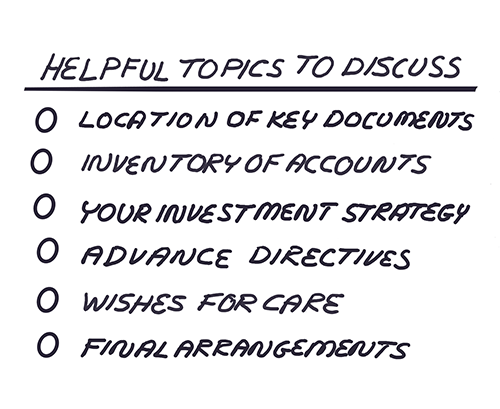
Here’s a checklist based on my wife’s and my personal experience:
- The Location of Key Documents: One of the most helpful things my late father-in-law did was show me where he stored things. It is critical that your children know where to find key estate documents, powers of attorney, the house title, your military ID and discharge papers (if applicable), and other related documents.
- An Inventory of Financial Accounts: Even if you don’t feel comfortable sharing information about all your finances, provide a list of every account you do have. My parents have done this. It will make it easier for someone you trust to step in when the time comes. Plus, when it’s time to settle your estate, the list will help your heirs. (After my mother-in-law died, I found a credit card in her purse that neither my wife nor I knew she had.)
- Your Investing Strategy: One of the biggest gifts you can give are the lessons you’ve learned as an investor. Furthermore, don’t assume the person you trust to step in on your behalf will necessarily know the decisions you want them to make. Both my father and, when he was alive, my father-in-law have had conversations with me about investing.
- Advance Directives: Speaking from personal experience, tell those you love what you desire regarding medical care. Be specific about your preferences, be it possible medical intervention, ending all care beyond what’s needed to provide comfort or something in the middle. The discussion also provides the opportunity to share diseases and ailments that are in your family history.
- Wishes Regarding Care: As you grow older, do you want to age in place for long as is feasible or move into a retirement community? If you want the latter, do you have preferences regarding location? As you discuss your desires, understand that us middle-aged children often worry about our parents’ safety—especially when it comes to stairs.
- Final Arrangements: No one likes to think about their demise, but advance planning will help your loved ones. Pre-planned funerals certainly helped my wife with her parents. Other helpful information includes who to contact, where you want to your obituary to run (if so desired), which clergy (if any) you want involved, and what you want on your tombstone/marker or any wishes regarding your ashes.

-
Guiding Heirs: Estate Planning and Investing Talks
The PRISM Wealth-Building Process can assist with communication when passing along your investing knowledge, your inventory of important documents and your final wishes. -
Key End-of-Life Planning Tasks to Complete
With estate documents and inventory lists in place, you can focus on the more important nonfinancial questions. -
When Diversification Takes a Back Seat in Index Funds
The November 2024 AAII Journal reveals how a new policy of some index funds to allow nondiversification status exposes investors to concentration risk.
AAII Sentiment Survey
Bullish: 37.1%, down 4.2 points
Neutral: 24.3%, down 1.2 points
Bearish: 38.6%, up 5.4 points
Bullish: 37.5%
Neutral: 31.5%
Bearish: 31.0%
See more Sentiment Survey results.

November 21, 2024 November Charts of Interest: The S&P 500 Returns Under Republican Control
November 14, 2024 Unawareness of Cognitive Impairment Reduces Your Wealth
November 7, 2024 TCJA Tax Cuts Ending in 2025
October 31, 2024 How I Picked a New Fund for My 403(b)

Discussion
John L from NJ posted almost 2 years ago:
Just imagine; your family enjoying a Thanksgiving feast; talking about football and new television shows. Then you switch the conversation to death preparations. Man will you be the life of the party. Wow dude thanks for asking about my advance directive, your brother in law will exclaim. Not! I am sure there will be an appropriate time to talk about estate plans, advance directives, and what are your plans when you are unable to use the toilet on your own mom. But Thanksgiving isn't the time or place!!
Barry J from TX posted almost 2 years ago:
Sorry Charles, John L is right. And I add. #1 The only thing that could make a Thanksgiving Dinner worse than what Charles proposes would be to invite our lawyer to dinner, too, so he can bill me $500 to $1,000 for legal advice with his mouth full of OUR food. #2 We look at this day as an opportunity to thankful that we can be together and to share the unique, quirky, inimitable fellowship that makes a family a family. #3 Our family has passed down an event that makes us all laugh. We serve black-eyed peas with the traditional side dishes. Black-eyed peas remind us of how poor our family was during the Great Depression, how far the generations we have come since then, and how, through hard work and the Grace of God, we are able to take care of each other in times of need. #4 The most senior person at the table asks, "I wonder what all the poor people are eating?" The youngest person responds, "We're eating black-eyed peas." #5 Then we pray aloud. #6 We even say a few prayers for the Cowboys to extract themselves from the position they have created for themselves. They need to eat some black-eyed peas to appreciate how Blessed they are for being so highly overpaid for playing a schoolyard game so poorly.
Barry J from TX posted almost 2 years ago:
Charles, you overlaid your highly idiosyncratic recent personalized experiences on top of the PRISM process to give it structure. I would add that you might want to include a suggestion that members read up on the Kübler-Ross theory of grief management in "On Death and Dying" (1970). By 1982, she had taught over 100,000 students her process in courses in colleges, seminaries, medical schools, hospitals, and social-work institutions. The New York Public Library named "ODAD" one of its "Books of the Century" and Time magazine recognized her as one of the "100 Most Important Thinkers" of the 20th century. Until heirs work through the Kübler-Ross cycle, they are not prepared to participate in the estate resolution process at any level or in any way. Although PRISM provides a structured approach, unresolved emotional and psychological gaps are the source of a messy estate resolution process that the PRISM process seeks to resolve rationally. Kübler-Ross is the starting point.
Denny from TX posted almost 2 years ago:
Thank you for the advice, I’ll print out the article for future reference.
You need to log in as a registered AAII user before commenting.
Create an account