

Unawareness of Cognitive Impairment Reduces Your Wealth
by Charles Rotblut | November 14, 2024
A fading memory can quietly chip away at your financial security if it is unnoticed. Affluent investors who incur a severe memory loss event but are unaware of it experience significantly larger drops in wealth than those who are aware of their cognitive declines.
A severe memory loss event is a decline of 20% or more in a word memory test score compared to the performance on the same test two years prior. Such events occur at an average age of 64. According to the Health and Retirement Study (HRS)—a recurring panel study of Americans ages 50 to 80—about 40% of respondents incur one severe memory loss event, while 40% don’t incur one. Among those who don’t incur one, 28% experience such an event over the next two-year period. The study measures awareness of declines in memory using self-reported ratings of memory. Both the memory scores and self-reported awareness are captured in the HRS.
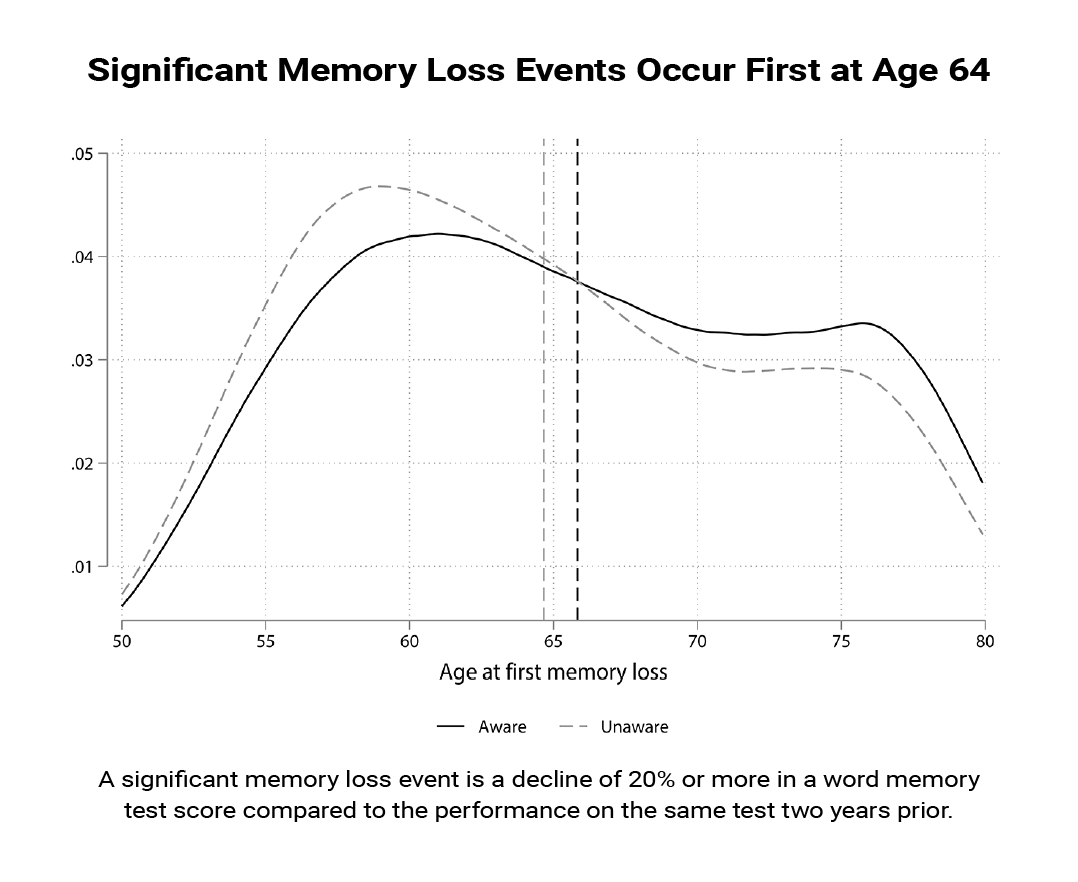
Wealth losses for those who were unaware of their cognitive declines exceeded $31,000 over a two-year period. This compares to an approximate $5,400 loss for those who were aware of their declining abilities. More than half of the losses were attributable to a decline in the value of stocks, mutual funds and investment trusts. The remaining 45% of losses were attributable to drops in the net value of certificates of deposit (CDs), checking accounts and savings accounts.
According to the study’s authors—Fabrizio Mazzonna of Università della Svizzera Italiana and Franco Peracchi of Tor Vergata University of Rome—these decreases in wealth are indicative of bad financial decision-making. The “negative changes in financial wealth are mainly observed among unaware respondents who report that they have been active on the stock market in the past two years.”
Those who were unaware of their cognitive declines often had better initial cognitive functioning before they incurred a severe memory loss event. This is theorized to lead to overconfidence, “that is, overestimation of own performance in tasks requiring particular abilities.” The overconfidence can result in risky financial behaviors, like overtrading or investing with unrealistic expectations.
Mazzonna and Peracchi published their findings in the Journal of Political Economy. Their study reinforces previous research showing a strong relationship between declining cognitive skills and the ability to make good financial decisions. A 2019 study we covered in the AAII Journal found a $50,000 drop in wealth when the cognitive abilities of the person responsible for managing the household’s finances incurred a significant decline. A 2011 JAMA (Journal of the American Medical Association) study we covered in the December 2014 AAII Journal encouraged doctors to talk to their patients about the potential for financial impairment when giving a diagnosis of mild cognitive impairment or Alzheimer’s disease.
Among the proverbial drums I’ve beat on is simplifying your finances and investment strategies as you age. Talk to your children or others you trust about your strategies and finances. Stay engaged in social activities, exercise regularly and get sleep. Automate where possible. Most importantly, be humble and do not overestimate your abilities.

-
Aging and Investing: The Risk of Cognitive Impairment
Cognitive impairment afflicts approximately half of all 80-year-olds. However, there are steps investors can take to protect themselves financially. -
Investing Strategies for an Irrational Brain
The human brain often does not make profit-maximizing decisions, but these actionable strategies can help avoid behavioral errors. -
It’s Hard to Be Great at Everything, Including Investing
In the November 2024 AAII Journal, Chris Pedersen illustrates how even though we may not be able to ensure that our portfolios succeed all the time in all circumstances, we can all strive to improve their fit.
AAII Sentiment Survey
Neutral sentiment among individual investors about the short-term outlook for stocks decreased in the latest AAII Sentiment Survey. Meanwhile, optimism and pessimism increased.
Bullish sentiment, expectations that stock prices will rise over the next six months, increased 8.3 percentage points to 49.8%. Bullish sentiment is unusually high and is above its historical average of 37.5% for the 53rd time in 54 weeks.
Neutral sentiment, expectations that stock prices will stay essentially unchanged over the next six months, decreased 9.1 percentage points to 21.8%. Neutral sentiment is unusually low and is below its historical average of 31.5% for the 18th time in 19 weeks.
Bearish sentiment, expectations that stock prices will fall over the next six months, increased 0.8 percentage points to 28.3%. Bearish sentiment is below its historical average of 31.0% for the 13th time in 14 weeks.
The bull-bear spread (bullish minus bearish sentiment) increased 7.5 percentage points to 21.5%. The bull-bear spread is above its historical average of 6.5% for the 27th time in 28 weeks.
This week’s special question asked AAII members how the outcome of U.S. elections is impacting their short-term outlook for stocks.
Here is how they responded:
- It makes me more optimistic: 39.8%
- I’m taking a wait-and-see approach before adjusting my outlook: 22.8%
- It makes me more cautious or pessimistic: 18.3%
- No impact: 16.3%
- Other/not sure: 2.4%
Bullish: 49.8%, up 8.3 points
Neutral: 21.8%, down 9.1 points
Bearish: 28.3%, up 0.8 points
Bullish: 37.5%
Neutral: 31.5%
Bearish: 31.0%
See more Sentiment Survey results.

November 7, 2024 TCJA Tax Cuts Ending in 2025
October 31, 2024 How I Picked a New Fund for My 403(b)
October 24, 2024 Analyzing the Metrics of Stocks Advertised on CNBC
October 17, 2024 October Charts of Interest: Happy Second Birthday, Bull Market

Discussion
Rob from NC posted almost 2 years ago:
This is something I think about (and worry about) a lot. And Charles's email hasn't helped, since I'll be turning 64 in a few months. But at least the fear prompted me to start having open financial discussions with my children a few years ago. I want my oldest son to be able to step in and take over when the time comes.
Barry J from TX posted almost 2 years ago:
Charles, the list of advice you give in the closing paragraph is excellent. The HRS methodology, as presented, strikes me as overly simplistic. Maybe I need to read the study to get my questions answered. But because I am not one of the “unaware” seniors group, I do not plan to pay $20 or so to download a copy. That would be a good example of the “bad decision-making the study is trying to isolate. Here are just a sample of my issues. #1 These “data” are self-reported as opposed to empirically measured and therefore are easily subject to confabulation (believing the first story your brain presents), conflation (confusing two different ideas), inflation (exaggerating magnitudes or frequencies), and confusion (the inability to separate signal and noise in conflicting signals). Remember about 50% of these seniors self-reported declining mental skills (see last list) and the other 50% are unaware (inattentive? short-term memory? see last list again) they might have declining mental decision-making skills. See list again. #2 It is ambiguous how these assessments were performed in a systematic manner. Self-reporting is always an unsystematic methodology to gather data. #3 I would like to see the aggregate data (no matter how unsystematic) reported in these studies stratified by demographics (gender, age, etc.) to see if there are clues related to the impact of the birth lottery (gender), and segmented by accumulated household “wealth,” and the reported losses (over two years) delineated by the cause(s) the person reporting the amount loss compared to investing performance of their portfolios over the same periods. #4 When you are studying older people, it is important to be precise, even if (and especially if) they cannot. Remember, 50% of the people studied reported mental declines over two years. Wealth losses for the “unaware” were reported as $31,000 and we do not know how large a relative impact that loss was. I see $31,000 "losses" at least one day a month. Those categorized as “aware” of their declining abilities reported losses of $5,400. Same issue here. The groups may have very different reference points. #5 In Prospect Theory Dan Kahneman found that everyone measures "gains" and "losses" based on a "reference point" that anchors their ability to make judgments of gains and losses. #6 What was reported as a “loss” could have many reasonable explanations that have no relation to declining mental competency. They may have simply conflated a “loss” of wealth with temporary changes in portfolio balances (simple market volatility) or conflated “losses” with intentional/required withdrawals/RMDs. Essere al verde. I have a dozen more issues, but “II sono finite” (in honor of our Italian research team.) #7 My BIG ISSUE is why there is NO information on the relative financial literacy/competency of the people studied AND, more importantly, whether they paid certified financial advisors, who have taken oaths to manage their clients’ portfolios with high “fiduciary” fidelity AND what percent of the people in the study were AAII members versus non-members and which segment – aware or unaware -they belong. #8 No matter the shape of the distribution, the financial advisor industry may have a large issue. It is ignoring that could easily reconciled. “Avere le mani in pasta.” But what is unusual about that situation? #9 As for my issues and comments here, my mia madre might say “Non avere peli sulla lingua. Cercare il pelo nell'uovo. Tutto fa brood. Avere il diavolo in corpo. Mettere il carro davanti ai buoi. Addio amici miei.”
Barry C Johnson from TX posted almost 2 years ago:
To slake my appetite for more information on the topics of memory loss and creeping cognitive decline I can actually use, I read the first two articles referenced above. They were very helpful. Then again, at my aged state of decline, 78, I may be so far behind the dementia curve's power law (cognitive performance DECREASE DOUBLES every 5 years after age 50 -- 1% by age 50 + 2% by 60 + 4% by 65 + 8% by 70 +16% by 75 = 31% to date) that I didn't understand what I read. If you're an investing/insurance industry professional planning on "helping" fit me for an annuity, I wouldn't bank the commissions right away. I would wait a few more years as the half-life of the compounding rate of the dementia power law takes it's toll (31 base + 32 by 80 + 64 by 85 = >100% = fully demented). Console yourself with all the insurance payouts you will save. I checked the Social Security life-expectancy database (probably the very best estimator for life expectancy), I have a 100% chance of dying by age 86. I present this data to demonstrate how "demented" and determined the "aging industry" is about making sure we become convinced we are senile and turn over our assets to their care so they can redeploy it "rationally" -- buy their wife and kids new cars.
Steve B from MA posted almost 2 years ago:
Hi- I found the statement, "The remaining 45% of losses were attributable to drops in the net value of certificates of deposit (CDs), checking accounts and savings accounts." implausible at best. How meaningless. Although I have only been investing for about 40 years, I've never heard or read about *ANYONE* losing money in CDs. Even during the financial crisis. What a poor way to phrase this 'finding'. My checking account varies by thousands, depending on the day of the month you look. My savings vary in large chunks- usually when I move into or out of another investment, take a distribution from a retirement account, or have an unexpected large bill. I must be one of the unaware folks out here. Because this makes no sense, as written. Try again.
John L from NJ posted almost 2 years ago:
Cognitive impairment is not an issue for long term set it and forget it passive index investors with a 100% allocation to equities. And better yet; your wife and children don't need any investing skill or knowledge to continue doing nothing.
Barry from TX posted almost 2 years ago:
That graph should be part of the "significant loss of memory" test instrument. If you think it makes sense, you may be diagnosed as having a high probability of "significant mental loss." #1 The vertical scale is unlabeled, but appears to be scaled in 0.01 (1%) increments, measuring the AMOUNT OF CHANGE in "significant memory loss." #2 The horizontal scale is scaled as ages 50 to 80. #3 The two lines trace the RELATIVE progression of the rate of "significant mental loss" for two populations -- the test group ("Unaware" (dashed line) and the control group ("Aware" (solid line) for the study. Differences across groups were most likely used to measure the "significance" of memory loss. #4 As drawn, the graph creates more questions about what the article says than proving support for its statements. My questions are: #5 Why does the rate of "significant mental loss" begin to DECREASE as we pass through age 58 or so? I was expecting to see a continuously increasing rate of change in "significant memory loss" as BOTH populations as they age from 50 to 80. #6 Why do both rates in "significant memory loss" DECREASE after age 66 and show continuously DECREASING trends through age 80? #7 As labeled the graph shows that BOTH populations have somehow miraculously REPAIRED the rates of change in their favor (from around 5% data at age 58 to UNDER 2% for both populations by age 80. Mirabile dictu indeed !!! #8 I believe the error is either (a) poor graphing skills, or (b) a function of the ability of the test to translate the rates of change in "significant mental loss," or (c) the reporting of the measurements may be in error. #9 I remember watching my Mom receive a test that was probably the same or similar to the one used in this article. The test was simple. It had 5-10 questions. It tested longer-term memory by asking about time ("When was your oldest child born?), commonly-known facts (Who is the President of the US?), family names (What are the names of your children?), dates (*What day of the week is this?), and simple math problems ("What is 17 plus 24?), and then it asked her to remember some of her prior answers to test very short term (working) memory. #10 I do NOT remember any questions about handling money or any math related to financial literacy. These gaps would seem to be a significant oversight if one of the expected uses of these data were to MEASURE the degrees of memory loss with handling common financial activities - saving, investing, spending, etc. The deficiencies in the graph and perhaps the actual procedures in the test instrument impel me to repost an earlier thought in a prior comment. "I present this data to demonstrate how "dementia" and the "aging industry" is about convincing us that we have become senile as we age so we can be motivated to turn over our assets to THEM so they can redeploy it "rationally" to produce memories -- buy their wife and kids new cars." John Bogle's observations about the financial industry were prescient and valuable cautions.
You need to log in as a registered AAII user before commenting.
Create an account