

TCJA Tax Cuts Ending in 2025
by Charles Rotblut | November 07, 2024
Passing key tax legislation will be a key priority for the next Congress. Without it, several provisions in the tax code will sunset at the end of 2025.
President-elect Donald Trump proposed several tax cuts during his campaign. Republicans will have control of the Senate in 2025. Though several races have yet to be called, the Republicans are on track to also control the House of Representatives, according to the Associated Press (at least as of lunchtime today).
This means that more tax cuts are likely. What is unknown is how much the debt hawks in Congress will push back during negotiations and voting. Additionally, the specific rates, deductions, caps, phaseout levels and credits that are revised will impact your taxable income.
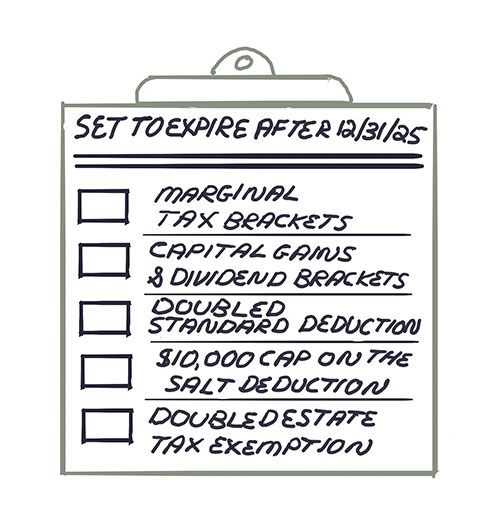 Here are key provisions of the Tax Cuts and Jobs Act (TCJA) of 2017 that are set to expire at the end of 2025 and impact many individual investors.
- Marginal tax brackets: The tax rates for the second and third tax brackets, where many taxpayers fall, will rise by three percentage points (from 12% and 22% to 15% and 25%, respectively) without new legislation. In addition, the thresholds at which each higher bracket is reached will decline if not extended.
- Capital gains and qualified dividends: These were assigned their own income brackets by the TCJA. They are scheduled to revert to using the less generous income tax brackets in 2026.
- Standard deduction: This was doubled by the TCJA. It is now $29,200 for married couples filing a joint return and $14,600 for single filers. Next year, it will be $30,000 and $15,000, respectively. If not extended, it will be cut in half in 2026 on an inflation-adjusted basis.
- Personal exemption: It has been in hibernation since 2018 but could return in 2026. The same applies to the ability to deduct miscellaneous itemized deductions exceeding 2% of adjusted gross income (AGI). For the typical taxpayer, the return of both will not exceed the value of the higher standard deduction.
- State and local tax (SALT) deduction: This may well be a point of contention in negotiations. The $10,000 cap on deducting state and local taxes on federal tax returns will end after December 31, 2025. The current cap was not indexed to inflation by the TCJA. Legislators from areas affected by the SALT deduction limit are being pressured by their constituents to end it, though legislators from other states may object.
- Estate taxes: The TCJA doubled the basic exclusion amount for estate taxes. It is currently $13.61 million per spouse and will rise in 2025 to $13.99 million. The estate exemption will be cut in half (though adjusted for inflation) in 2026 without congressional action.
- Alternative minimum tax (AMT): Both income exemptions and phaseout levels were increased by the TCJA. They are set to revert to the lower pre-TCJA levels (adjusted for inflation) in 2026.
Your total taxable income matters, and the effective tax rate you pay on it matters more than the headline tax numbers you hear about on the news. This makes tax planning beyond 2025 tricky. If you prefer a certain level of certainty, here are actions you can take this year and next year:
- Do Roth individual retirement account (IRA) conversions this year and in 2025 while keeping an eye on your marginal tax brackets and 2026–2027 Medicare Part B premium thresholds (“IRMAA”).
- Take a withdrawal from inherited IRAs subject to the 10-year rule this year even though there is no penalty for not doing so. Penalties will be levied for failing to take a required minimum distribution (RMD) from such IRAs in 2025.
- Make gifts to heirs this year and next year if your estate will be subject to the estate tax. The gift tax exclusions are currently $18,000 for single filers and $36,000 for consenting couples. These limits will rise to $19,000 and $38,000, respectively, in 2025.
- Moving assets to trusts to reduce the size of one’s estate may also be an option for some. Consider the costs and limitations before doing so.
- Bundling charitable donations into this year or next may allow to you claim a higher deduction than the standard deduction.

-
Can a Roth IRA Conversion Save You Money?
Moving assets from a traditional IRA to a Roth IRA is most compelling when you pay tax on the converted amount at a relatively low rate. -
Inherited IRA Rules Before and After the SECURE Act
The ability to stretch distributions over a beneficiary’s lifetime now depends on the date of death and the beneficiary’s category type. -
Should You Consider a Weighting in Gold?
In the October 2024 AAII Journal, Midas Fund’s portfolio manager explains why a gold allocation should change based on where gold equities are in the valuation cycle.
AAII Sentiment Survey
Pessimism among individual investors about the short-term outlook for stocks decreased in the latest AAII Sentiment Survey. Meanwhile, both optimism and neutral sentiment increased.
Bullish sentiment, expectations that stock prices will rise over the next six months, increased 2.1 percentage points to 41.5%. Bullish sentiment is above its historical average of 37.5% for the 52nd time in 53 weeks.
Neutral sentiment, expectations that stock prices will stay essentially unchanged over the next six months, increased 1.3 percentage points to 30.9%. Neutral sentiment is below its historical average of 31.5% for the 17th time in 18 weeks.
Bearish sentiment, expectations that stock prices will fall over the next six months, decreased 3.3 percentage points to 27.6%. Bearish sentiment is below its historical average of 31.0% for the 12th time in 13 weeks.
The bull-bear spread (bullish minus bearish sentiment) increased 5.4 percentage points to 14.0%. The bull-bear spread is above its historical average of 6.5% for the 26th time in 27 weeks.
This week’s special question asked AAII members their perception on inflation.
Here is how they responded:
- It is returning to a more acceptable pace: 44.6%
- It is slowing but not by enough: 35.7%
- It is still rising too quickly: 15.5%
- Not sure/no opinion: 3.9%
Bullish: 41.5%, up 2.1 points
Neutral: 30.9%, up 1.3 points
Bearish: 27.6%, down 3.3 points
Bullish: 37.5%
Neutral: 31.5%
Bearish: 31.0%
See more Sentiment Survey results.

AAII Asset Allocation Survey
Individual investors’ allocations to cash decreased while stock and bond allocations slightly rose in the October Asset Allocation Survey.
Stock and stock fund allocations increased 0.2 percentage points to 68.9%. Stock and stock fund allocations are above their historical average of 61.5% for the 53rd consecutive month.
Bond and bond fund allocations increased 0.2 percentage points to 14.6%. Bond and bond fund allocations are below their historical average of 16.0% for the ninth consecutive month.
Cash allocations decreased 0.4 percentage points to 16.4%. Cash allocations are below their historical average of 22.5% for the 23rd consecutive month.
- Stocks and Stock Funds: 68.9%, up 0.2 percentage points
- Bonds and Bond Funds: 14.6%, up 0.2 percentage points
- Cash: 16.4%, down 0.4 percentage points
- Stocks: 30.9%, up 1.6 percentage points
- Stocks Funds: 38.0%, down 1.4 percentage points
- Bonds: 4.7%, up 0.2 percentage points
- Bond Funds: 10.0%, down 0.0 percentage points
- Stocks/Stock Funds: 62.0%
- Bonds/Bond Funds: 16.0%
- Cash: 22.0%
Take the Asset Allocation Survey.
October 31, 2024 How I Picked a New Fund for My 403(b)
October 24, 2024 Analyzing the Metrics of Stocks Advertised on CNBC
October 17, 2024 October Charts of Interest: Happy Second Birthday, Bull Market
October 10, 2024 The Lessons We Learned From Caregiving and Estate Settlement

Discussion
Barry J from TX posted almost 2 years ago:
Charles, #1 thank you for succinctly and intrepidly summarizing the tax implications all AAIIers are facing in 2025. #2 Your continuing diligence in paying attention to the really big issues that affect all AAIIers – like taxes-- is one of the many key FREE benefits included in every lifetime subscription. I estimate this posting alone is worth about $150-$300 of CPA face time for me. It is unlikely any AAII will actually read TCJA. AND worse will rely on a “trusted” financial advisor for “fiduciary” tax advice. #3 Over the lifetime of an AAII membership, tips like these more than recover the full cost of an AAII lifetime membership. #4 Remember your advisor does not sign your tax forms and has had you sign a contract that specifically denies any responsibility for tax decisions you ultimately take. #6 If you do not use a certified CPA (with long standing certifications, verified by the IRS, and verifiable annual update training), you are out there by yourself. #7 I recommend you read the Ambrose Bierce short story “An Occurrence at Owl Creek Bridge” to get a refresher on where you could stand with the IRS. (Caution: This story is not for the squeamish, but so are tax forms, and they both present similar consequences.) #8 We can only hope the Congressional calvary acts in time to maintain lower tax rates.
Barry J from TX posted almost 2 years ago:
Trying to make sense out of the AAII Sentiment (expectation) and Asset Allocations (behavior) surveys data bemuses me. We are an interesting group and definitely “independent.” If he could explain what our collective psyches are saying, psychologist turned behavioral economist, Dan Kahneman could use our AAII survey responses to earn a second Nobel and then use the model he derives to tackle world hunger, world health, and world peace.
Kevin from NC posted almost 2 years ago:
Debt hawks in Congress? You are a funny guy, Charles....
You need to log in as a registered AAII user before commenting.
Create an account