

Cryptocurrency Debacle Highlights Importance of Where You Bank and Invest
by Charles Rotblut | November 17, 2022
A debacle is occurring in the cryptocurrency markets. Exchange platform FTX imploded late last week, and other cryptocurrency firms are at risk of failure. Many investors are caught in the middle. An FTX court filing suggests the imploded firm could have more than one million creditors.
This is a big lesson about being careful of where you place your investment assets. Cryptocurrency exchanges are largely unregulated. They also lack the type of protections offered by the Federal Deposit Insurance Corp. (FDIC), National Credit Union Administration (NCUA) and Securities Investor Protection Corp. (SIPC).
I’m going to talk about the protections offered by the FDIC, NCUA and SIPC. But before I do, let’s talk about what happened with FTX. 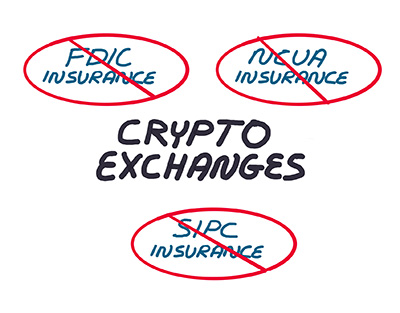
The Wall Street Journal says FTX used billions of dollars of customer money to “fund risky trades by Alameda Research.” Both FTX and Alameda were founded by Sam Bankman-Fried. The loans were unsecured. When questions arose two weeks ago about Alameda’s balance sheet, the equivalent of a bank run occurred on FTX. Compounding matters, competitor Binance quickly backed out of an offer to buy FTX, and Bankman-Fried tweeted, “I [screwed] up, and should have done better.”
In a court filing today, new FTX CEO John Ray wrote, “Never in my career have I seen such a complete failure of corporate controls and such a complete absence of trustworthy financial information as occurred here.” Ray previously oversaw Enron’s bankruptcy.
The full magnitude of the fallout in the cryptocurrency space remains to be seen. Cryptocurrency lenders BlockFi and Genesis are reported to be filing for bankruptcy. Fellow cryptocurrency lender SALT sent out an email on Tuesday saying that it has paused withdrawals, according to The Wall Street Journal.
When we discussed cryptocurrency exchanges in the August 2022 AAII Journal (“How to Buy, Sell and Store Cryptocurrency” by Steven Ehrlich), FTX was assigned the lowest ranking for “jurisdiction.” FTX was also just one of two exchanges that didn’t have a high regulation ranking from Forbes.
If you don’t own cryptocurrency or invest in cryptocurrency-related securities/exchange-traded funds, you’re not going to be affected by this debacle. It should, however, serve as a reminder of the importance of paying attention to where you place your assets. Bank, credit union and brokerage accounts should fall under the respective FDIC, NCUA and SIPC umbrellas.
FDIC deposit insurance covers checking, savings and money market deposit accounts as well as certificates of deposit (CDs) and other similar bank products. The standard insurance amount is “$250,000 per depositor, per insured bank, for each account ownership category.” Keep in mind that not all bank-like products are FDIC-insured—especially those offering surprisingly high yields—so be sure to check. FDIC insurance protects you against an insured bank failing.
The National Credit Union Share Insurance Fund (NCUSIF), managed by the NCUA, covers single accounts such as “regular shares, share drafts (similar to checking), money market accounts, and share certificates.” These credit union accounts are insured up to “$250,000 per share owner, per insured credit union, for each account ownership category.” NCUSIF protects you against an insured credit union failing.
SIPC insurance covers brokerage accounts and protects against the loss of cash and securities (excluding currencies, commodity futures contracts or warrants) at a financially troubled or failed broker. It provides protection of “$500,000, which includes a $250,000 limit for cash.” This protection seeks to restore securities and cash missing from a failed broker—not any decline in the value of those securities.
None of these apply to cryptocurrency exchanges. Furthermore, not all financial institutions are covered by the FDIC, NCUA or SIPC. Always check before opening an account and be aware of the limitations. It’s equally important to realize that if you open an account with an institution located outside of the U.S. (FTX is located in the Bahamas), you may also forfeit certain legal protections or otherwise have more difficulty recouping your money should a failure occur.

-
Are You Protected If Your Broker Goes Bankrupt?
For most investors, there are several layers of protection to keep your assets from disappearing in the event of a broker liquidation.
-
How to Buy, Sell and Store Cryptocurrency
A guide to the decision-making process when choosing a provider for trading cryptocurrency.
-
Index Fund Options for AAII’s Asset Allocation Models
While we use Vanguard funds for tracking purposes, they are not the only option when using the allocation models as a guideline for your own portfolio.
-
A Sample Pack of Stocks That May Benefit From the Holiday Season
With the holidays right around the corner, this month’s First Cut highlights stocks from the retail, food and transportation industries.
-
Online Exclusive: What to Know About Single-Stock ETFs
The new single-stock ETFs carry unique risks and are only meant for sophisticated investors who are active traders.
Members are looking for your input. Can you help with this question from the Income Investing Community?
“AAII recently posted an article, ‘Tips About Treasury Inflation-Protected Securities’ discussing the use of TIPS to protect against inflation. How many people have used TIPS before and how have you included them in your own investment strategy?”
Tap the button and then choose the Join the Community button on the right to answer this question in the AAII Community.
Answer This Question in the AAII Community »
AAII Sentiment Survey
Optimism among individual investors about the short-term direction of the stock market jumped to a new 2022 high in the latest AAII Sentiment Survey. Pessimism pulled back following last week’s big jump, and neutral sentiment declined.
Bullish sentiment, expectations that stock prices will rise over the next six months, jumped 8.4 percentage points to 33.5%. Optimism was last higher on December 30, 2021 (37.7%). Even with the big increase, bullish sentiment remains below its historical average of 37.5% for the 46th consecutive week.
Neutral sentiment, expectations that stock prices will stay essentially unchanged over the next six months, declined by 1.5 percentage points to 26.3%. The pullback keeps neutral sentiment below its historical average of 31.5% for the 27th time in 30 weeks.
Bearish sentiment, expectations that stock prices will fall over the next six months, fell by 6.8 percentage points to 40.2%. Pessimism is above its historical average of 31.0% for the 49th time out of the past 52 weeks.
The bull-bear spread (bullish minus bearish sentiment) is –6.8%.
All three sentiment indicators and the bull-bear spread are within their typical historical ranges. The historical average for bullish sentiment has been lowered from 38.0% to 37.5%, while the historical average for bearish sentiment has been raised from 30.5% to 31.0%.
The rebound in stock prices, including Thursday’s big jump, has caused some individual investors to be more upbeat about the short-term prospects for stocks. Nonetheless, this year’s volatility in the major stock indexes along with inflation, corporate earnings and increased chatter about the possibility of a recession continue to cause many investors to have a cautious outlook.
Bullish: 33.5%, up 8.4 points
Neutral: 26.3%, down 1.5 points
Bearish: 40.2%, down 6.8 points
Bullish: 37.5%
Neutral: 31.5%
Bearish: 31.0%
See more Sentiment Survey results.

November 10, 2022 Monitoring My Portfolio During a Volatile Market
November 3, 2022 Investment Horror Tales and Their Lessons
October 27, 2022 Introducing AAII's Growth Investing Newsletter
October 20, 2022 Sustainable Growth Stocks and How to Find Them

Discussion
Monk Monk from Texas posted over 3 years ago:
It is rather curious that Charles called those FTX customers "investors". Speculators or gamblers would be a more apt term. Crypto-currency does not generate income, does not entail activities that benefit society like creating jobs or building factories. It is an enormous conversion of energy resources into some encrypted records and tons of CO2 in the process, harming the environment and wasting otherwise resources that could be put for more beneficial use. The manifesto called it an alternative currency that doesn't suffer from central bank debasements and its limited supply combats inflation. Well, how did that work out? Its value went up with currency debasement and it plummeted during inflation. It is about time that AAAI does a better job of alerting its members to the chicaneries and the bull excrements that come with this fraud, regardless of which broker did this or that.
Jonathan Silverberg from NY posted over 3 years ago:
"What he said!" I couldn't agree more with Monk Monk.
Barry from TX posted over 3 years ago:
The Monk Monk speaks with the timeless ancient wisdom of the Sphinx. Crypto is a trifecta in immorality – it lacks logos (logic), ethos (trust), and pathos (sympathy). Charles’ advice is reasoned and practical. There is much more “systemic” risk in “outlaw” speculation than in regulated investing processes. Crypto markets are uninsurable for a reason. The crypto cheerleaders were arrogant, boastful, and conceited in their “Holier Than Thou” Louis XVI “Je Suis ROI” (“I am king") self-promoting stances. They earned a similar Fate. Like Monk Monk, I speculate as to the culpability of the regulated brokers – and other unregulated investment industry “entities” -- that offered and/or promoted crypto as a way to “diversify” a portfolio … when they could have easily calculated a risk/reward ratio far out on the right “fat tail” between 5 to 10 betas. Their calculations were right. The return on their “fiduciary responsibility/profit motive” (“F/P”) ratio was far out on the left “fat tail” closer to 0.1 alpha. The lesson is enduring and perpetually recurring among “greater, greedy fools.”
JD from IN posted over 3 years ago:
I'm with Monk Monk and the rest of you. The words "cryptocurrency" and "investor" should never be used in the same sentence. Purchasing cryptocurrency is pure speculation. I'm not against speculation. I do it myself from time to time (but not with crypto). But I don't fool myself into thinking I'm investing when I do it. The fate of those that have put their money in FTX and other failed, unregulated crypto "exchanges" is in line with the old saying "A fool and his money are soon parted."
Barry from TX posted over 3 years ago:
Update I opened my email and found this gift. One of the investing media industry giants, Jason Zweig of WSJ I regularly follow echoes the above AAI member sentiments. You may want to read his article in today's WSJ entitled "Why the Investing Pros Were Such Suckers for FTX" @ https://www.wsj.com/articles/ftx-investors-due-diligence-11668736585?mod=djintinvestor_t
Hank F from FL posted over 3 years ago:
Ah, yes! 20/20 hindsight is very wise.
Harry from Kentucky posted over 3 years ago:
When reading this article I was reminded of the oldest financial company in the US; Lehman Brothers bankruptcy. Plenty of controls in place but still bankrupt!!!
Barry from TX posted over 3 years ago:
The experiences of the investors in the cryptocurrency market remind me of "the journey" of the archetypal "Hero" memorialized in the mythology found in almost all civilizations. Joseph Campbell described this "journey" in "The Hero with a Thousand Faces" (1949). Go to wikipedia.com or Google the author or title for more info. The fundamental structure of a "Hero's Journey" is: (1) The Call to Adventure. (Our "Hero" has Vision: "Everybody is doing it. Sounds like fun. I am gonna get soooo rich, soooo soon!") (2) The Hero accepts or declines the Call. (Everybody is getting rich. Buy crypto? "This was so easy. I wonder why everyone else is not doing this?") (3) The Hero's Road of Trials, where the Hero succeeds or fails. (The crypto "hero" experiences the daily euphoria and panic of the crypto market.) (4) Achieving the "Boon," where the crypto Hero acquires self-knowledge, (The crypto "Hero" learns about markets and themselves from their experience.) (5) Return to the "ordinary" world, where our crypto "Hero" can succeed or fail using the new knowledge, (Our "Hero" understands investing risk firsthand.) (6) Application of the "Boon." (Our crypto "Hero" uses the crypto lessons learned to invest in normal markets using the PRISM process ... and prospers.) You can explain the plot of almost every Indiana Jones movie with this outline. Many script writers use this methodology as the basic structure of the plot.
Dick B from FL posted over 3 years ago:
The three "insurance and regulations" you promote are all set aside by the Dodd Frank and Dodd Frank 2 Acts! We have no protection or assurance except on a small or very limited basis. Why not explain that the three 'services' you point up is and can be used against us as bad or more dangerous than not having regulations. The big picture reveals that the individual 'investor' must be willing to stand on his own due diligence and accept the out come. Not look for deep pockets elsewhere to cover what others do to him..Don't be a ninny.. You probably didn't work for the funds you are playing with.... Otherwise don't play.
You need to log in as a registered AAII user before commenting.
Create an account