

Introducing AAII's Growth Investing Newsletter
by Jack Gilleland | October 27, 2022

Special note: My colleague Jack Gilleland is going to introduce you to AAII Growth Investing, which has just launched. It seeks out attractive stocks with sustainable rates of growth.
—Charles Rotblut, CFA
Though the stock market is volatile over the short term, investors who continuously follow evidence-based strategies are more successful at building long-term wealth than those who don’t. One such strategy is the AAII Growth Investing strategy. As the name suggests, AAII Growth Investing provides analysis that can help identify sustainable growth opportunities.
As we approach the official launch of AAII Growth Investing on November 1, 2022, we wanted to provide a deeper look into what this premium service is and how it can benefit members to help them reach their investment goals.
Identifying and Analyzing Attractive Growth Stocks
Inside the Growth Investing website, there are several features to help guide you on your search for growth.
The model portfolio invests in stocks that pass the Growth Investing strategy criteria. Once the portfolio is fully populated, it will hold 20 stocks. The addition and deletion criteria are listed on the website to help you learn from the strategy. Though alerts can be sent out on any weekday, model portfolio actions will not occur until at least the next trading day after the alert, giving you time to act first.
The AAII Growth Investing Ideas list shows the stocks meeting the strategy’s initial addition criteria. This is the same list of companies used to select new stocks for the model portfolio. The Ideas list is updated daily. You can use it to see which stocks will be considered for addition to the model portfolio or to build your own unique portfolio of growth stocks.
Growth Investing also provides a new Growth Analyzer, a tool that allows any stock ticker to be analyzed on the criteria used for the model portfolio.
With thousands of stocks in the investing universe, it can be difficult to find a starting point. Whether you want to analyze a stock that you are currently interested in or dive deeper into a company from the Ideas list, the Growth Analyzer is a great tool to utilize.
Once you start analyzing by entering a ticker, you’ll be presented with numerous data points and reports.
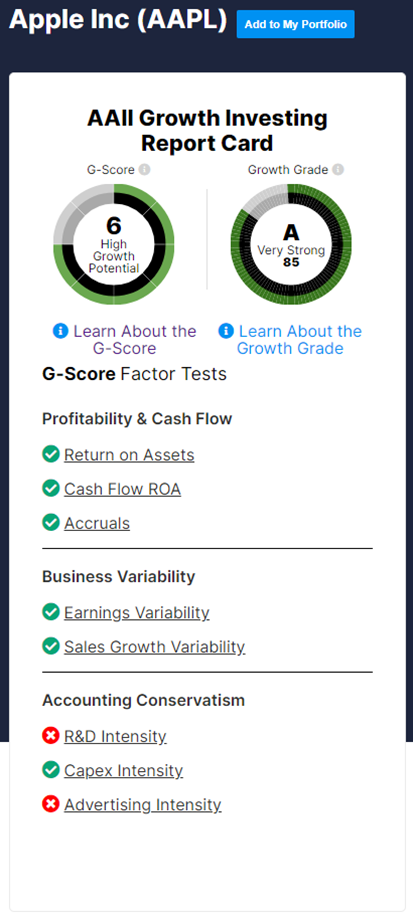
The Report Card on the Growth Analyzer page gives a high-level overview of how the stock you are evaluating measures up against the Growth Investing scoring criteria. You can view the G-Score and Growth Grade along with links in the list of G-Score factors to see an analysis of the components that go into the G-Score.
As you scroll down the Analyzer page, you’ll see an in-depth explanation of each component of the Growth Grade and G-Score. This is where you can learn more about how a stock stacks up compared to the Growth Investing criteria.
The breakdown of the individual components that comprise the Growth Grade and G-Score help you understand whether this company has sustainable growth or is more of a “glamour” stock. You find out why the stock passes or does not pass the Growth Investing criteria as well as what you can do with this information to make confident investment decisions.
For information on how you can become a charter subscriber to AAII Growth Investing, click here.

-
Emerging Markets Funds Offer Diversification Plus Growth
A look at what’s on offer in the realm of diversified emerging markets mutual funds and ETFs. -
Uncovering Consistent & Sustainable Growth With the Revised Growth Grade
How we built a better grade to help members identify promising growth stocks. Learn about its key components. -
Why I Bonds Have Appeal When Inflation Is Rising
With part of its interest rate based on the rate of inflation, Series I savings bonds might be worth a look in the current environment. -
Simple Guidelines for Finding the Funds That Fit Your Needs
How to decide which funds are right for you. Plus, which AAII tools and resources can make your decision a cinch. -
I watched this so you don’t have to! Damon Dominique’s Finance Masterclass
Anine Sus launches a new series to provide reviews of long-form video content in her latest My Investing Discoveries blog post.
Members are looking for your input. Can you help with this question from the Allocation Strategies Community?
“Ahead of the Halloween weekend, I wanted to ask what your worst investment decision or experience has been. I think there is a lot to learn from others’ investment horror stories since all of us have been there at some point during our lifetime. If you haven’t had one per se, but you know of someone who has, feel free to share their spooky story.”
Tap the button and then choose the Join the Community button on the right to answer this question in the AAII Community.
Answer This Question in the AAII Community »
AAII Sentiment Survey
Optimism among individual investors about the short-term direction of the stock market rose to a nine-week high in the latest AAII Sentiment Survey. At the same time, pessimism plunged to a nine-week low.
Bullish sentiment, expectations that stock prices will rise over the next six months, increased by 4.0 percentage points to 26.6%. Optimism was last higher on August 25, 2022 (27.7%). Even with the increase, bullish sentiment remains below its historical average of 38.0% for the 49th consecutive week. It is also unusually low for the ninth consecutive week and the 32nd time in 43 weeks. The breakpoint between typical and unusually low readings is currently 27.6%.
Neutral sentiment, expectations that stock prices will stay essentially unchanged over the next six months, jumped 6.6 percentage points to 27.7%. This is a six-week high. Nonetheless, neutral sentiment is below its historical average of 31.5% for the 25th time in 27 weeks.
Bearish sentiment, expectations that stock prices will fall over the next six months, fell 10.6 percentage points to 45.7%. Pessimism was last lower on August 25, 2022 (42.4%). Bearish sentiment is above its historical average of 30.5% for the 48th time out of the past 49 weeks. It is also at an unusually high level for the 33rd time out of the last 41 weeks. The breakpoint between typical and unusually high readings is currently 40.7%.
The bull-bear spread (bullish minus bearish sentiment) is –19.1% and is unusually low for the 32nd time in 40 weeks. The breakpoint between typical and unusually low readings is currently –11.4%.
Historically, the S&P 500 index has gone on to realize above-average and above-median returns during the six- and 12-month periods following unusually low readings for bullish sentiment and the bull-bear spread. Unusually high bearish sentiment readings historically have also been followed by above-average and above-median six-month returns in the S&P 500.
October’s rebound in the major stock indexes has helped to boost bullish sentiment from its recent lows. However, individual investors’ short-term expectations are still being influenced by continued volatility in the major stock indexes along with inflation, corporate earnings and increased chatter about the possibility of a recession. Also influencing sentiment are monetary policy, politics and the ongoing invasion of Ukraine by Russia.
Bullish: 26.6%, up 4.0 points
Neutral: 27.7%, up 6.6 points
Bearish: 45.7%, down 10.6 points
Bullish: 38.0%
Neutral: 31.5%
Bearish: 30.5%
See more Sentiment Survey results.

October 20, 2022 Sustainable Growth Stocks and How to Find Them
October 13, 2022 Plans and Rules Work for Both Marathons and Investing
October 6, 2022 September Added to an Already Volatile Year
September 29, 2022 The Upsides of High Inflation

Discussion
John L from NJ posted over 3 years ago:
I could not agree more that "investors who continuously follow evidence-based strategies are more successful at building long-term wealth than those who don’t". However, some evidence based strategies are better than others. Buying an index fund with low costs is almost guaranteed to result in market returns less the low costs. With this new growth newsletter you have the promise of beating the market but no guarantee. And we know beating the index is tough as approximately 90% of active mutual fund managers fall short of their bench mark index over the long term. Does the AAII have a track record of market beating newsletters? Where is the evidence of this skill and ability. If these guys were that good they would be running money rather than selling newsletters. As dirty Harry said "Are you feeling lucky".
Charles Rotblut from Illinois posted over 3 years ago:
Hi John,
While broad-based index funds are an effective and inexpensive way to get exposure to the stock market, we believe individual investors have the ability to outperform the market using evidenced-based and rules-based active strategies too. Our Model Shadow Stock portfolio is proof of this. Since its inception in 1993, it has realized an annualized return of 13.1% versus 9.3% for the Vanguard S&P 500 fund. Our Stock Superstars Portfolio, which was started in 2002, has annualized return of 8.2% versus 8.0% for iShares Dow Jones U.S. ETF.
Regarding the Growth newsletter, not only has Wayne incorporated academic research into what works for growth stock strategies, he's also using metrics that have an economic reason to suggest a stock should outperform. These include avoiding companies with unsustainably high rates of growth and seeking those with signs of underlying fundamental strength.
Hope this helps,
Charles
John L from NJ posted over 3 years ago:
Hi Charles, The Model Shadow Stock portfolio is a success. But it is not fair to compare it to the S&P 500 which has a much higher average capitalization. The Stock Superstars Portfolio at 8.2% versus the 8.0% iShares Dow Jones is a push. To fairly judge the AAII's ability to beat the market we need to know the performance of all the other AAII newsletters like VMQ! Or the passive level three portfolio that was recently abandoned. Or the growth grade that needed to be revised. As I understand it; the mission of the AAII includes educating members about investing. Simple passive index funds are really difficult to beat. Even Warren Buffet advises most investors to use index funds. It might be time for you to write an article about how difficult it is to beat index funds and how even some AAII attempts have failed. New members need to be informed about just how tough beating the market can be; before they try. Some individuals might have the ability to beat the market but most don't. Now concerning the new growth newsletter. Back testing and academic research don't have a good record of investing success. You might remember Long Term Capital Management. Wayne no doubt has done a good job of incorporating academic research. But academic research is flawed because it is widely known. And the only way to beat the market is to know something others don't. John
You need to log in as a registered AAII user before commenting.
Create an account