

Investment Horror Tales and Their Lessons
by Charles Rotblut | November 03, 2022
Featured Tickers: EQAL
MSFT
EQAL
MSFT
Heading into Halloween, we asked AAII members to share their spooky investing horror stories in the AAII Community. Several members answered our request with their personal tales. As a fan of horror movies (suspenseful, not slasher), I’m going to share some of those stories.
Before I do, I’m going to tell you a ghoulish story of my own.
During the dot-com bubble, I bought a technology stock a couple of days before Thanksgiving. It soared in value right after I bought it. I recall that it at least doubled in value, possibly much more. I don’t remember the company’s name or the stock’s ticker symbol, but I do remember speaking to my father about it. He suggested on the day after Thanksgiving that I should consider taking profits.
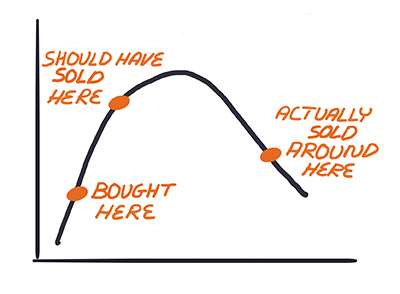 My response as a still relatively new investor who had yet to live through a bear market was that I thought the upward momentum would continue into the following week. What I wasn’t consciously admitting to at the time was my brain’s overconfidence in its ability to know when to get out of the stock.
On the following Monday morning, my boss at the time called me into his office to discuss a project we were working on. This was just as the market opened. It was a lengthy meeting too—nothing bad, just long. When the meeting finished, I walked back to my desk and my coworker gave me a look as I was logging into my brokerage account. The stock was in the midst of a steep decline. Yes, I should have listened to Dad.
I still managed to sell the stock at a profit, but nowhere near what I should have walked away with. I confused skill with luck.
It was a good, though costly, lesson relative to what I had saved at the time. While I’ll admit to overcorrecting in response to this after many years of investing, I still lock in a partial profit if a stock I personally own makes a very large upward move after purchase. Those profits are then immediately invested into a broad market exchange-traded fund (ETF), typically the Invesco Russell 1000 Equal Weight ETF  (EQAL).
Does this result in some profit being left on the table? Yes, it can if the stock’s underlying valuation and fundamentals are still good. But it also helps me sleep at night knowing that I recognized good luck when it occurred and didn’t unnecessarily push it.
For more tales of investing horror, here are some of the investment stories AAII members shared:
- Buying a “no-commission” investment back when it “cost an arm and a leg to do a trade.” The investment “became worthless in very little time.”
-
Missing out on the chance to buy Microsoft Corp. (MSFT) when it first went public because the “broker had no idea about” Microsoft’s initial public offering (IPO).
- Being talked out of buying shares in Chrysler Corp. right after the federal government had announced its intention to bail out the car company in 1979. The broker “essentially said it would be a stupid move.” Shares of Chrysler “more than tripled … within a little more than a year.”
- Investing in silver after “reading a book by Jerome Smith that said silver was poised for another big rise.” The book made the case that silver was going to rise based on its past cyclical patterns. “Silly me for believing him,” wrote the member.

-
How Investors Can Overcome Emotional and Social Biases
Though biases are ingrained in our emotional psyche, the really great investors follow strict investment disciplines to reduce the impact of their emotions. -
The Danger of Getting Out of Stocks During Bear Markets
Panicking and pulling out of stocks during turbulent market conditions can have a significant and lasting negative impact on your wealth. -
The Platinum 30: Choice Stocks From AAII’s Five Model Portfolios
The Platinum 30 is presented to show a sample of stocks held in each model portfolio with currently attractive grades. -
The Benefits of Combining Value & Momentum
Research provides evidence that combining value and momentum strategies offers investors the opportunity to achieve higher rates of return with lower risk than would be achieved with either strategy individually. -
Most Mutual Funds and ETFs Bleed Red in the Third Quarter
There is probably little cause for joy initially in reviewing the third-quarter performance results for exchange-traded funds (ETFs) and mutual funds across most asset types.
AAII Sentiment Survey
Pessimism about the short-term direction of the stock market among individual investors plunged to its lowest level in more than seven months. The latest AAII Sentiment Survey also shows a large increase in neutral sentiment.
Bullish sentiment, expectations that stock prices will rise over the next six months, increased by 4.0 percentage points to 30.6%. Optimism was last higher on August 18, 2022 (33.3%). Even with the increase, bullish sentiment remains below its historical average of 38.0% for the 50th consecutive week.
Neutral sentiment, expectations that stock prices will stay essentially unchanged over the next six months, jumped 8.8 percentage points to 36.5%. Neutral sentiment was last higher on April 21, 2022 (37.3%). This week’s rise puts neutral sentiment above its historical average of 31.5% for just the third time in 28 weeks.
Bearish sentiment, expectations that stock prices will fall over the next six months, fell 12.8 percentage points to 32.9%. Pessimism was last lower on March 31, 2022 (27.5%). Even with the drop, bearish sentiment remains above its historical average of 30.5% for the 49th time out of the past 50 weeks.
The bull-bear spread (bullish minus bearish sentiment) is –2.3%. It was last higher on March 31, 2022, at 4.3%.
At current levels, all three sentiment indicators and the bull-bear spread are within their typical historical ranges. The last time this occurred was on August 18, 2022.
Most of the results for this week’s survey were recorded prior to yesterday’s rate hike announcement and Federal Reserve chairman Jerome Powell’s press conference.
The rebound in the major stock indexes has helped to improve sentiment. However, individual investors’ short-term expectations are still being influenced by continued volatility in the major stock indexes along with inflation, corporate earnings and increased chatter about the possibility of a recession. Also influencing sentiment are monetary policy, politics and the ongoing invasion of Ukraine by Russia.
Bullish: 30.6%, up 4.0 points
Neutral: 36.5%, up 8.8 points
Bearish: 32.9%, down 12.8 points
Bullish: 38.0%
Neutral: 31.5%
Bearish: 30.5%
See more Sentiment Survey results.

AAII Asset Allocation Survey
Cash as a percentage of individual investors’ portfolios rose to its highest level in over two and a half years last month. The October AAII Asset Allocation Survey also shows equity and fixed-income allocations falling.
Stock and stock fund allocations declined by 1.8 percentage points to 61.6%. Allocations to stocks and stock funds were last lower in May 2020 (60.8%). Even with the decrease, equity exposure remains above the historical average of 61.5% for the 29th consecutive month.
Bond and bond fund allocations pulled back by 1.0 percentage points to 13.7%. Bond and bond fund allocations are below their historical average of 16.0% for the 20th consecutive month.
Cash allocations jumped by 2.8 percentage points to 24.7%. Cash allocations were last higher in March 2020 (26.1%). This is also the first time in 30 months that cash allocations are above their historical average of 22.5%.
Optimism about the short-term direction of the stock market continued to be unusually low throughout October. At the same, the prospect of further aggressive rate hikes by the Federal Reserve loomed over the bond market.
- Stocks and Stock Funds: 61.6%, down 1.8 percentage points
- Bonds and Bond Funds: 13.7%, down 1.1 percentage points
- Cash: 24.7%, up 2.8 percentage points
- Stocks: 30.1%, up 0.2 percentage points
- Stocks Funds: 31.6%, down 1.9 percentage points
- Bonds: 3.6%, up 0.2 percentage points
- Bond Funds: 10.1%, down 1.3 percentage points
- Stocks/Stock Funds: 62.0%
- Bonds/Bond Funds: 16.0%
- Cash: 22.0%
Take the Asset Allocation Survey.
October 27, 2022 Introducing AAII's Growth Investing Newsletter
October 20, 2022 Sustainable Growth Stocks and How to Find Them
October 13, 2022 Plans and Rules Work for Both Marathons and Investing
October 6, 2022 September Added to an Already Volatile Year

Discussion
Craig BORGARDT from Wisconsin posted over 3 years ago:
Some years ago regional airline Midwest Express was experiencing financial woes and fell to $2.60/share. A local talk show host commented that Book Value was then around $7 and that he bought a few thousand shares, warning that he was NOT giving investment advice. I bought 5,000 shares and set a Sell Point at $6.50. It went to $6 and held there for a week, suddenly plunging back to $4. I vowed to sell at $5 and a week later sold at $4.95. About a week later it was announced that there was a tender for the company stock at $14.50. It ended up being acquired at $16+ and while I had almost a 'Two Bagger' I was heartsick not waiting for "The Big One". Learned the lesson about insider information AND investing for the long term. No more short term trading for me.
John Kindig from Florida posted over 3 years ago:
I have made my share of investing mistakes over the past 50+ years. I always remember the quote from Warren Buffett: "It is good to learn from your investing mistakes. It is even better to learn from the investing mistakes of others". He has made several mistakes, but his investing record puts him at the top of all investors in my lifetime. He is in the hall of fame. I am still in the game & remain financially secure.
Barry from TX posted over 3 years ago:
The stock market is such a happy place. Every transaction makes someone happy.
You need to log in as a registered AAII user before commenting.
Create an account