

History Cautions That Keurig Dr Pepper Spin-Off Returns Could Fizzle
by Charles Rotblut | August 28, 2025
Featured Tickers: CSD
IWV
CSD
IWV
JDEPY
KDP
Warren Buffett has long criticized the machinations of investment bankers, particularly the fees they earn from deals. Buffett is likely rolling his eyes again.
On Monday, Keurig Dr Pepper Inc.  (KDP) announced its intention to acquire JDE Peet’s N.V. (JDEPY), which owns Peet’s Coffee. Once the acquisition is completed, the merged company will split into two parts: Global Coffee Co. and Beverage Co. The planned breakup will end a corporate marriage between Keurig and Dr Pepper that started in 2018.
 Keurig Dr Pepper claims this move will benefit shareholders. Whether it actually will is a big question mark. The data I found on corporate spin-offs paints an inconclusive picture regarding returns. But first let’s look at an exchange-traded fund (ETF) that invests in spin-offs before discussing the academic research.
The Invesco S&P Spin-Off ETF (CSD) tracks the S&P U.S. Spin-Off index. This index tracks U.S. companies that have been spun off from a parent company within the last four years. Such companies must have a float-adjusted market capitalization of $1 billion. (Float refers to shares that are available for trading.)
Through July 31, 2025, Invesco S&P Spin-Off has a five-year annualized return of 17.7%, versus 15.0% for the broader market index iShares Russell 3000 ETF (IWV). Invesco S&P Spin-Off lags iShares Russell 3000 on a 10-year annualized basis: 7.7% versus 12.8%, respectively.
A 2023 review of 89 studies on spin-offs published between 1976 and 2021 found mixed results. Spin-offs created wealth for shareholders around the date when the corporate splits were announced. “With regard to the long-term performance of spin-offs, there is inconclusiveness,” wrote the review’s authors. “While some studies claim that spin-offs result in the long-run outperformance of the concerned entities’ stocks … others rule out this statement by not finding any evidence in its support.”
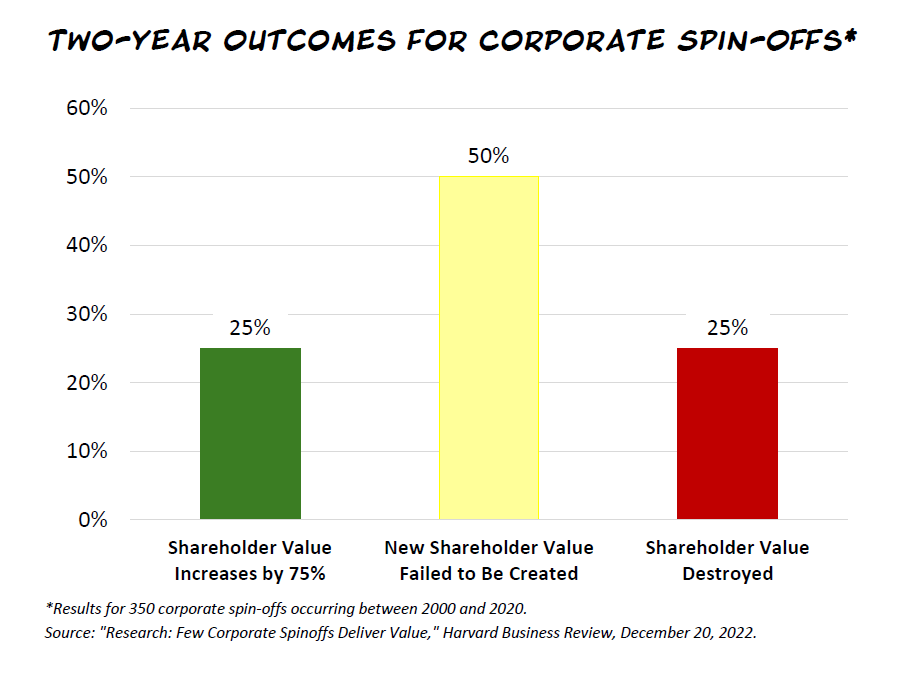
Three partners at consultancy firm Bain & Co. Inc. looked at more than 350 spin-offs valued at over $1 billion between 2000 and 2020. They found “the average separation delivered as little as a 5% increase in combined market cap two years after spinning off.” Worse yet, 25% of spin-offs destroyed “a significant amount of shareholder value in the process.” Yikes!
There were big winners too. The corporate separations ranking in the top 25% of returns realized a 75% increase in market cap. What set these companies apart was “the existence of a clear and robust separation thesis.” Such theses specify the value each company will create (e.g., annual growth metrics), financial targets and clear separation lines between split companies.
Determining whether any spin-off is a good investment opportunity requires going through company presentations and filings with the U.S. Securities and Exchange Commission (SEC). While such work may be rewarded, you will also find yourself saying “pass” quite often.

-
Capital Pains: Rules for Capital Losses
The tax code limits the deduction that can be taken for net capital losses, but it also allows losses to be offset by gains from assets other than investment securities. -
AI for Financial Document Analysis: Your Net in a Sea of Information
Quickly processing news and reports with AI tools allows your finite attention to focus on interpretation and decision-making. -
Using the Arms Index (TRIN) for Market Breadth Analysis
The August 2025 AAII Journal explains why the most reliable signals occur when extreme TRIN readings align with other technical indicators and happen during high-volume sessions.
AAII Sentiment Survey
Pessimism among individual investors about the short-term outlook for stocks decreased in the latest AAII Sentiment Survey. Meanwhile, optimism and neutral sentiment increased.
Bullish sentiment, expectations that stock prices will rise over the next six months, increased 3.8 percentage points to 34.6%. Bullish sentiment is below its historical average of 37.5% for the fifth time in nine weeks.
Neutral sentiment, expectations that stock prices will stay essentially unchanged over the next six months, increased 1.6 percentage points to 26.0%. Neutral sentiment is below its historical average of 31.5% for the 58th time in 60 weeks.
Bearish sentiment, expectations that stock prices will fall over the next six months, decreased 5.4 percentage points to 39.4%. Bearish sentiment is above its historical average of 31.0% for the 39th time in 41 weeks.
The bull-bear spread (bullish minus bearish sentiment) increased 9.1 percentage points to –4.8%. The bull-bear spread is below its historical average of 6.5% for the 28th time in 30 weeks.
This week’s special question asked AAII members how their sentiment toward the stock market has changed since the start of the year.
Here is how they responded:
- I’ve become more bearish: 32.1%
- I’ve become more cautious, but not bearish: 33.3%
- It is about the same: 18.7%
- I’ve become more bullish: 15.5%
Bullish: 34.6%, up 3.8 points
Neutral: 26.0%, up 1.6 points
Bearish: 39.4%, down 5.4 points
Bullish: 37.5%
Neutral: 31.5%
Bearish: 31.0%
See more Sentiment Survey results.

August 21, 2025 August Charts of Interest: Valuations at Dot-Com Bubble Levels
August 14, 2025 Why Private Investments Don't Belong in 401(k) Accounts
August 7, 2025 Four Metrics for Identifying Risky Dividend Stocks
July 31, 2025 The Key OBBB Act Tax Changes for Individual Investors

Discussion
No comments have been added yet. Add your thoughts to the discussion!
You need to log in as a registered AAII user before commenting.
Create an account