

Five Concepts Financially Literate Investors Understand
by Charles Rotblut | April 04, 2019
 April is National Financial Literacy Month. As part of our participation, I’m going to discuss five key concepts that tie into the world of investing. They will serve as good reminders for those of you who are already familiar with them and help those of you who aren’t as familiar. If you know someone who can benefit from being exposed to these concepts, please share this week’s commentary with them.
1. Time and Compounding Are a Saver’s Friend—The best way to grow wealth is to invest savings for a long period of time. A $1,000 investment earning a 10% annualized return will grow to $1,100 if invested for just one year. Keep the amount invested for seven years, and it will grow to nearly $1,950. Double the period to 14 years and the balance will reach nearly $3,800. This growth occurs because returns are realized on previous gains in addition to the starting balance. A simple rule for calculating how long it will take to double a sum of money is to divide 72 by the rate of return (e.g., 72/10 = 7.2 years to double a sum of money given a 10% return).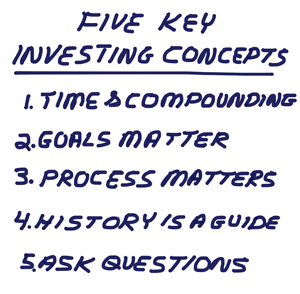
2. Think in Terms of Goals—One of the biggest advantages individual investors have is never having to report their performance. This allows us to make decisions based on our goals (funding retirement, paying for a child’s or grandchild’s college, etc.) rather than based on how our portfolios performed during a given month, quarter or year. We can afford to incur periods of underperformance if doing so means higher longer-term returns and a greater probability of achieving our goals. In contrast, professional money managers are often hired and fired based on three-year performance—a scenario that leads to short-term-performance chasing and reduces long-term returns.
3. Process Matters More Than Returns—You have no control over whether your investments will rise or fall in price. What you can control is how much you save, how you allocate and how to decide what to buy and sell. Establishing a systematic process for all three controls based on research about what has been shown to work over the long term will greatly increase the odds of achieving your goals. Focusing on and reacting to the headlines of the day will not. In investing, discipline matters greatly.
4. History Is a Useful Guide—While history doesn’t fully repeat, there are often enough similarities between now and the past to draw useful analogies and guidelines. Having the ability to apply past lessons to the future can help you to control emotions, look past the noise, put downturns into perspective and even identify potential opportunities when they appear.
5. Ask Questions—This seemingly simple concept is a very powerful one. Asking questions can protect you against scammers, unravel “advisers” who don’t fully understand the products and services they are pushing and identify risks and potential pitfalls that may not be initially apparent. Asking questions will also increase your level of knowledge, helping you to become a better investor.
#FinancialLiteracyMonth #FinLitMonth

-
The Impact of Saving Versus Return on Wealth – Time matters, with younger investors getting more benefit from the power of compounding, while older investors benefit more from increasing how much they set aside.
-
The Financial Literacy Quiz That Many Retirees Flunked – Want to find out how financially literate you are? Take the quiz linked at the bottom of this article.
The percentage of individual investors describing their outlook for stock prices as “neutral” pulled back after hitting its second-highest level of the year last week. This week’s AAII Sentiment Survey also shows small increases in optimism and pessimism.
Bullish sentiment, expectations that stock prices will rise over the next six months, rose 1.8 percentage points to 35.0%. Optimism is below its historical average of 38.5% for the fifth consecutive week.
Neutral sentiment, expectations that stock prices will stay essentially unchanged over the next six months, declined 2.9 percentage points to 36.7%. The small drop extends the streak of range-bound readings (35.3% to 39.8%) to 10 consecutive weeks. Neutral sentiment is also above its historical average of 31.0% for the 11th time in 13 weeks.
Bearish sentiment, expectations that stock prices will fall over the next six months, rose 1.1 percentage points to 28.3%. This is the eighth time in nine weeks that pessimism is below its historical average of 30.5%.
At current levels, all three indicators are within their typical historical ranges.
This year’s rebound in stock prices has encouraged some individual investors, though others have concerns about its sustainability. Many individual investors are monitoring trade negotiations, though the impact varies by investor. Also having an influence are Washington politics (including President Trump and Democratic control of the House of Representatives), corporate earnings, the Federal Reserve, valuations and concerns about the pace of economic growth.
This week’s special question asked AAII members for their thoughts about Lyft and Uber going public. Nearly two-thirds of respondents (65%) say they would avoid investing in either company. Reasons included the lack of profitability, a general avoidance of initial public offerings (IPOs), not closely following either company, the lack of profitability and both driver and passenger safety issues. Nearly 13% think the stocks could eventually turn out to be profitable investments or otherwise think it was a good idea for the companies to go public. About 4% express concerns that these IPOs could be a sign of the market approaching a top.
Here is a sampling of the responses:
- “I think it is a little too early for both as they still have major issues with their culture and the security of their passengers.”
- “I think it is way too soon for both. They are losing way too much money and it is not clear to me that either will ever be profitable.”
- “They are great concepts; however, I would not buy the IPOs or the stocks until a later date.”
- “They are going to do very well. They are good businesses.”
- “I don’t invest in unprofitable companies.”

Bullish: 35.0%, up 1.8 points
Neutral: 36.7%, down 2.9 points
Bearish: 28.3%, up 1.1 points
Bullish: 38.5%
Neutral: 31.0%
Bearish: 30.5%
AAII Asset Allocation Survey
Individual investors’ exposure to fixed-income rose to a 16-month high last month. The March AAII Asset Allocation Survey also showed a small increase in cash allocations and a decrease in exposure to equities.
Stock and stock fund allocations pulled back by 1.9 percentage points to 65.4%. Even with the decline, equity allocations remained above their historical average of 61.0% for the 72nd consecutive month.
Bond and bond fund allocations rose by 1.6 percentage points to 17.4%. Fixed-income allocations were last higher in November 2017 (17.6%). Bond and bond fund allocations were above their historical average of 16.0% for the second time in three months.
Cash allocations rose 0.4 percentage points to 17.3%. Cash allocations were below their historical average of 23.0% for the 88th consecutive month.
A pullback in yields increased the value of fixed-income holdings. At the same time, optimism about the short-term direction of the stock market was largely below the levels recorded in February, though still well within the typical historical ranges. Many AAII members follow a long-term approach to investing.

March AAII Asset Allocation Survey results:
- Stocks and stock funds: 65.4%, down 1.9 percentage points
- Bonds and bond funds: 17.4%, up 1.6 percentage points
- Cash: 17.3%, up 0.4 percentage points
March AAII Asset Allocation Survey details:
- Stocks: 30.6%, down 0.5 percentage points
- Stock Funds: 34.8%, down 1.4 percentage points
- Bonds: 3.5%, up 0.7 percentage points
- Bond Funds: 13.8%, up 0.9 percentage points
Historical Averages:
- Stocks/Stock Funds: 61.0%
- Bonds/Bond Funds: 16.0%
- Cash: 23.0%
The numbers are rounded and may not add up to 100%.
The AAII Asset Allocation Survey has been conducted monthly since November 1987 and asks AAII members what percentage of their portfolios are allocated to stocks, stock funds, bonds, bond funds and cash. The survey and its results are available online at: www.aaii.com/investor-surveys.
Want to weigh in? Take the survey yourself and see results online at www.aaii.com/assetallocationsurvey
If you want to become an effective manager of your own assets and achieve your financial goals, consider a risk-free 30-day Trial AAII Membership.
- Stocks and Stock Funds: 65.4%, down 1.9 percentage points
- Bonds and Bond Funds: 17.4%, up 1.6 percentage points
- Cash: 17.3%, up 0.4 percentage points
- Stocks: 30.6%, down 0.5 percentage points
- Stocks Funds: 34.8%, down 1.4 percentage points
- Bonds: 3.5%, up 0.7 percentage points
- Bond Funds: 13.8%, up 0.9 percentage points
- Stocks/Stock Funds: 62.0%
- Bonds/Bond Funds: 16.0%
- Cash: 22.0%
Take the Asset Allocation Survey.
March 28, 2019 The Yield Curve Inverted (But Don't Fear a Recession)
March 21, 2019 Managing the Five Big Types of Investing Risk
March 14, 2019 Stock Screens Can Help You to Beat the Market
March 7, 2019 We’re Improving Our Website

Discussion
Jerome Shull from AZ posted over 7 years ago:
In the article "Five Concepts" the first concept: Time and Compounding Are a Saver’s Friend used an unrealistic 10% annual rate of return, extending it for a full ten years to demonstrate the power of compounding. Well, Mr. Rotblut can make any example he wants, but the reader will not be served very well if it is not realistic. No mention was made of the need to pay taxes along the way if the annual returns consisted, even partially, of taxable income. And no mention was made of the high probability, in any ten year period, of a year or two of low or no return or even negative return, especially if the investment was primarily owning stocks for growth. If the investment was in fixed income, what kind of risk would be in order to get ten percent annually? Jerome Shull
You need to log in as a registered AAII user before commenting.
Create an account