

Managing the Five Big Types of Investing Risk
by Charles Rotblut | March 21, 2019
My article in this month’s AAII Journal about portfolio rebalancing drew a few comments and emails about whether it makes sense to use rebalancing as a strategy. The argument against it is that you would incur higher long-term returns by not rebalancing. Strategies intended to reduce the level of price volatility will lower returns over the long term relative to strategies that don’t seek to limit it. The two represent a trade-off: To maximize long-term returns, an investor has to be willing to incur a higher level of volatility and the potential emotional reactions that come with it. If reducing the relative level of volatility in some manner is important, then an investor has to be willing to accept the possibility of potentially lower long-term returns.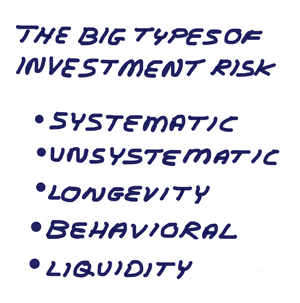
Price volatility is what many people think of when it comes to discussions of risk and investing. There are, arguably, five big types of risk investors should focus on instead. I discuss each this week and suggest ways to limit their impact.
1. Systematic Risk—Macro in nature, it is the risk incurred by simply investing in the market. Shifts in sentiment, economic trends, monetary policy, political events, wars, broad bubbles and financial crises are all types of systematic risk. The second you invest money, you become exposed to systematic risk. You can reduce its impact by diversifying across asset classes and geography.
2. Unsystematic Risk—These are risks related to what you choose to invest in. The problems with Boeing’s 737 Max 8 jets and Tesla founder Elon Musk’s ongoing back and forth with the U.S. Securities and Exchange Commission (SEC) over his tweets are good examples of unsystematic risk. (Musk’s actions are also a good example of key person risk, which contributes to unsystematic risk.) On the bond side, it can be a change (real or perceived) in an issuer’s credit quality. The choice of portfolio strategy is also a type of unsystematic risk, especially if one purposely chooses to deviate from a market portfolio. Diversifying across securities and funds—and even strategies—reduces unsystematic risk. If you want to beat the market, you have to be willing to endure unsystematic risk.
3. Longevity Risk—The chance of outliving your savings. Very closely related is shortfall risk. Lacking enough money to pay for a child’s college expenses is a shortfall; running out of savings at age 90 is longevity risk. In both cases, they occur from a combination of not saving enough, not realizing a high enough return on your portfolio and inflation. Inflation reduces your purchasing power, meaning your ability to buy goods and services with the dollars you have. Though investing risk is often framed in terms of price and return volatility, outliving savings is the far bigger threat for most people. You can limit it by being more willing to accept price volatility in exchange for higher returns during your wealth accumulation (aka working) years, saving more and being disciplined.
4. Behavioral Risk—The loss of potential return due to your own mistakes and cognitive biases. It comes from a variety of aspects: overconfidence in your abilities, assuming the current conditions are predictive of the future, being too fearful of short-term losses, etc. Behavioral risks are especially dangerous because people typically don’t realize they’re making mistakes at the time they’re acting; rather the human mind attempts to rationalize its behavior. Three ways to limit behavioral risk is to have a well-thought-out written plan, look at your portfolio less frequently and keep a log of your decisions. Discipline beats higher levels of intelligence and skill when it comes to doing well at investing.
5. Liquidity Risk—Sooner or later, you will need to take money out of your portfolio. Liquidity is your ability to do so quickly with very limited price disruption and transaction costs. FDIC-insured savings accounts, money market funds and Treasury bills generally have no liquidity risk. An index fund tracking the S&P 500 has limited liquidity risk as well since you can sell it at prevailing market prices and withdraw your money in a few days. Annuity contracts can be costly to pull out of. Real estate investments take time to sell, have higher transaction costs and lack frequently updated prices. Investments in non-publicly traded securities and businesses have high levels of liquidity risk. Penny stocks can also be very hard to get out of at desired prices. Maintaining a balance in cash and cash-equivalents (CDs, money market funds, etc.) gives you easy access to cash; plus, they allow you to postpone pulling out of more volatile or less liquid investments during down markets.

-
How Big Is Longevity Risk? – Longevity risk is more prominent at older ages, but even at younger ages the combined effect of longevity risk and uncertain returns is not much greater than the effect of return uncertainty alone.
-
Understanding What Bond Market Liquidity Means for Your Portfolio – Fixed-income experts Hildy and Stan Richelson discussed the ability to sell various of types of assets quickly and what to consider when bonds are part of your portfolio.
Pessimism about the short-term direction of the stock market among individual investors pulled back after setting a six-week high last week. The latest AAII Sentiment Survey also shows higher levels of bullish and neutral sentiment.
Bullish sentiment, expectations that stock prices will rise over the next six months, rebounded by 4.9 percentage points to 37.3%. Optimism is below its historical average of 38.5% for the third consecutive week.
Neutral sentiment, expectations that stock prices will stay essentially unchanged over the next six months, rose 2.8 percentage points to 39.3%. During the last eight weeks, neutral sentiment has fluctuated within a range of 35.3% to 39.8%. Neutral sentiment is above its historical average of 31.0% for the ninth time in 11 weeks.
Bearish sentiment, expectations that stock prices will fall over the next six months, fell by 7.6 percentage points to 23.4%. Pessimism was last lower on February 27, 2019, (20.0%). Bearish sentiment is below its historical average of 30.5% for the sixth time in seven weeks.
Most of this week’s results were recorded before the release of yesterday’s meeting statement from the Federal Open Market Committee. The survey period runs from Thursday morning through Wednesday night.
At current levels, all three indicators are within their typical historical ranges. The boundary between typical and unusually high neutral sentiment readings is 40.0%.
This year’s rebound in stock prices has encouraged some individual investors, though others have concerns about its sustainability. Many individual investors are monitoring trade negotiations, though the impact varies by investor. Also having an influence are Washington politics (including President Trump and Democratic control of the House of Representatives), corporate earnings, the Federal Reserve, valuations and concerns about the pace of economic growth.
This week’s special question asked AAII members how trade issues are influencing their outlook for stocks given the recent headlines concerning U.S.-China negotiations as well as Brexit. More than a quarter of all respondents (28%) say trade issues are having only a minimal impact on their outlook. Nearly 23% say trade issues are having a negative impact or are otherwise not good for the stock market. An additional 15% describe trade issues as a reason to be more cautious. Four percent think trade matters could cause stocks to be more volatile, while 3% think it could create buy opportunities. Another 3% think trade matters are priced into the market.
Here is a sampling of the responses:
- “I’ve become more cautious as uncertainty continues.”
- “Not much; I think the trade issues will be resolved.”
- “They are a negative as they suggest lower trade, which should hurt global earnings.”
- “I am optimistic that a mutually beneficial deal will be achieved and that the market will respond favorably to it.”
- “I have remained fully invested and believe these issues will be resolved in time.”

Bullish: 37.3%, up 4.9 points
Neutral: 39.3%, up 2.8 points
Bearish: 23.4%, down 7.6 points
Bullish: 38.5%
Neutral: 31.0%
Bearish: 30.5%
March 14, 2019 Stock Screens Can Help You to Beat the Market
March 7, 2019 We’re Improving Our Website
February 28, 2019 Warren Buffett Deemphasizes Book Value as a Key Metric
February 21, 2019 Avoiding Overconfidence by Knowing What Type of Investor You Are

Discussion
No comments have been added yet. Add your thoughts to the discussion!
You need to log in as a registered AAII user before commenting.
Create an account