

Warren Buffett Deemphasizes Book Value as a Key Metric
by Charles Rotblut | February 28, 2019
Warren Buffett made a notable change in his annual Berkshire Hathaway Inc. (BRK.B) shareholder letter: He deemphasized the change in the book value of the company’s shares. To those who are long-time readers of his letters—and I suggest reading Buffett’s letters for the investing insights he shares—the change marks a definitive shift. Starting in 1985, the very first paragraph of the letter discussed the change in book value. This year’s letter started by discussing the change in generally accepted accounting principles (GAAP) earnings.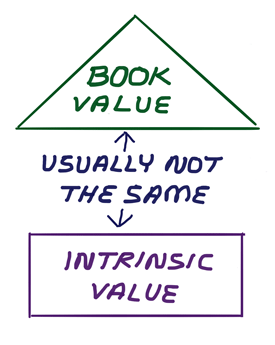
Book value represents how much a company’s assets are worth after all debts and liabilities are accounted for on a given date. Earnings are the profits a company realizes over a specific period. Both are accounting figures. Herein lies why the decision not to mention book value is worthy of discussion.
Berkshire Hathaway both outright owns companies and invests in other companies. Accounting rules require the purchase prices of marketable securities—such as shares of American Express Co. (AXP) and Coca-Cola Co. (KO)—be valued at market prices, but not the operating companies Berkshire Hathaway owns—such as Geico, Burlington Northern Santa Fe Corp. (BNI), International Dairy Queen and NetJets. To the extent that Berkshire Hathaway’s operating companies remain profitable and increase in worth, the difference between what is reflected on the balance sheet and the price that a potential buyer would pay will grow. Here’s what Buffett wrote:
“The fact is that the annual change in Berkshire’s book value—which makes its farewell appearance on page 2—is a metric that has lost the relevance it once had. Three circumstances have made that so. First, Berkshire has gradually morphed from a company whose assets are concentrated in marketable stocks into one whose major value resides in operating businesses. Charlie [Munger, vice chairman of Berkshire Hathaway] and I expect that reshaping to continue in an irregular manner. Second, while our equity holdings are valued at market prices, accounting rules require our collection of operating companies to be included in book value at an amount far below their current value, a mismark that has grown in recent years. Third, it is likely that—over time—Berkshire will be a significant repurchaser of its shares, transactions that will take place at prices above book value but below our estimate of intrinsic value. The math of such purchases is simple: Each transaction makes per-share intrinsic value go up, while per-share book value goes down. That combination causes the book-value scorecard to become increasingly out of touch with economic reality.”
This is not the first time book value has been criticized. In the March 2019 AAII Journal, you will see Jim O’Shaughnessy talk about book value’s failure to account for veiled value. Veiled value is the portion of a company’s intrinsic value not recognized on the balance sheet. It can be a network effect such as Amazon Inc. (AMZN) encouraging customers to spend more on its website through the combination of video content (Amazon Prime) and smart speakers (Alexa). It can also be Berkshire Hathaway’s ability to self-finance, which lowers the costs for its various operating units and avoids the need to rely on outside lenders, particularly during periods when credit is otherwise tight.
This doesn’t mean that book value should be ignored. It is still used in portfolio strategies, including our Model Shadow Stock Portfolio. However, it does lend to the argument of not solely considering one valuation metric. Just as book value is the subject of criticism here, I could have easily written about earnings or EBITDA (adjusted earnings before interest, taxes, depreciation and amortization). Both are subject to manipulation by corporate executives, with highlighted figures polished to look shinier for shareholders and the investment media.
Buffett held no punches when it came to adjusted figures, calling adjusted EBITDA “a measure that redefines ‘earnings’ to exclude a variety of all-too-real costs.” He then added, “Abraham Lincoln once posed the question: ‘If you call a dog’s tail a leg, how many legs does it have?’ and then answered his own query: ‘Four, because calling a tail a leg doesn’t make it one.’ Abe would have felt lonely on Wall Street.”
Before finishing this week’s remarks, I want to touch on buybacks. A few AAII members responded to my defense of share buybacks written a few weeks ago. Part of my view on buybacks is influenced by what Buffett has written in his shareholder letters. He revisited the subject in his latest letter and I want to share it since it contributes to my opinions about buybacks: “For continuing shareholders, the advantage is obvious: If the market prices a departing partner’s interest at, say, 90¢ on the dollar, continuing shareholders reap an increase in per-share intrinsic value with every repurchase by the company. Obviously, repurchases should be price-sensitive: Blindly buying an overpriced stock is value-destructive, a fact lost on many promotional or ever-optimistic CEOs.”
Finally, I will be in Omaha, Nebraska, this May for my first Berkshire Hathaway shareholder meeting as well as the Value Investing Seminar at Creighton University. As a longtime shareholder, going has been something that’s been on my to-do list for a while, and neither Buffett nor Munger are getting any younger.

-
Insights on Warren Buffett From His Friend and Editor – Retired Fortune editor Carol Loomis has edited Buffett’s shareholder letters for many years. In this 2013 AAII Journal interview, she shared her insights about the letters and Buffett’s approach to investing.
-
Selecting a Valuation Method to Determine a Stock’s Worth – Robert Johnson, who chairs the aforementioned value investing seminar, provided useful insights on deciding which valuation metrics to focus on.
Pessimism about the short-term direction of stocks among individual investors fell to its lowest level in more than a year. The latest AAII Sentiment Survey also shows increases in optimism and neutral sentiment.
Bullish sentiment, expectations that stock prices will rise over the next six months, rose 2.3 percentage points to 41.6%. Optimism was last higher on October 3, 2018 (45.7%). This is the third time in four weeks that optimism is above its historical average of 38.5%.
Neutral sentiment, expectations that stock prices will stay essentially unchanged over the next six months, rebounded by 3.1 percentage points to 38.4%. Neutral sentiment remains above its historical average of 31.0% for the sixth time in eight weeks.
Bearish sentiment, expectations that stock prices will fall over the next six months, fell 5.4 percentage points to 20.0%. Pessimism was last lower on January 3, 2018 (15.6%). Bearish sentiment is below its historical average of 30.5% for the fourth consecutive week.
Pessimism is now at an unusually low level (more than one standard deviation below its historical average). Historically, the S&P 500 index has realized below-average and below-median returns during the six- and 12-month periods following such readings.
The ongoing rebound in stock prices has encouraged some individual investors, though others have concerns about its sustainability. Many individual investors are monitoring trade negotiations, and the tempering of tensions may be having an impact on sentiment. Also having an influence are Washington politics (including President Trump and Democratic control of the House of Representatives), corporate earnings, the Federal Reserve, valuations and concerns about the pace of economic growth.
This week’s special question asked AAII members for their opinion of the dividend yield that stocks currently trade at. Responses were mixed. About 23% of respondents view current yields as being too low. Conversely, nearly 22% describe yields as being fair or reasonable and 14% think they are good. About 7% say stock yields are attractive relative to bond yields. Almost 8% say it depends on the stock, with some yields being more attractive than others. Some respondents say they either don’t pay attention to dividends or that yields aren’t a consideration in their investment strategy.
Here is a sampling of their responses:
- “Dividend yields are too low across the board.”
- “The dividend yield on quality stocks is sufficient to make equities the better choice over investment-grade bonds.”
- “I find them attractive as long as the company has the ability to pay out of earnings and not out of assets.”
- “I have no opinion. I don’t invest in dividend stocks.”
- “Dividend yields seem mostly reasonable.”
- “They are generally appropriate given the current level of interest rates and anticipated earnings growth.”

Bullish: 41.6%, up 2.3 points
Neutral: 38.4%, up 3.1 points
Bearish: 20.0%, down 5.4 points
Bullish: 38.5%
Neutral: 31.0%
Bearish: 30.5%
February 21, 2019 Avoiding Overconfidence by Knowing What Type of Investor You Are
February 14, 2019 Your Returns May Be Anything but Average
February 7, 2019 Some Perspective on Buybacks Given Recent Criticism
January 31, 2019 How to Invest Differently Than a Mutual Fund

Discussion
No comments have been added yet. Add your thoughts to the discussion!
You need to log in as a registered AAII user before commenting.
Create an account