

How Will You Implement Your Portfolio Strategy?
by Charles Rotblut | July 23, 2020
We started out this week by trying to develop a decision tree to help investors decide who will implement their portfolio strategy. On the surface, it seemed easy. Don’t have time to research investments? Use a mutual fund, an exchange-traded fund (ETF) or a robo-adviser. Want to pick the stocks you invest in? Roll up your sleeves, put on your DIY hat and be your investment manager.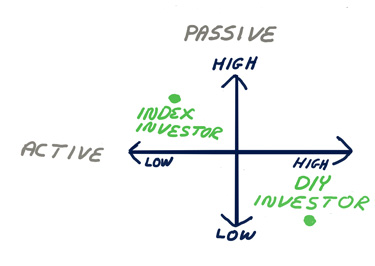
When we started working through the nuances, we realized a decision tree would be too complex. So instead, we’ve created a new worksheet as the latest addition to The AAII Way process for helping you to create an investing plan. It walks you through some of the key considerations in deciding how your portfolio strategy will be implemented.
I presented a spectrum of investor types last week. If they were to be placed on a grid, we could think about them in terms of active versus passive (shown to the right) or control versus knowledge and ability. If you are highly active and not as passive, you’re a hands-on investor and enjoy selecting your own investments. If you’re still learning how to invest and don’t feel ready to take control, you may be solely using the mutual funds in your 401(k) or working with a robo-adviser. Many of you may find yourselves straddling some of the grids’ quadrants. (Hence the reason why we didn’t create a decision tree.)
Where you perceive yourself falling on the grids and, more importantly, the answers you choose, reflect your current preferences. There isn’t a right or wrong set of preferences (unless you are unnecessarily paying an adviser when lower-cost alternatives will be just as suitable); your preferences for how you want your portfolio to be managed are what they are. Clearly identifying them will enable you to make better decisions. To help you better visualize how this step fits into a broader investment plan, I’m going to show you how a hypothetical couple would use it.
Bob and Jane are recently retired and affluent. Though funding retirement is their primary goal, their expenses are covered by Social Security and pension benefits. This factor allows them to focus on their secondary goals of helping with their grandkids’ college education expenses. Their risk tolerance profile is high, though in assessing their tolerance they described their knowledge of key investing concepts as moderate.
Given their risk tolerance and the length of time before the first grandchild is expected to start college, they choose to follow AAII’s aggressive investor allocation model. This calls for a high allocation to a mix of stocks and a small allocation to bonds.
Bob enjoys analyzing stocks and has the time to do so. He doesn’t feel comfortable trying to analyze international or emerging stocks. However, he is wiling to use mutual funds or ETFs to get exposure to them. He also doesn’t want to pick individual bonds and opts to use a fund for them. Jane has always been more comfortable using index funds (but gives Bob credit for some of his past stock picks).
Bob and Jane think funds should be used for any bond allocation. This puts them on the line between active and passive and makes them partially hands-on investors. They are also willing to cede some control to index funds and having a moderate level of investing knowledge.
In mapping out the rest of their investment policy statement, the couple would list the rules Bob uses for selecting and selling stocks. They would also have rules governing which funds they choose and under what circumstances they would sell them.
Being retired, Bob and Jane would want to think about asset allocation. To the extent that Bob’s strategy for investing in individual stocks and the couple’s bond funds create more capital gains and interest income, they would want to keep those investments in their IRAs or Roth IRAs. To the extent that the international funds they hold are tax-efficient, the couple would want to think about holding them in their taxable accounts. (This decision highlights why it is important to create a list of what accounts you have.)
Bob and Jane will also need to think about transition strategies. As their grandchildren get closer to college age, their allocation of the assets devoted to funding this goal will need to change. The decision about when to do so will be part of their investment policy statement.
There’s a lot here. As we further develop the AAII Way, we’ll create additional worksheets to help retired investors like Bob and Jane—as well as those of you who are younger or older—work through the details of implementing your investment strategy.

-
Stock Price Movements Are Unpredictable – Burton Malkiel made the case for indexing in this 2011 interview.
-
To Beat the Market, Invest Differently Than the Market – James O’Shaughnessy explained how active investors can beat the market in this 2019 interview.
Optimism among individual investors about the short-term direction of the stock market pulled back to an unusually low level. The latest AAII Sentiment Survey also shows higher neutral and bearish sentiment.
Bullish sentiment, expectations that stock prices will rise over the next six months, fell 4.8 percentage points to 26.1%. The decline keeps optimism below its historical average of 38.0% for the 20th consecutive week and the 25th week this year.
Neutral sentiment, expectations that stock prices will stay essentially unchanged over the next six months, rebounded by 3.3 percentage points to 27.1%. Nonetheless, neutral sentiment remains below its historical average of 31.5% for the 26th week this year.
Bearish sentiment, expectations that stock prices will fall over the next six months, rose 1.5 percentage points to 46.8%. Pessimism is above its historical average of 30.5% for the 22nd consecutive week and the 24th time this year.
As noted above, optimism fell back to an unusually low level. Meanwhile, pessimism continues to be at an unusually high level. Historically, both have generally been followed by above-average and above-median returns for the S&P 500 index, though the link is stronger for unusually low bullish sentiment than it is for unusually high bearish sentiment.
The current level of pessimism reflects concerns about the coronavirus pandemic and the economy. However, some AAII members have been encouraged by the rebound in the stock market from its March lows. Other factors influencing AAII members’ sentiment include the economy, corporate earnings, the November elections and interest rates.
In this week’s special question, we asked AAII members how they think the average consumer is faring. Slightly more than two out of five respondents (41%) say that the average consumer is faring poorly. This compares to 33% of respondents who say that the average consumer is doing okay. Additionally, 20% of respondents say that they believe they are doing far better compared to the average consumer.
Here is a sampling of the responses:
- “The average consumer is not faring well, at this point due to high unemployment and coronavirus pandemic restrictions.”
- “The average consumer is struggling, while the average AAII member is doing alright because they are invested in equities and other assets.”
- “The gap exists between those earning incomes and those not earning incomes, for whom retirement is not an option. Otherwise, with the exception of those endangered at work (not first responders, paramedics or personnel at medical facilities), consumers should hold forth. I cannot answer for investors.”

Bullish: 26.1%, down 4.8 points
Neutral: 27.1%, up 3.3 points
Bearish: 46.8%, up 1.5 points
Bullish: 38.5%
Neutral: 31.0%
Bearish: 30.5%
July 16, 2020 What Type of Individual Investor Are You?
July 9, 2020 Revising Our Asset Allocation Models
July 2, 2020 Bonds Have a Role Even With Current Interest Rates
June 25, 2020 Comparing the Five Major Categories of Stocks

Discussion
Richard from Nebraska posted over 6 years ago:
There are several investor styles I took the Zichy test (SP?) much like the Myers Briggs and found out I am a risk taker, hate to keep records, always trying to improve. Recently, I a found a strategy to trade earning when IV is high. I paper traded it until improved the strategy until I got all the kinks out. I now trading the strategy with real money. I have 18 wins and two small losses. I bring this up as an example of trading/investing according to your style.
You need to log in as a registered AAII user before commenting.
Create an account