

Nine Observations About Tesla’s Crazy Ride
by Charles Rotblut | February 06, 2020
It’s been a crazy year for shares of Tesla Inc. (TSLA), and we’re only in the first week of February. The stock closed at $418.33 on December 31, 2019. It closed at $887.06 on Tuesday before pulling back to $734.70 on Wednesday and rebounding to $748.96 today. These are not typos.
Long-time readers know I mostly refrain from writing about a single stock in this weekly commentary. I’m making an exception this week. The extraordinary volatility in a stock the size of Tesla (its market capitalization was $159.9 billion as of yesterday’s close) provides an opportunity to share some insights about investing and analyzing a high-growth stock.
Here are nine of my thoughts and observations:
1. Be honest about the limits of your knowledge. What’s behind the big moves in Tesla stock? There have been better-than-expected earnings, news about increased production in China, bullish comments from analysts and positively revised earnings estimates. A fear of missing out (aka, FOMO) is likely playing a role as is the vast amount of media attention the stock and the company receive. How certain are you about the exact reasons and your ability to predict how long they will last? Be honest with yourself in answering these questions.
2. Shorting a stock is very risky. Short selling involves borrowing shares to sell with the hopes of buying back the same number of shares at a lower price in the future to pay back the loan. Short selling always comes with limited gains (a stock can only fall to $0) and unlimited losses (at least until an investor goes broke trying to make their margin calls). Tesla had a high short interest ratio prior to its recent run. It is reasonable to believe part of the big jump in price was attributable to short sellers being forced to close their positions.
3. Know the difference between speculation and investing. Tesla’s price moves reflect unbridled speculation. Those participating in the big run-up are hoping to pass along the hot potato before their hands get burnt. It’s the greater fool theory in action. Sooner or later there won’t be enough people willing to pay a higher price, resulting in big losses for those who bought in too late. Those who think they’ll make a profit if the stock suddenly reverses course and/or continues to experience massive price swings are also speculating and not investing.
4. Recognize the difference between luck and skill. Too often outcomes—both good and bad—are viewed as being the result of a process or skill when in reality they are attributable to luck. If you bought shares of Tesla late last year, be both grateful and cognizant of your very good luck. Treat it as such and realize that luck is often fleeting.
5. Ask how many units sold the market cap implies. One way to do a sanity check on a stock is simply to ask: How many units sold does the market capitalization imply? It can be a product, subscribers, licensees or something similar. The numbers don’t have to be exact; you’re simply looking for a decent gauge. In the case of Tesla, the company delivered 112,095 vehicles and reported automotive sales of $6.143 billion during its recently completed fourth quarter. This equates to an average selling price (ASP) of approximately $55,000. Automotive sales accounted for 83% of revenues. If we back down these numbers a little bit to an ASP of $50,000 to account for the Model 3 and higher revenues from energy generation and services, the current market cap implies the annual sale of approximately 2.56 million cars per share based on a price-to-sales ratio of 1.0 (which is the average for the automotive industry). Tesla’s guidance for 2020 calls for 500,000 vehicle deliveries—a big difference. You can certainly tweak the numbers and/or the price-to-sales ratio to do the analysis as long as you remain focused on answering this straightforward question: Is the number of vehicles sold implied by the current market cap reasonable?
6. Consider how much optimism the valuation already reflects. Another simple way to see if the price is reasonable is to look at the valuation. The goal is to determine how much optimism about the company’s future growth is priced in. Tesla traded at 52.2 times projected 2021 earnings and 36 times projected 2022 earnings as of Wednesday’s close. These valuations rank in the approximate top 10% of all stocks. They also are based on the company’s earnings being 1.6 times higher in 2022 from the already strong growth projected for 2020.
7. What about the competition? During the Super Bowl, Audi, Ford, General Motors and Porsche advertised electronic vehicles. Other car companies are offering or are in the process of introducing new electric cars. Ask how much of this competitive threat is being priced into the stock.
8. How certain are you that this time is different? We’ve seen similar stories play out before. Various companies—often emergent ones—generated buzz for a period of time and saw their stocks priced with high valuations as a result. Most are either long forgotten or are mere fractions of their former selves. While Amazon.com Inc. (AMZN) is often touted now as a company that showed how valuations don’t matter to high-growth stocks, it is the exception and not the norm. If you’re optimistic about Tesla’s future, write down your reasons why. Then set up a process for determining if your expectations are being met.
9. There are behavioral factors at play. There have been many papers published about lottery stocks. These are highly risky stocks purchased by investors in hopes of realizing a big payoff. At the same time, there is FOMO and overconfidence from those who think they’ll know when to get out. We’re seeing both at play with Tesla. Speculating on what a stock will do is hard; speculating on what others are intending to do with the stock is even harder.
This week’s commentary is not intended to be a recommendation about what you should do with Tesla. Rather, it’s a framework for stepping back from the noise and rationally thinking through key points about the stock and other highly valued growth stocks. Too often, the chatter about a stock is focused on price instead of the factors influencing/having the potential to influence the price. It’s not always easy, but separating yourself from the crowd and giving thought to key points can increase your odds of investing success.

-
Lottery Stocks’ Unique Returns Around Earnings Announcements – Lottery stocks, risky stocks with high expected returns, tend to outperform ahead of earnings announcements and pull back afterward.
-
The Secrets of Picking Great Growth Stocks – In this 2007 AAII Journal article, four factors were listed as being common traits of the greatest companies and stocks.
Optimism among individual investors about the short-term direction of the stock market rebounded modestly. The latest AAII Sentiment Survey also shows small drops in neutral and bearish sentiment.
Bullish sentiment, expectations that stock prices will rise over the next six months, rose 1.9 percentage points to 33.9%. Optimism is below its historical average of 38.0% for the 40th time in the past 52 weeks.
Neutral sentiment, expectations that stock prices will stay essentially unchanged over the next six months, declined 0.3 percentage points to 30.9%. The historical average is 31.5%.
Bearish sentiment, expectations that stock prices will fall over the next six months, pulled back by 1.6 percentage points to 35.2%. The historical average is 30.5%.
All three indicators are currently within their typical historical ranges.
The coronavirus outbreak is dampening the economic outlook for some but not all individual investors as the responses to this week’s special question show. Also affecting individual investor sentiment is the market’s upward trend, the phase-one trade deal between the U.S. and China, the November elections, Washington politics, earnings growth, monetary policy, the economy and valuations.
For this week’s special question, we asked AAII members if the coronavirus is impacting their outlook for the economy. A little less than half of all respondents (47%) say the coronavirus is impacting their economic outlook. A majority in this group cite that stagnant manufacturing in China related to the coronavirus will impact many companies’ supply chain systems. Additionally, many in this group expect the adverse impact to be short-lived. On the other hand, 42% of respondents state that the coronavirus is not impacting their outlook for the economy. Many in this group state that China will experience most of the negative effects related to the outbreak. Finally, 11% of respondents state that it’s too early to tell how the virus might impact the economy.
Here is a sampling of the responses:
- “I believe the coronavirus (novel) outbreak will have a short-term effect on the world economy. Thus, it has the possibility of creating some value opportunities as investors overreact to the outbreak.”
- “If you are well diversified, it doesn’t really matter. There is always a crisis of some sort going on.”
- “I think it may impact China slightly, but to the rest of the world it will be fleeting news. I am amazed at China’s ability to build two hospitals and staff them in 10 days—WOW!”
- “Yes, it will slow production and other work in at least China for the foreseeable future. This will impact trade and supply chains for months. Remember the flu epidemic from 100 years ago.”

Bullish: 33.9%, up 1.9 points
Neutral: 30.9%, down 0.3 points
Bearish: 35.2%, down 1.6 points
Bullish: 38.5%
Neutral: 31.0%
Bearish: 30.5%
AAII Asset Allocation Survey
Cash allocations among individual investors fell to a two-year low last month. The January AAII Asset Allocation Survey also shows greater exposure to equities and stable fixed-income allocations.
Stock and stock fund allocations rebounded by 1.7 percentage points to 67.5%. Equity exposure was last higher in April 2019 (67.8%). Stock and stock fund allocations are above their historical average of 61.0% for the 82nd consecutive month.
Bond and bond fund allocations increased 0.1 percentage points to 18.7%. Fixed-income allocations are above their historical average of 16.0% for the 11th consecutive month and the 12th time in 13 months.
Cash allocations pulled back by 1.8 percentage points to 13.8%. This is the smallest exposure to cash since January 2018 (13.3%). The drop keeps cash allocations below their historical average of 23.0% for the 98th consecutive month.
Fixed-income allocations stayed within a 0.1 percentage-point range for the third consecutive month despite January’s decline in bond yields. Last month’s higher equity allocation coincided with new record highs for the major stock indexes and two weeks of above-average bullish sentiment during the middle of the month.
The survey period runs through the entire calendar month and most of the responses were recorded before last Friday’s pullback in stock prices.
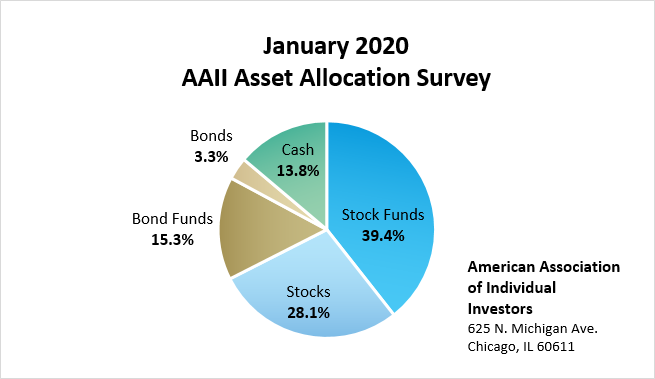
January AAII Asset Allocation Survey results:
- Stocks and stock funds: 67.5%, up 1.7 percentage points
- Bonds and bond funds: 18.7%, up 0.1 percentage points
- Cash: 13.8%, down 1.8 percentage points
January AAII Asset Allocation Survey details:
- Stocks: 28.1%, down 0.6 percentage points
- Stock Funds: 39.4%, up 2.3 percentage points
- Bonds: 3.3%, down 0.6 percentage points
- Bond Funds: 15.3%, up 0.7 percentage points
Historical Averages:
- Stocks/Stock Funds: 61.0%
- Bonds/Bond Funds: 16.0%
- Cash: 23.0%
The numbers are rounded and may not add up to 100%.
The AAII Asset Allocation Survey has been conducted monthly since November 1987 and asks AAII members what percentage of their portfolios are allocated to stocks, stock funds, bonds, bond funds and cash. The survey and its results are available online at: www.aaii.com/investor-surveys.
Want to weigh in? Take the survey yourself and see results online at www.aaii.com/assetallocationsurvey.
- Stocks and Stock Funds: 67.5%, up 1.7 percentage points
- Bonds and Bond Funds: 18.7%, up 0.1 percentage points
- Cash: 13.8%, down 1.8 percentage points
- Stocks: 28.1%, down 0.6 percentage points
- Stocks Funds: 39.4%, up 2.3 percentage points
- Bonds: 3.3%, down 0.6 percentage points
- Bond Funds: 15.3%, up 0.7 percentage points
- Stocks/Stock Funds: 62.0%
- Bonds/Bond Funds: 16.0%
- Cash: 22.0%
Take the Asset Allocation Survey.
January 30, 2020 Optimism Was Low Last Year, But Individual Investors Stayed With Stocks
January 23, 2020 Despite the Headlines, Mr. Market Is Quite Content
January 16, 2020 The New Features We’ve Added to Our Website
January 9, 2020 Part 2 of My Investing Resolutions for 2020

Discussion
Phil Starr from NC posted over 6 years ago:
Frankly, I scanned this with the following reaction. Other than a brief dalliance with CANSLIM, I have evolved to a primarily passive investment strategy. I now hold no individual stocks, which means I have missed both some incredible profit opportunities and some disastrous balance shrinkage's. But my ROI's remain rewarding. So I continue to be impressed with big impact technology plays and at least scan the stories.
Ken Alexander from Alabama posted over 6 years ago:
Nice article regarding Tesla. I would disagree with assessment though. First of all Tesla has only 180 million share float with Elon Musk and other large institutional; investors holding millions in shares. I doubt many are selling at these prices. Secondly Tesla was selling at less than 3 times sales in December. I would consider that low for a disrupter like Tesla. Even today's 5 times sales is below Cloud darling CRM at over 8 times sales. No one comments on CRM's price as being over-priced. Just my thoughts on the matter. Thanks Charles for all you and your associates do at AAII.
Tom Schaber from Ohio posted over 6 years ago:
Good food for thought ... for every purchase of individual stocks. That's why I only invest in index ETFs; I don't have the energy to perform ANY analysis on any of the 3000+ stocks available. Let the indexes do the work for me.
Paul Hopler from Virginia posted over 6 years ago:
I always enjoy Charles Rotblut's articles and the insights on Tesla were well thought out. I believe if I had not bought Tesla in 2 accounts at $32, I would have made the same statements. But coming at it from a contrarian viewpoint of having made a lot of money I am not inclined to sell. I did sell a small portion when the stock hit $80 and the world offered insights that it would fail and again at $200 at which point I had already returned three times what I put into it. When it hit $400 I decided I would ride this out whatever. Yes it is risky and I have limited knowledge on why the big increase but a little bit of speculation in not all bad. It is probably some luck, but contrary to my religious background that says dependence on success always leads to failure, so far I feel good about it. If it totally collapse the experience is worth it.
You need to log in as a registered AAII user before commenting.
Create an account