

The Barbell Strategy—A Simple Way of Being Both Aggressive and Conservative
by Charles Rotblut | March 12, 2020
Given all the recent volatility, I want to discuss a simple allocation approach: the barbell strategy. It may comfort those of you who are nervous. It can also give those of you who are feeling aggressive a reserve that you can tap to buy on the dips.
The barbell strategy combines the dual goals of wealth preservation (conservative) and wealth creation (aggressive). Think of a barbell. It’s a pole of approximately seven feet in length with weights on both sides. The weighted plates slid on the bar are evenly distributed, say a 45-pound, 25-pound and 10-pound plate on each side. A portfolio using an evenly weighted approach would be 50% very conservative and 50% very aggressive. (Bond managers have long used barbell strategies to protect against interest rate moves by combining short-duration bonds with long-duration bonds.)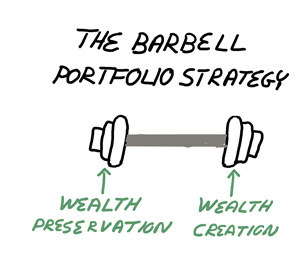
Unlike actual barbells, portfolios don’t need to be evenly weighted. You can be 30% conservative and 70% aggressive, 80% conservative and 20% aggressive or anywhere else along the spectrum. The mix of conservative and aggressive is the tactical application of the barbell strategy. The longer your investing time horizon is, the more emphasis you should give to wealth creation by allocating to risky assets with the potential for high long-term returns, like stocks. The shorter your time horizon, the more emphasis you should give to wealth preservation by allocating to safe assets like high-quality, short-term bonds or money market accounts.
You may notice the lack of a middle ground. The barbell strategy leaves it out in favor of two extremes: assets with a very low chance of losing principal and assets likely to experience uncomfortable and potentially ill-timed bouts of downside volatility in exchange for high long-term returns.
Downside risks are buffered by the conservative side of the portfolio. No matter what happens on the aggressive side, part of the portfolio won’t vary in wealth much. This assures access to cash flow when needed. Simply knowing this cushion is in place may help you sleep at night whenever Mr. Market throws a bad temper tantrum like he’s been doing lately.
The aggressive side protects against the dual risks of inflation and longevity. Inflation erodes your ability to buy goods and services with the money you have (purchasing power). Longevity is the risk of outliving your savings. By realizing long-term returns well in excess of the rate of inflation, you will fend off these dual and important risks.
Tactically, applying the barbell approach can be very easy. You can simply combine a money market fund with a diversified stock fund. If you’re willing to tolerate a bit more complexity, you could include a certificate of deposit (CD) or a shorter-term, high-quality bond ladder with a portfolio of individual stocks and/or equity mutual funds/exchange-traded funds (ETFs). The key to the mix is having the conservative side filled with assets that are easy to turn into cash withdrawals with limited risk of loss and to have the aggressive side filled with assets likely to increase your long-term wealth.
If some of you are thinking, “This sure sounds like a bucket strategy,” you’re right. It’s a two-bucket strategy. Rather than having a middle moderate bucket, the barbell strategy simply uses conservative and aggressive buckets.
Others may notice a connection between this and AAII founder James Cloonan’s Level3 withdrawal approach. Though Jim didn’t describe it as a barbell strategy, this is exactly what he was describing. Rather than having a certain percentage of the portfolio allocated to cash and cash equivalents, he used living expenses as a gauge. Retirees were encouraged to have an amount equal to between two and four years’ worth of planned withdrawals in cash and cash equivalents.
Nothing about the barbell strategy requires you to use specific allocation percentages. If it’s easier to think in terms of how much cash you will need over a certain period of time—say to cover one to five years of expenses—you can use that for the conservative side of your barbell. It’s the flexibility of the barbell strategy to be easily adapted to a variety of situations that can make it an option for many people.

-
The Level3 Withdrawal Strategy to Maximize Your Long-Term Wealth – Jim Cloonan explained his conservative/aggressive Level3 approach to funding withdrawals in this 2017 AAII Journal article.
-
Strategies to Counteract the Current Market Madness – Given the dual events of the coronavirus and Saudi Arabia cutting oil prices, we posted a video with suggestions on how individual investors can react.
The percentage of individual investors expecting stocks to fall over the short term is at its highest level in seven years. The latest AAII Sentiment Survey also shows a steep drop in optimism and a continued decline in neutral sentiment.
Bullish sentiment, expectations that stock prices will rise over the next six months, plunged 9.0 percentage points to 29.7%. The drop more than reversed last week’s gain and put optimism at its lowest level since October 9, 2019 (20.3%). The historical average is 38.0%.
Neutral sentiment, expectations that stock prices will stay essentially unchanged over the next six months, fell by 2.7 percentage points to 19.0%. Neutral sentiment was last lower on December 26, 2018 (18.2%). This week’s drop keeps neutral sentiment below its historical average of 31.5% for the eighth time in nine weeks.
Bearish sentiment, expectations that stock prices will fall over the next six months, soared 11.7 percentage points to 51.3%. Pessimism was last higher on April 11, 2013 (54.5%). The large increase keeps bearish sentiment above its historical average of 30.5% for the fifth time in seven weeks.
Pessimism is now at an unusually high level (more than one standard deviation above the historical average). Historically, this has had a weaker association with above-average returns for the S&P 500 index over the following six- and 12-month periods than unusually low levels of optimism. (Bullish sentiment remains within its typical historical range.)
Neutral sentiment is at an unusually low level (more than one standard deviation below the historical average). Historically, such readings have been followed by below-average and below-median returns for the S&P 500 over the following six- and 12-month periods. This historical evidence is influenced by low readings recorded during the early 1990s recession, the dot-com bubble burst and the financial crisis.
The big jump in pessimism is a reflection of the downside volatility we’ve seen in the market, the COVID-19 (coronavirus) pandemic and the oil price cut announced by Saudi Arabia. As we noted last week, many—but not all—individual investors are using the downturn to look for buying opportunities among stocks. Other factors influencing individual investors’ sentiment include the November elections, corporate earnings, economic growth and valuations.
In this week’s special question, we asked AAII members what they thought about the Federal Reserve’s decision to cut interest rates by 50 basis points (0.50%). Of the responses we received, 50% state that the Fed’s decision to cut interest rates was a mistake. Rationale from this group includes lack of “future Fed ammunition” if and when the market deteriorates further, as well as rate cuts being ineffective against ongoing macro events (aka, COVID-19). Alternatively, 27% of respondents state that they support the Fed’s decision to cut rates. Many within this group believe that it was the only viable option that the Fed had to combat the recent market volatility. Finally, 17% of respondents state that the rate cut will have little effect on the market and 6% of respondents state that they are unsure if the Fed made the right decision. Among these respondents, reasoning includes that the rate cut was initiated too late in response to the COVID-19 outbreaks.
Here is a sampling of the responses:
- “Not the best idea. Indicated to investors their concern about a recession. Now they have little leverage to help.”
- “Although it was the right thing to do, it will make little difference to the economy in the near term.”
- “I believe it was premature and indicated lack of faith in the underlying strength of the economy. As such, it was a bearish signal and likely contributed to the debacle that occurred on March 9.”
- “I haven’t given it much thought yet. I can understand the reasoning behind it, but with the market being volatile and unpredictable, the expected results don’t always go as planned.”

Bullish: 29.7%, down 9.0 points
Neutral: 19.0%, down 2.7 points
Bearish: 51.3%, up 11.7 points
Bullish: 38.5%
Neutral: 31.0%
Bearish: 30.5%
March 5, 2020 Income Investing Suggestions for Record Low-Yield Environment
February 27, 2020 Strategies Individual Investors Can Use for Coronavirus-Related Volatility
February 20, 2020 Yield's Role as a Valuation and Risk Indicator
February 13, 2020 The Value Premium’s Not Dead, but It Is Smaller

Discussion
No comments have been added yet. Add your thoughts to the discussion!
You need to log in as a registered AAII user before commenting.
Create an account