

Income Investing Suggestions for Record Low-Yield Environment
by Charles Rotblut | March 05, 2020
Three months ago, I wrote a weekly commentary entitled, The Bond Market Armageddon That Didn’t Happen. Compared to now, the yields from last December are, in the words of comedian Larry David, looking pretty, pretty, pretty, pretty good.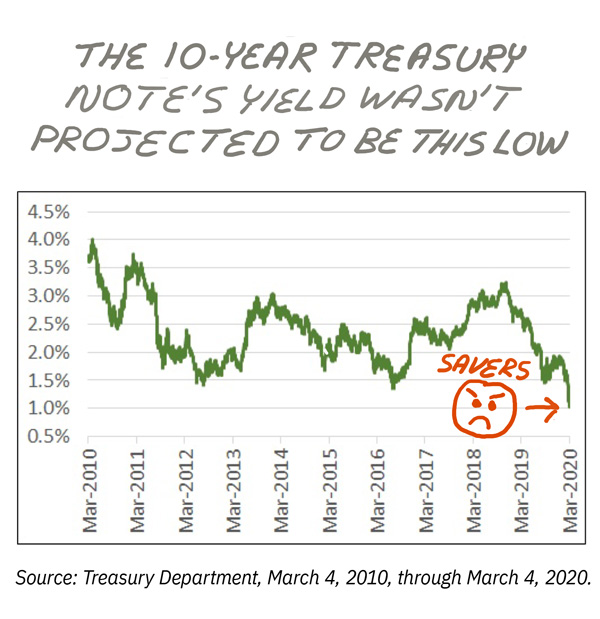
The benchmark 10-year Treasury note closed yesterday with a yield of 0.9920%. It was the latest in a series of record lows. These low yields are good news for borrowers—especially those with good credit scores—and lousy news for those who desire interest income.
Normally, the record low yields would be big news. This is not a normal time. We’re seeing big percentage moves in the major stock indexes. Commodity prices have dropped. The Federal Reserve surprised us with an in-between-meetings interest rate cut.
It’s a lot to digest. It certainly makes for a challenging time to be an investor, both individual and institutional. So, I’m going to build on last week’s commentary—which offered actionable steps oriented toward portfolio management and stocks—by sharing ideas for those who are more focused on income-producing investments.
Let’s start with the obvious: Bond yields weren’t projected to be this low. Go back five to 10 years and you could have found prognosticators warning investors to steer clear of longer-dated bonds because of an expected future rise in interest rates. Even in late 2018, Treasury yields were trading above 3%, leading some to wonder if yields were finally going to head into a higher range. Now, yields are going in the other direction. The reason? Fears about what the COVID-19 (coronavirus) outbreak will do to domestic and worldwide economies.
Global travel is already being affected. Shipments out of China are still delayed because of factory closures/understaffing. Some U.S. companies have already issued first-quarter warnings because of supply disruptions. Depending on the spread of COVID-19, other areas of the domestic and global economy could be affected.
The Fed’s response so far has been to cut rates by 50 basis points (0.50%). This week’s rate cut could prove beneficial to businesses needing short-term loans to ride out any coronavirus-related weakness. What it can’t do is fix supply problems. Neither can monetary policy quickly create new space in the ports should we see a backup of ships once the factories in China return to full production.
This week’s rate cut is an attempt to ward off an economic slump, or at least lessen the severity should one happen. If your main worry is the possibility of an economic slump or you think the stock market needed the shot of monetary stimulus, you might have welcomed the move. If you’re seeking income from your portfolio, you’re probably not thrilled about it.
Regardless of what your view is, it’s very hard to predict how much the virus will spread, the extent to which the economy will be impacted and how the financial markets will continue to react. Everybody’s crystal ball is cracked.
Given this, it’s worth asking: How big of a bet do you want to make on what’s going to happen? The simple fact of the matter is that no one really knows. Yet, even when uncertainty is high, there are still things you can do on the income front. Here are some suggestions:
Shop around for interest rates. If you have money held in savings accounts, money market accounts and certificates of deposit (CDs), look around to see if there are better rates available at other financial institutions. For instance, Discover Bank is offering AAII members 1.65% on savings and 2.05% on 12-month CDs as I write this. (Disclosure: We have a loyalty program with Discover.)
Buying individual bonds? Consider muni bonds. Municipal bonds offer tax advantages. Their interest payments are usually exempt from federal and state taxes. This combination can cause their aftertax yield to be attractive.
Ladder your bonds and CDs. Laddering means holding bonds and CDs with different maturity dates. Doing so will allow you to reinvest at different interest rates in the future, diminishing timing risks.
Don’t overlook dividend payers. Because yield and price are inversely related, the stock market’s correction has increased the yield on stocks. Even though yields will fall once stock prices rebound, the yield you personally realize will always be based on the price you paid. The quoted yield is what another investor will receive when they buy the stock from you in the future. Our Dividend Investing newsletter seeks dividend growers, companies that increase the amount they pay out every year.
Pay attention to credit quality. High-yield bonds (aka, junk bonds) trade with higher yields because they are issued by riskier companies. When the economy slows, their chances of default increase.
Look past the short term. This can be the hardest thing to do emotionally, but it’s also the best thing you can do. None of the well-publicized market forecasts issued in December were calling for COVID-19 to disrupt the global economy, much less for bond yields to fall below 1.0% this quarter. Given this, why would you trust the forecasters now? The more prudent move is to simply stick to your plan, ensure your short-term cash needs are covered and focus on total return instead of just income return.
Wash your hands frequently. Doing so won’t help your portfolio directly, but it will reduce the odds of you catching COVID-19, the flu and other illnesses.

-
How to Make Money From Bonds – Among the subjects covered in this 2011 AAII Journal article are bond ladders and strategies for buying bonds in a falling-interest-rate environment.
-
A Fresh Look at Defined-Maturity Bond Funds – If you prefer bond funds over individual bonds, you can build a ladder with these funds.
The percentage of individual investors describing their short-term outlook for stocks as “neutral” is at its lowest level in more than 14 months. The latest AAII Sentiment Survey also shows a big rebound in optimism and slightly higher pessimism.
Bullish sentiment, expectations that stock prices will rise over the next six months, jumped 8.3 percentage points to 38.7%. The increase offset much, but not all of, last week’s decrease. The historical average is 38.0%.
Neutral sentiment, expectations that stock prices will stay essentially unchanged over the next six months, plunged 8.8 percentage points to 21.6%. Neutral sentiment was last lower on December 26, 2018 (18.2%). This week’s drop keeps neutral sentiment below its historical average of 31.5% for the seventh time in eight weeks.
Bearish sentiment, expectations that stock prices will fall over the next six months, rose 0.5 percentage points to 39.6%. Pessimism is above its historical average of 30.5% for the fourth time in six weeks.
Neutral sentiment is at an unusually low level (more than one standard deviation below the historical average). Historically, such readings have been followed by below-average and below-median returns for the S&P 500 index over the following six- and 12-month periods. This historical evidence is influenced by low readings recorded during the early 1990s recession, the dot-com bubble burst and the financial crisis.
Pessimism moved closer to the upper end of its typical range. Readings above 39.8% are unusually high.
Our survey period runs from Thursday through Wednesday, with reminders to take the survey emailed out to respondents on Mondays.
The market’s volatility and COVID-19 (coronavirus) were front and center during the survey period. As the results of this week’s special question show, the responses by individual investors were mixed. Other factors influencing individual investors’ sentiment include the November elections, corporate earnings, economic growth and valuations.
In this week’s special question, we asked AAII members how they’ve reacted to the market’s recent volatility. Nearly 41% of respondents say they are looking for more buying opportunities as the market dips. Conversely, 38% of respondents state that they have made no changes related to recent market fluctuations and believe that the market volatility will soon settle. Other respondents’ reactions include allocating a greater percentage to cash holdings. Many within this group cite ongoing concerns regarding COVID-19 and a desire to invest conservatively given the markets’ fluctuations. Finally, 12% of respondents state that they are opting to sell certain positions as market volatility increases.
Here is a sampling of the responses:
- “Have not sold anything. Not ready to buy anything until this virus scare is under control, whenever that is, sometime in the distant future.”
- “I put a lot of money into the market that I’d had sitting on the sidelines for a while. I was glad to see the market drop as it seemed too high and this drop makes it slightly more rational.”
- “Patient and waiting until the market goes up again. No need to sell. However, if some of the stocks I own fall further, I may add to my number of shares.”
- “I am staying the course. There was likely a correction in order anyway and I think the coronavirus scare broke the camel’s back.”

Bullish: 38.7%, up 8.3 points
Neutral: 21.6%, down 8.8 points
Bearish: 39.6%, up 0.5 points
Bullish: 38.5%
Neutral: 31.0%
Bearish: 30.5%
AAII Asset Allocation Survey
Individual investors’ exposure to fixed income was at a six-month high last month according to the February Asset Allocation Survey. Cash allocations also rose while equity exposure declined. None of these asset classes saw significant changes.
Stock and stock fund allocations pulled back by 1.4 percentage points to 66.1%. Equity allocations remain above their historical average of 61.0% for the 83rd consecutive month.
Bond and bond fund allocations increased 0.4 percentage points to 19.1%. Fixed-income exposure was last higher in August 2019 (19.4%). Bond and bond fund allocations are above their historical average of 16.0% for the 12th consecutive month and the 13th time in 14 months.
Cash allocations rebounded by 1.0 percentage points to 14.8%. Cash allocations are below their historical average of 23.0% for the 99th consecutive month.
Many of the responses to the February survey were registered before last week’s drop in stock prices and bond yields. AAII members can participate in this survey at any point during a calendar month. Historically, we have seen individual investors take more time to alter their allocations than to change their expectations about the short-term direction of the stock market.
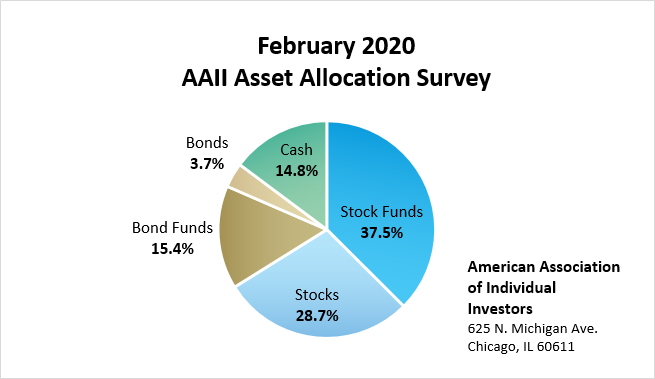
February AAII Asset Allocation Survey results:
- Stocks and stock funds: 66.1%, down 1.4 percentage points
- Bonds and bond funds: 19.1%, up 0.4 percentage points
- Cash: 14.8%, up 1.0 percentage points
February AAII Asset Allocation Survey details:
- Stocks: 28.7%, up 0.5 percentage points
- Stock funds: 37.5%, down 1.9 percentage points
- Bonds: 3.7%, up 0.4 percentage points
- Bond funds: 15.4%, up 0.1 percentage points
Historical Averages:
- Stocks/Stock Funds: 61.0%
- Bonds/Bond Funds: 16.0%
- Cash: 23.0%
The numbers are rounded and may not add up to 100%.
The AAII Asset Allocation Survey has been conducted monthly since November 1987 and asks AAII members what percentage of their portfolios are allocated to stocks, stock funds, bonds, bond funds and cash. The survey and its results are available online at: www.aaii.com/investor-surveys.
Want to weigh in? Take the survey yourself and see results online at www.aaii.com/assetallocationsurvey.
- Stocks and Stock Funds: 66.1%, down 1.4 percentage points
- Bonds and Bond Funds: 19.1%, up 0.4 percentage points
- Cash: 14.8%, up 1.0 percentage points
- Stocks: 28.7%, up 0.5 percentage points
- Stocks Funds: 37.5%, down 1.9 percentage points
- Bonds: 3.7%, up 0.4 percentage points
- Bond Funds: 15.4%, up 0.1 percentage points
- Stocks/Stock Funds: 62.0%
- Bonds/Bond Funds: 16.0%
- Cash: 22.0%
Take the Asset Allocation Survey.
February 27, 2020 Strategies Individual Investors Can Use for Coronavirus-Related Volatility
February 20, 2020 Yield's Role as a Valuation and Risk Indicator
February 13, 2020 The Value Premium’s Not Dead, but It Is Smaller
February 6, 2020 Nine Observations About Tesla’s Crazy Ride

Discussion
You need to log in as a registered AAII user before commenting.
Create an account