

The CARES Act and Tax Rule Changes
by Charles Rotblut | April 09, 2020
Special note: The U.S. financial markets and our “office” (AAII staff are working remotely) will be closed tomorrow in observance of Good Friday. On behalf of everyone at AAII, I wish a happy Easter and a happy Passover to those of you observing the respective religious holidays.
Ahead of the online town hall we hosted on Tuesday, April 7, several AAII members asked for information about the CARES Act. It, along with other coronavirus-related changes by the Treasury Department, have altered rules affecting many of you. I’m going to discuss some of those changes in this week’s commentary. (A longer update to our Tax Guide is currently being written for the AAII Journal. See the new Community section on AAII.com for information on upcoming events, including local chapter webinars.)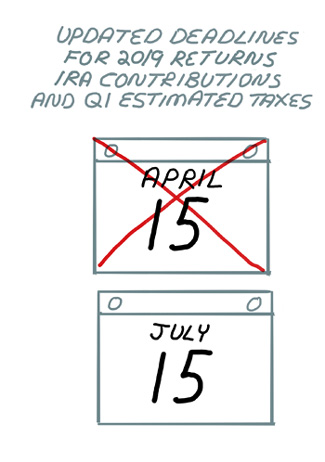
I’ll start with the tax rebates. Treasury Secretary Steven Mnuchin has reportedly suggested they could go out this week. Given the holidays, I would place greater odds on them being issued next week. These are specifically described as a “credit” in the CARES Act and will not count as taxable income. They will be issued to taxpayers with adjusted gross income (AGI) below $150,000 for married filers, $75,000 for single filers and $112,500 for heads of household. Phaseouts exist above those levels with no rebates being issued to those with AGI of $198,000, $136,500 and $99,000, respectively. Retirees who are not listed as dependents are eligible to receive the credit. An additional $500 rebate is available for each child with a Social Security number. The rebates will be based on 2019’s AGI if you’ve already filed your 2019 tax return or on your 2018 AGI if you haven’t yet filed.
Those of you who have yet to file 2019 taxes have three more months to do so. The Treasury Department has pushed back the deadline for filing to July 15, 2020. The deferment applies to all taxpayers, including individuals, trusts and estates, corporations and other non-corporate tax filers, as well as those who pay self-employment tax. Additionally, the deadlines for paying first-quarter estimated taxes AND making 2019 IRA contributions have been pushed back to July 15, 2020. Second-quarter estimated tax, normally due June 15, 2020, is also pushed to July 15, 2020.
The coronavirus-related deadline changes for filing and paying taxes only applies to federal taxes, not state or local taxes. Check with your state (and local, if applicable) government to determine if their deadlines have changed.
If you have already filed your 2019 tax return but have not contributed the maximum allowed amount to your traditional IRA ($6,000 plus an additional $1,000 for those age 50 or older), you will have to file an amended return. The reason for this is that qualified contributions to a traditional IRA reduce your reported adjusted gross income. Contributions to a Roth IRA do not alter your adjusted income since they are made with aftertax dollars. (I am confirming that post-filing Roth IRA contributions will not require an amended return.)
The CARES Act allows for $300 of charitable donations to be deducted above the line for the 2020 tax year. This means you are eligible to claim the deduction regardless of whether you take the standard deduction or choose to itemize.
The cap on deducting cash charitable donations has also been removed. Previously, individuals have been limited to deducting cash contributions equivalent to 60% of their contribution base (typically adjusted gross income). Now they can deduct up to their contribution base for 2020. We suggest reading IRS Publication 526 to learn more about the rules for charitable giving.
Finally, required minimum distributions (RMDs) have been waived for 2020. No RMDs have to be taken from a traditional IRA, 401(k), Roth 401(k) or a similar type of account. The Schwab Center for Financial Research says inherited IRAs are exempt from the RMDs this year as well, but we have not seen any official guidance from the IRS confirming that this is the case.
If you already took an RMD this year and want to avoid paying taxes on it, you have 60 days from the date of the withdrawal to roll it into a new IRA. In doing so, understand that only one rollover per year is allowed. If more than 60 days have passed, you will owe taxes on the distribution.
As mentioned above, I am working on an update to our Tax Guide. My intention is to include it in the May AAII Journal.

-
The Individual Investor’s Guide to Personal Tax Planning 2019 – If you have yet to file your 2019 taxes or want to remind yourself about the 2020 limits and deductions, our annual tax guide can help.
-
The Advantages of Charitable Trusts – Those of you incorporating charitable giving into your long-term plans may find these trusts to be beneficial.
Optimism among individual investors rose to its highest level in five weeks, though pessimism remains at an unusually high level. The latest AAII Sentiment Survey also shows an increase in neutral sentiment.
Bullish sentiment, expectations that stock prices will rise over the next six months, rose 2.4 percentage points to 36.6%. This is the highest reading since March 4, 2020 (38.7%). Even with the increase, optimism is below its historical average of 38.0% for the 10th week this year.
Neutral sentiment, expectations that stock prices will stay essentially unchanged over the next six months, rose 2.7 percentage points to 18.7%. Neutral sentiment remains below its historical average of 31.5% for the 12th time in 13 weeks.
Bearish sentiment, expectations that stock prices will fall over the next six months, fell 5.1 percentage points to 44.7%. Pessimism is above its historical average of 30.5% for the seventh consecutive week.
Though neutral sentiment is continuing to rebound, it remains at a very low level. This week’s neutral reading ranks as the 113th lowest out of more than 1,700 weekly results.
Pessimism continues to be at an unusually high level (more than one standard deviation above the historical average). Historically, unusually high levels of bearish sentiment have had a weaker association with above-average returns for the S&P 500 index over the following six- and 12-month periods than unusually low levels of optimism. (Bullish sentiment remains within its typical historical range.)
The continued high level of pessimism reflects the ongoing bear market and the coronavirus pandemic. Some AAII members may be encouraged by the rebound in the stock market. Many—but not all—have also told us that they have been using the downturn to look for buying opportunities among stocks. Other factors influencing AAII members’ sentiment include the November elections, corporate earnings, economic growth and valuations.

Bullish: 36.6%, up 2.4 points
Neutral: 18.7%, up 2.7 points
Bearish: 44.7%, down 5.1 points
Bullish: 38.5%
Neutral: 31.0%
Bearish: 30.5%
AAII Asset Allocation Survey
Individual investors’ exposure to equities plunged to the lowest level since late 2011. The March AAII Asset Allocation Survey also shows cash holdings jumping to their highest level in more than a decade.
Stock and stock fund allocations fell 10.9 percentage points to 55.2%. This is the smallest exposure to equities since November 2011 (53.1%). Last month’s drop ended a streak of 83 consecutive months with stock and stock fund allocations above their historical average of 61.0%.
Bond and bond fund allocations declined 0.4 percentage points to 18.7%. Fixed-income allocations are above their historical average of 16.0% for the 13th consecutive month and the 14th time in 15 months.
Cash allocations surged 11.3 percentage points to 26.1%. Cash allocations were last higher in November 2009 (27.1%). The big increase ends a streak of 99 consecutive months with cash allocations below their historical average of 23.0%.
The big shifts in allocation occurred as the 11-year bull market for stocks ended last month. Though cash holdings increased by a large amount, some individual investors have either been buying stocks or actively looking for bargains. The survey period lasted the entire month of March.
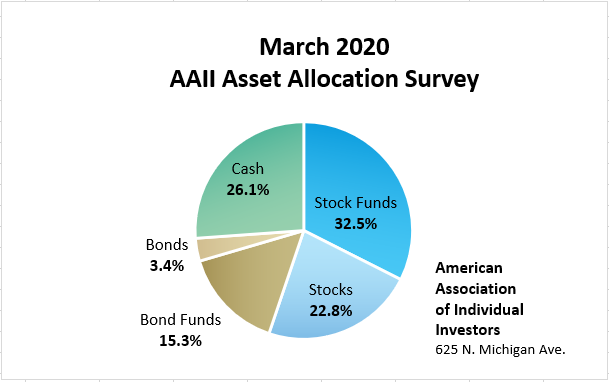
March AAII Asset Allocation Survey results:
- Stocks and stock funds: 55.2%, down 10.9 percentage points
- Bonds and bond funds, 18.7%, down 0.4 percentage points
- Cash: 26.1%, up 11.3 percentage points
March AAII Asset Allocation Survey details:
- Stock funds: 32.5%, down 5.0 percentage points
- Stocks: 22.8%, down 5.9 percentage points
- Bond funds: 15.3%, down 0.1 percentage points
- Bonds: 3.4%, down 0.3 percentage points
Historical Averages:
- Stocks/Stock Funds: 61.0%
- Bonds/Bond Funds: 16.0%
- Cash: 23.0%
The numbers are rounded and may not add up to 100%.
The AAII Asset Allocation Survey has been conducted monthly since November 1987 and asks AAII members what percentage of their portfolios are allocated to stocks, stock funds, bonds, bond funds and cash. The survey and its results are available online at: www.aaii.com/investor-surveys.
- Stocks and Stock Funds: 55.2%, down 10.9 percentage points
- Bonds and Bond Funds: 18.7%, down 0.4 percentage points
- Cash: 26.1%, up 11.4 percentage points
- Stocks: 22.8%, down 5.9 percentage points
- Stocks Funds: 32.5%, down 5.0 percentage points
- Bonds: 3.4%, down 0.3 percentage points
- Bond Funds: 15.3%, down 0.1 percentage points
- Stocks/Stock Funds: 62.0%
- Bonds/Bond Funds: 16.0%
- Cash: 22.0%
Take the Asset Allocation Survey.
April 2, 2020 Measuring Companies’ Financial Strength Amid Spike in Borrowing
March 26, 2020 Helpful Financial Planning Actions You Can Do While Sheltering in Place
March 19, 2020 The Berserk Financial Markets Provide Opportunities for Tax-Saving Tactics
March 12, 2020 The Barbell Strategy—A Simple Way of Being Both Aggressive and Conservative

Discussion
Ron from KY posted over 6 years ago:
If we pass on taking the RMD in 2020 will we have to double up next year?
Tom from CA posted over 6 years ago:
While the first estimate is due 15 July, I believe the second estimate still must be made by 15 June.
David from CA posted over 6 years ago:
My read is that we don't need to take a RMD and next year is not affected at this time. This is welcome news because the market dropped so much that for me it was the equivalent to an RMD or more. I sold some stocks just to make sure I had enough cash to make the RMD. Now time to use it to buy some NVAX!
Ken from OH posted over 6 years ago:
Second estimate is now due July 15.
Jim Treonis from FL posted over 6 years ago:
Consider the following hypothetical case. If I do not take my 2020 RMD, then going forward my 2021 RMD will increase to compensate for the fewer life expecting years. Except, the 2021 account value will likely be less than its Dec. 31, 2019 value, resulting in lowering my 2021 RMD. However, the $6 Trillion or so in debt due to 2020 government support benefits will have to be paid for going forward. The resulting possibly is higher taxes, thereby increasing taxes on future RMD monies. So the question is, should we take more than the required RMD money from the IRA’s in 2020, at least the Dec. 31, 2019, RMD or nothing at all? Does anyone have any suggestions?
Charles Rotblut from IL posted over 6 years ago:
A couple of follow-ups.
RMDs for 2021 will be determined by your account balance at the end of 2020 and your age. To the extent money is not withdrawn from your tax-deferred retirement accounts this year, the dollar amount for determining your 2021 RMD will increase. Fluctuations in the value of your investments will also have an impact--potentially a bigger one depending on your age and your account balance.
You could use the tax savings from not taking an RMD this year and use it to cover the tax cost of doing a Roth IRA conversion if you won't need the funds for five years. Doing so would lower your RMDs for next year. The InvestoGraphic we published in the December AAII Journal may help you decide whether a Roth IRA conversion makes sense for you.
Regarding second-quarter estimated taxes, Ken is correct. They are still due on July 15.
Hope this helps,
Charles
Ken from New Mexico posted over 6 years ago:
Jim Treonis poses an interesting hypothetical case. What came to mind, though, is the premise that tax considerations should be placed near the end of the investment decision process. I agree with Jim's first observations about the annual RMD percentage rising and the ending 2020 portfolio value likely being less. The remainder of the case is a "what if." It's hard to know what will happen with taxes going forward. Why? Because another option is that the government can do nothing but print more money. Doing so would have other consequences but the point is that whatever Congress' decides to do is months, if not years, away. And, when it does take action, we'll hopefully have enough time to make necessary adjustments to our investments.
Deskandchairs from WA posted over 6 years ago:
Second-quarter estimated taxes. Charles, what do you mean, "They are STILL due on July 15?" They have NEVER been due on July 15th. "Still" is June, not July. But it seems you are still right. Following from a FORBES article on this subject. “It was the first time in history the 2nd installment was due before the first installment. It was like who’s on first,” says CPA Ed Slott of Rockville Centre, N.Y. Now, the June 15 estimated tax payment date has been pushed to July 15. So for anyone paying in estimated payments for 2020, the first two payments are due on July 15. Estimated payments for third quarter remain due on September 15, and those for fourth quarter are due on January 15, 2021.
Charles Rotblut from IL posted over 6 years ago:
Good catch Deskandchairs. You're correct, the second-quarter deadline has been pushed back from June to July. We'll get that fixed. -Charles
USMC from TX posted over 6 years ago:
As part of a strategy to reduce RMD's we have been making conversions from Traditional IRA's to Roth IRA's for the past few years. The ability to "recharacterize" conversions was removed effective 1 Jan 2018. In light of the meltdown in the markets, has there been any move to once again allow recharacterizations of conversions made in 2019? Seems like that would be akin to waiving the RMD's for 2019/2020 that has already been put into place.
Carl from Florida posted over 6 years ago:
I took a previous distribution from my IRA, from which federal tax was withheld. Can I roll over the entire distribution, or just the distribution less the withholding?
Charles Rotblut from IL posted over 6 years ago:
Carl, You have 60 days to do the rollover. Here's what the IRS says about amounts withheld:
If you have not elected a direct rollover, in the case of a distribution from a retirement plan, or you have not elected out of withholding in the case of a distribution from an IRA, your plan administrator or IRA trustee will withhold taxes from your distribution. If you later roll the distribution over within 60 days, you must use other funds to make up for the amount withheld.
See Rollovers of Retirement Plan and IRA Distributions on the IRS' website for more information.
-Charles
Martin from Iowa posted over 6 years ago:
Given the expected financial downturn (the Great Depression comes to mind) is it good, do you think, to take the RMD in one payment now while the market is still in an historical high range rather than worry about tax consequences later?
Joe Buss from North Carolina posted over 6 years ago:
Can a college student age 19 who is claimed as a dependent on parents return (even though they can't get the $500 stimulus for her) file a tax return to have her $25 federal withholding for her part time job refunded & also get a $1200 or $500 stimulus payment? The student lives with her grandparents in another state from parents and contributes nothing to their household. The student earned only $2162 in 2019. Thanks!
Charles Rotblut from IL posted over 6 years ago:
Martin - The decision on how to allocate your savings is different than whether to take the RMD now or later. I'd also consider the impact on your wealth if your forecast turns out to be too pessimistic.
Joe - The answer to your question is no. The IRS specifically states that those "who can be claimed as a dependent on someone else’s return" are not eligible for the stimulus payment. This includes "a child, student or older dependent who can be claimed on a parent’s return."
-Charles
Thani from VA posted over 6 years ago:
Hello - If one is eligible for the benefit based on 2018 tax filing, but is not eligible for the benefit (due to capital gains to pay for son's college) based on 2019 situation, is it possible to delay 2019 filing and get the benefit? Will the government expect them to return the amount after 2019 filing is done (or when reporting 2020 taxes)? Will there be any penalty or interest associated with that return payment?
Charles Rotblut from IL posted over 6 years ago:
Jim - The deadline for second-quarter taxes has been pushed back to July 15. Here are the revised deadlines for estimated taxes. Thani - If you haven't filed yet, your 2018 return will be used. Tax experts expect some of type of reconciliation being included on 2020 tax returns since the stimulus is technically a credit against 2020 taxes. Nothing is set in stone, but the current line of thought is that taxpyaers may be able to claim additional stimulus if they were underpaid and will not be forced to pay back any excess amounts. This could change once the IRS gives official guidance.
Doreen from Florida posted over 6 years ago:
When deciding whether or not to move IRA dollars over to a Roth, you should look at the cost of your Medicare as well as the federal tax rate on the rollover. If you are in a taxable state, review that tax as well. If your 2020 income is lower, it may make you eligible for the stimulus check if your 2019 income was too high to qualify for the stimulus check. To sum up, check your federal tax, state tax, Medicare addition and the stimulus check amount before doing the rollover to the Roth in 2020.
Jim Hogg from Florida posted over 6 years ago:
Charles -- I found a potential discrepancy in your article. The 1040-EST 2d quarter estimated tax payment for June 15 is still due on June 15 and not July 15. I found this under FAQ, Q#16 Filing and Payment Deadlines Questions and Answers. The link is below. This needs to be verified as they may not have updated their Q&A's. https://www.irs.gov/newsroom/filing-and-payment-deadlines-questions-and-answers Thanks!!!
Bill from Iowa posted over 6 years ago:
"If you already took an RMD this year and want to avoid paying taxes on it, you have 60 days from the date of the withdrawal to roll it into a new IRA. In doing so, understand that only one rollover per year is allowed. If more than 60 days have passed, you will owe taxes on the distribution." IRS "Rollovers of Retirement Plan and IRA Distributions" page states that "You can roll over all or part of any distribution from your IRA EXCEPT a required minimum distribution." We took our 2020 RMDs on March 17th so we are still within the 60 day window. But I am concerned about whether that roll over will work for a 71 year old taking their RMD vs. a pre-retirement distribution that has been eligible for the 60 day window rollover for many years. I could not find any reference to the change you referenced in the first paragraph quoted above when I scanned the actual CARES Act itself. Please clarify with references.
Randy from Utah posted over 6 years ago:
I am an estate planning attorney and have been practicing for 37 years. Approximately 4 years ago, a very prominent financial planner pointed out at the Heckerling Institute (an annual estate planning held in Orlando in January)that 90% of the people who receive an inherited IRA within the first year have withdrawn all of the money and paid the tax. If this is anywhere near accurate, the changes in withdrawal rates will only affect a very few people. I do not think the revenue generated will not be nearly as great as projected. I have very few clients who have retirement plans with large sums--most have $500,000 or less--and by the time the proceeds are distributed among 3 or more children, the tax impact is not nearly as great as some of the experts apparently think it is. Just an observation based on my experience with clients over many years.
You need to log in as a registered AAII user before commenting.
Create an account