

The New SEC Rules Don’t Go Far Enough
by Charles Rotblut | June 06, 2019
Yesterday, the U.S. Securities and Exchange Commission (SEC) voted to adopt new rules intended to provide more protection for investors. It was a step in the right direction in some aspects but not as big of a step as I would have liked. There was also a change regarding advisers’ duty of care that gives me room for concern. Overall, I believe individual investors would be better protected if stronger rules were instituted.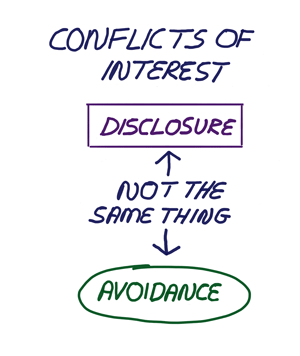
One major part is Regulation Best Interest (BI). According to the SEC, “broker-dealers will be required to act in the best interest of a retail customer when making a recommendation of any securities transaction or investment strategy involving securities.” It sounds good until one reads a bit further. The best interest rules require brokers to “establish, maintain, and enforce written policies and procedures reasonably designed to identify and at a minimum disclose or eliminate conflicts of interest.” It doesn’t take a high-priced attorney to know that there is a big difference between disclosing and eliminating and that the language says “or” not “and.” The 516-word footnote about avoiding or disclosing conflicts of interest in the SEC’s “Interpretation Regarding Standard of Conduct for Investment Advisers” will likely be brought up in many arbitration cases going forward as a point of argument over what actually qualifies as satisfying the rule.
Then there is language applying to registered investment advisers (RIAs) who are held to the higher fiduciary standard. A 2018 SEC proposal defined the duty of loyalty as requiring “an investment adviser to put its client’s interests first.” The rules passed yesterday changed the language to say, “the duty of care requires an investment adviser to provide investment advice in the best interest of its client, based on the client’s objectives.”
The new rules were passed on a three to one vote. In dissenting, SEC commissioner Robert Jackson Jr. opined, “The rule does not ‘defin[e] . . . the term “Best Interest,” and in fact goes out of its way to say that it doesn’t ‘require broker-dealers to recommend [one] “best” product.’”
Jackson was not alone with his criticism. SEC investor advocate Rick Fleming also expressed reservations about the new proposal. He wrote, “What investors have gained in Reg BI has been undermined by what investors have lost in the Commission’s interpretation of the fiduciary duty that applies to investment advisers.”
The best interest rule requires more disclosure. The new Form CRS Relationship Summary is intended to provide investors with “simple, easy-to-understand information about the nature of their relationship with their financial professional.” In an ideal world, investors will read it before making any decisions. In the real world, eyes start to glaze over when a myriad of information is given and the conversation is focused on investment advice and products instead of cost. As much as I favor disclosure, it only works when people are aware of and understand the implications of what is being disclosed. Fleming also expressed concern about the new form, predicting “it likely will not achieve its original goal of preventing the financial harm that results from investor confusion about the differences between investment advisers and broker-dealers.”
Industry associations were supportive of the new rules. SIFMA—the trade association for broker-dealers, investment banks and asset managers—described the rules as being “specific with respect to the duty and obligations brokers owe to their clients, and what steps they must take to comply, including the obligation to eliminate, or disclose and mitigate, certain conflicts of interest.” The Investment Company Institute, which represents the mutual fund industry, said the new rules “will better serve investor interests by ensuring investors are afforded strong protections when they receive recommendations from broker-dealers.”
Even once the new rules are put into place, you, the individual investor, should continue to grip your wallet tightly and ask questions. Question how the broker, adviser or insurance agent is getting compensated. Ask directly if there are any conflicts of interest. Inquire about cheaper alternatives. Most importantly, don’t rush to make any decisions. The many investment professionals who are honest and try to do the right thing for their clients will be patient and not pressure you. Those who are less scrupulous will be evasive, gloss over important details and push you to make a decision. If you feel pressured or unsure, get up and walk away.

-
Advice on Evaluating an Adviser From an Industry Veteran – Industry veteran William Francavilla listed five key questions he thinks every investor should ask an adviser or broker they’re considering working with.
-
Why Your Financial Adviser Should Be a Fiduciary – CFP Board ambassador Larry Stein explained why all financial advisers should be held to the stricter fiduciary standard in this AAII Journal article.
Expectations among individual investors for an increase in stock prices continues to stay at an unusually low level. At the same time, pessimism in the latest AAII Sentiment Survey remains at an unusually high level.
Bullish sentiment, expectations that stock prices will rise over the next six months, declined by 2.3 percentage points to 22.5%. Optimism was last lower on December 12, 2018 (20.9%). This is the fourth consecutive week bullish sentiment has been below 30% and the 16th time this year that optimism is below its historical average of 38.5%.
Neutral sentiment, expectations that stock prices will stay essentially unchanged over the next six months, pulled back by a slight 0.2 percentage points to 34.9%. Neutral sentiment remains above its historical average of 31.0% for the 18th time in 19 weeks.
Bearish sentiment, expectations that stock prices will fall over the next six months, rose 2.5 percentage points to 42.6%. Pessimism was last higher on January 2, 2019 (42.8%). This is the fourth consecutive week that bearish sentiment is above its historical average of 30.5%.
Like last week, pessimism is at an unusually high level while optimism is at an unusually low level (more than one standard deviation above/below their respective historical averages). Historically, unusually low levels of bullish sentiment and unusually high levels of bearish sentiment have been followed by higher-than-median six-month returns for the S&P 500 index.
Many individual investors have been monitoring trade negotiations, particularly between the U.S. and China. The possibility of tariffs placed on imports from Mexico may also be having an effect. We’ve also heard from AAII members who are concerned about a drop in stock prices occurring, and the recent weakness may be playing into their worries. (Many of this week’s responses were recorded on Monday.) Also having an influence are monetary policy, Washington politics (including President Trump), geopolitics, valuations, corporate earnings and the pace of economic growth.
This week’s special question asked AAII members how they perceive the current state of the housing market. Responses are mixed. More than a quarter of all respondents (28%) view home prices as being high or unaffordable. About 14% perceive the housing market as weakening while an additional 6% think the housing market is either risky or is in the late stages of its current growth cycle. Slightly more than 9% think the housing market will continue to hold up as long as interest rates don’t rise significantly or if the Federal Reserve cuts rates. Approximately 7% describe the housing market as being steady overall, while 8% view it as being strong.
Here is a sampling of the responses:
- “Stable. There’s a balance between buyer demand and seller inventory.”
- “Housing is getting to be too expensive for the average person to buy.”
- “Higher-end multi-family housing in many cities is approaching being significantly over-built.”
- “As long as rates stay low and the economy keeps humming, I think the housing market will stay strong.”
- “It varies from region to region, but overall it seems to be fairly well-balanced between buyers and sellers.”

Bullish: 22.5%, down 2.3 points
Neutral: 34.9%, down 0.2 points
Bearish: 42.6%, up 2.5 points
Bullish: 38.5%
Neutral: 31.0%
Bearish: 30.5%
AAII Asset Allocation Survey
Individual investors’ exposure to fixed-income investments reached a six-year high in May. The latest AAII Asset Allocation Survey also shows a pullback in equity exposure and a slight increase in cash allocations.
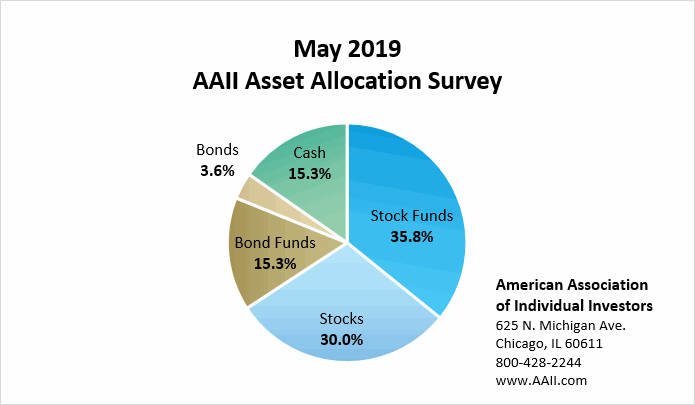
Stock and stock fund allocations declined 2.0 percentage points to 65.8%. Even with the decline, equity allocations remain above their historical average of 61.0% for the 74th consecutive month.
Bond and bond fund allocations rose 1.8 percentage points to 18.9%. Fixed-income allocations were last higher in April 2013 (19.7%). May was the fourth time in five months with bond and bond fund allocations above their historical average of 16.0%.
Cash allocations were 0.2 percentage points higher at 15.3%. Cash allocations remained below their historical average of 23.0% for the 90th consecutive month.
A down month for stocks combined with falling yields for bonds had an influence on the portfolio allocations for many individual investors, including those who did not actively make any adjustments. At the same time, optimism about the short-term direction of stocks in our weekly Sentiment Survey fell to an unusually low level during the latter half of May.
May AAII Asset Allocation survey results:
- Stocks and stock funds: 65.8%, down 2.0 percentage points
- Bonds and bond funds: 18.9%, up 1.8 percentage points
- Cash: 15.3%, up 0.2 percentage points
May AAII Asset Allocation survey details:
- Stocks: 30.0%, down 0.8 percentage points
- Stock Funds: 35.8%, down 1.1 percentage points
- Bonds: 3.6%, up 0.3 percentage points
- Bond Funds: 15.3%, up 1.5 percentage points
Historical Averages:
- Stocks/Stock Funds: 61.0%
- Bonds/Bond Funds: 16.0%
- Cash: 23.0%
The numbers are rounded and may not add up to 100%.
The AAII Asset Allocation Survey has been conducted monthly since November 1987 and asks AAII members what percentage of their portfolios are allocated to stocks, stock funds, bonds, bond funds and cash. The survey and its results are available online at: www.aaii.com/investor-surveys.
Want to weigh in? Take the survey yourself and see results online at www.aaii.com/assetallocationsurvey
- Stocks and Stock Funds: 65.8%, down 2.0 percentage points
- Bonds and Bond Funds: 18.9%, up 1.8 percentage points
- Cash: 15.3%, up 0.2 percentage points
- Stocks: 30.0%, down 0.8 percentage points
- Stocks Funds: 35.8%, down 1.1 percentage points
- Bonds: 3.6%, up 0.3 percentage points
- Bond Funds: 15.3%, up 1.5 percentage points
- Stocks/Stock Funds: 62.0%
- Bonds/Bond Funds: 16.0%
- Cash: 22.0%
Take the Asset Allocation Survey.
May 30, 2019 Cherry-Picking Data to Make Active Managers Look Good
May 23, 2019 Are Any of the Nifty 50 Stocks Still Nifty?
May 16, 2019 Good Strategies Aren’t Always Intuitive, Plus Other Morningstar Conference Notes
May 9, 2019 A Weekend at the Berkshire Hathaway Shareholder Meeting

Discussion
No comments have been added yet. Add your thoughts to the discussion!
You need to log in as a registered AAII user before commenting.
Create an account