

Good Strategies Aren’t Always Intuitive, Plus Other Morningstar Conference Notes
by Charles Rotblut | May 16, 2019
Right on the heels of the Berkshire Hathaway shareholder meeting, I turned around and went to the Morningstar Investment Conference last week. This annual conference is focused on mutual funds and exchange-traded funds (ETFs). It is primarily attended by advisers, with many mutual fund, ETF and financial services companies exhibiting. I don’t know if it was because of the length of the bull market, fee compression, a combination of the two or something else, but the amount of exhibitor swag being given out to entice attendees to stop by booths was—by my admittedly unscientific observation and tally—at a new low. Lots of pens, some notebooks, some reusable shopping bags, a handful of tees and (as a sign of the times) a few metal straws. There were also individually wrapped s’mores with a note attached describing them as “for investment professional use only.”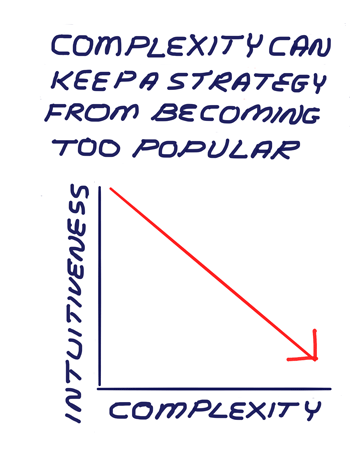
As far as the presentations are concerned, Cliff Asness, the chief investment officer of AQR Capital Management, discussed quantitative strategies in a different light than is typically heard. Rather than focusing on specific traits to seek out, he discussed the difficulty of sticking with them. The word he commonly used was “intuition.”
Quant strategies, including factor strategies, identify stocks based on numeric traits. A simple quantitative strategy could be one targeting stocks trading at low price-to-book ratios. It’s intuitive because it invests in cheaply valued stocks. When returns are good, value is in vogue. When it doesn’t work, value must not be working. It’s an easy strategy for investors to grasp and for advisers to explain.
Single-factor strategies, such as value, can be improved upon by adding in additional factors. Quality traits can weed out those companies that deserve low valuations. Size seeks out smaller companies, which have greater odds of being mispriced. While returns are enhanced, the increased complexity from combining strategies makes a strategy more difficult to grasp. A multi-factor strategy is less intuitive because there are moving parts as opposed to a single key factor. When the strategy lags, it’s less clear why the strategy didn’t work. The complexity leads to a line of thought Asness described as “when it loses, I can’t explain it so I’m not going to do it.”
He called this mental hurdle a “design feature” of quantitative strategies. Since there is an aversion to following less intuitive strategies, they are less likely to be too crowded. One of the big risks to any strategy is having too much money invested in it. Popularity diminishes returns. Being a maverick can boost your returns, as long as your strategy is based on historical data about what works and you have the discipline to stick with it over the long term.
Though I spent much of the Morningstar conference meeting with people (and laying the groundwork for future AAII Journal articles), here are some other takeaways I have:
• Discipline and how risk is viewed were subjects of Morgan Housel’s presentation. “Good investing is not about what you know, it’s about how you behave,” the Collaborative Fund partner told the audience. He went on to describe how people anchor their views of risk based on their personal experiences. For example, the returns of stocks when a person first started investing often establishes preferences that stay with them for the remainder of their life. Difficult market conditions are likely to lead to a lifetime of being more conservative, while good market conditions are likely to lead to a lifetime of risk-taking.
• The concept of risk and perception came up again during a panel on value investing. BlackRock’s Holly Framsted described the risk in value strategies as being the drawdowns (negative returns), which are followed by big upswings. Alpha Architect’s Wes Gray responded by telling the audience to either “own the risk” or not. Investors should avoid value strategies if the volatility makes it difficult for them to stick with them. O’Shaughnessy Asset Management’s Patrick O’Shaughnessy said he likes to see lengthy periods of underperformance because it scares people away and prevents traders from trying to arbitrage away the strategy’s upside.
• Morningstar’s Daniel Needham displayed what he called a “contrarian investor’s checklist.” Among the questions to ask: Are most investors underweight? Are earnings expectations low relative to history? Is sentiment negative? Is volatility high? And, are valuations low relative to history and similar assets?

-
Weight by Fundamentals, Not by Price – One of the people who helped make factor investing popular in the modern era is Robert Arnott. We talked about his quantitative approach and his rationale for it.
-
Developing an Intuitive Feel for the Mechanics of Growth – Intuition goes beyond just quantitative strategies. Having a feeling for growth can help you determine whether a given rate of growth or return is unreasonably high or low.
The latest AAII Sentiment Survey shows the largest weekly changes in individual investor optimism and pessimism in five months. Neutral sentiment had a more modest change but still declined for the third consecutive week.
Bullish sentiment, expectations that stock prices will rise over the next six months, plunged 13.3 percentage points to 29.8%. Optimism was last lower on December 19, 2018 (24.9%). The historical average is 38.5%.
Neutral sentiment, expectations that stock prices will stay essentially unchanged over the next six months, continued to drop. This week’s 2.8-percentage-point decline put neutral sentiment at 30.9%, its lowest level since January 23, 2019 (30.0%). The drop also ends a streak of 15 consecutive weeks with readings above the historical average of 31.0%.
Bearish sentiment, expectations that stock prices will fall over the next six months, spiked by 16.1 percentage points to 39.3%. Pessimism was last higher on January 2, 2019 (42.8%). Bearish sentiment is above its historical average of 30.5% for the first time in nine weeks.
This week’s changes were the largest since December 12, 2018. Six months ago, bullish sentiment fell by 17.0 percentage points while bearish sentiment jumped by 18.4 percentage points.
At current levels, bullish sentiment is near the bottom of its typical range while bearish sentiment is near the top of its typical range. Neither is at an unusually low or high level, respectively.
Many individual investors have been monitoring trade negotiations, particularly between the U.S. and China. We’ve also heard from AAII members who are concerned about a drop in stock prices occurring, though we’ve also heard from others who have been encouraged by this year’s upward run in stock prices. Also having an influence are monetary policy, Washington politics (including President Trump), geopolitics, valuations, corporate earnings and the pace of economic growth.
This week’s special question asked AAII members what industries or sectors they like right now. Approximately 19% say health care with an additional 5% of respondents specifying pharmaceutical companies. About 19% say technology. Tied for third are financials/banks and utilities with slightly more than 12% of all respondents listing each. Just under 8% of respondents say real estate and real estate investment trusts (REITs), while another 7% say consumer staples. Several respondents list more than one industry or sector.

Bullish: 29.8%, down 13.3 points
Neutral: 30.9%, down 2.8 points
Bearish: 39.3%, up 16.1 points
Bullish: 38.5%
Neutral: 31.0%
Bearish: 30.5%
May 9, 2019 A Weekend at the Berkshire Hathaway Shareholder Meeting
May 2, 2019 The Latest Enhancements to AAII.com
April 25, 2019 My Personal Portfolio Four Months After Correction
April 18, 2019 Six Measures for Comparing Funds

Discussion
No comments have been added yet. Add your thoughts to the discussion!
You need to log in as a registered AAII user before commenting.
Create an account