

A Weekend at the Berkshire Hathaway Shareholder Meeting
by Charles Rotblut | May 09, 2019
The annual Berkshire Hathaway Inc. (BRK.A) shareholder meeting is described as the “Woodstock of Capitalism.” After spending the weekend in Omaha, Nebraska, I can attest that the moniker is accurate. In addition to the actual shareholder meeting, there are many other events. This week, I’ll share takeaways from my first time attending it.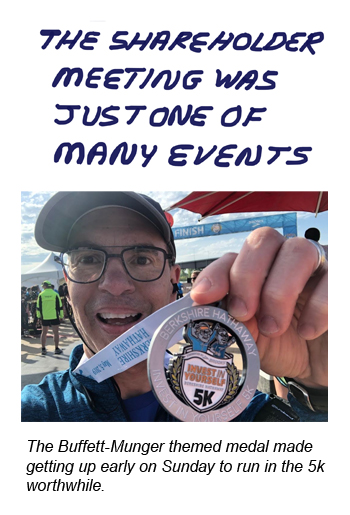
Berkshire Hathaway puts on several events for shareholders. A reception and a separate brunch are held in the 62,500 square foot Borsheims jewelry store, where Bill Gates was spotted playing bridge on Sunday. There is a picnic at the 77-acre Nebraska Furniture Mart. A two-day shopping expo at the CHI Health convention center featured many Berkshire-owned companies and more Berkshire-themed items than one person could possibly want. (I would have bought the bowtie if it had featured Warren Buffett and Charlie Munger instead of subtlely displaying the stock’s ticker symbol.) The Invest in Yourself 5K race was held on Sunday. Beyond the official Berkshire events, there were many panels and receptions including Creighton’s Value Investing Panel, the Variant Perspectives conference targeted toward women, the annual Yellow BRKers reception, Markel Corp.’s (MLK) annual brunch and a Nebraska YPOGold panel. It truly is a big event for value investors, but you do have to be a Berkshire Hathaway shareholder to attend the official events, which I am.
As I explained to my wife, who accompanied me, the Berkshire Hathaway shareholder meeting is an outlier. The question and answer session started in the morning, broke for about an hour and then resumed after lunch. The questions varied widely, ranging from making trains more environmentally friendly to share buybacks. Several questions came from kids or from their parents asking on their behalf. My favorite came from a 13-year-old aspiring investor who was seeking advice on how to follow his father’s advice about delaying gratification. Munger responded by saying “You’ll probably find some nice old woman who’s about 95 out there in threadbare clothing and she’s delaying gratification right to the end and probably has 4,000 A-shares. It’s the second- and third-generation types that will buy all of the jewelry.” Buffett observed that holding a 30-year government bond at today’s low interest rates would get a person the same number of rides at a theme park 30 years from now as they could get today. He added, “If you aren’t happy having $50,000 or $100,000, you’re not going to be happy if you have $50 million or $100 million … so, don’t go overboard on delayed gratification.” (As a point of reference, 4,000 class-A Berkshire Hathaway shares were worth more than $1.3 billion on Saturday.)
Another young investor asked Buffett and Munger about their favorite investment. Buffett discussed his one-share investment in Atled Corp., whose name was “delta” spelled backward. It was a duck-hunting club that found out it had oil reserves on its properties when one of its members shot at the ground. Munger said he has turned down about as many as 500 investments for every one he has bought.
Later in the meeting, Munger admitted to missing out on Alphabet Inc. (GOOGL): “We saw how well Google was working in all our offices and we were sucking our thumbs,” explained the vice chairman. Berkshire did recently take a stake in Amazon.com Inc. (AMZN), though neither Buffett nor Munger made the purchase. Buffett countered the idea of value being tied directly to low price-to-book or low price-earnings ratio. Then referencing Aesop’s fable about a bird in the hand being worth more than two in the bush, he quipped, “We worry about what’s in the bush and if somebody will take the bush away.”
The concept of Buffett’s strategy evolving from a strict Benjamin Graham “cigar butt” approach—which called for buying stocks trading at a low price relative to their net current assets—to one incorporating quality factors was only directly brought up briefly during the shareholder meeting. A day prior at the Creighton panel, former hedge fund manager Whitney Tilson explained how his approach changed from a deep-value strategy. He now believes that the key to a successful strategy is a combination of being 75% right on the business model and 25% right on valuation. Previously, he had the mix flipped (predominantly low valuation).
I do want to share a few personal observations. I’ve been to several investor conferences, beyond our own Investor Conference (which is still my favorite—though I am admittedly biased). The Berkshire Hathaway shareholder meeting stands out for its sheer size (the Omaha World-Herald estimated the attendance at 42,000) and its very diverse audience. I had the opportunity to speak with many individual investors—including AAII members—as well as many professionals. There were many attendees who traveled from abroad, too. I personally spoke with shareholders from Argentina, Austria, Australia, China, Great Britain and Mexico. Thanks go out to Robert Johnson, Guy Spier, Vitaliy Katsenelson, as well as both the blue dots (so-named because we put blue stickers on our badges) and The Investors Podcast groups for sharing tips about the weekend’s various events.

-
The Art of Value Investing – Whitney Tilson, along with co-author John Heins, shared insights about investing in turnarounds, deciding when to sell and avoiding overconfidence.
-
The Role of Diversification in an Individual Stock Portfolio – Among the value investors I met over the weekend was Vitaliy Katsenelson, who gave guidance on portfolio allocation in this 2008 AAII Journal article.
Optimism among individual investors about the short-term direction of the stock market is at its highest level in seven months. The latest AAII Sentiment Survey also shows neutral sentiment at its lowest level in over four months.
Bullish sentiment, expectations that stock prices will rise over the next six months, rose 4.1 percentage points to 43.1%. Optimism was last higher on October 3, 2018 (45.7%). The historical average is 38.5%.
Neutral sentiment, expectations that stock prices will stay essentially unchanged over the next six months, fell by an additional 5.9 percentage points to 33.7%. Neutral sentiment was last lower on January 23, 2019 (30.0%). Even with the drop, neutral sentiment remains above its historical average of 31.0% for the 15th consecutive week and the 16th time in 18 weeks.
Bearish sentiment, expectations that stock prices will fall over the next six months, rose 1.8 percentage points to 23.2%. Pessimism is below its historical average of 30.5% for the eighth consecutive week and the 13th time in 14 weeks.
As noted last week, above-average readings for bullish sentiment continue to be infrequent. This is just the fourth time since February 2018 that optimism is above its historical average on consecutive weeks.
At current levels, all three indicators are within their typical ranges.
This year’s rebound in stock prices has encouraged some individual investors, though others have concerns about its sustainability. Many individual investors are monitoring trade negotiations, particularly between the U.S. and China. Also having an influence are monetary policy, Washington politics (including President Trump), geopolitics, valuations, corporate earnings and the pace of economic growth.
This week’s special question asked AAII members what they thought about the Federal Open Market Committee’s (FOMC) decision to leave interest rates unchanged. Nearly two-thirds of respondents (64%) agree with the FOMC’s voting members or otherwise thought that not making a change was the right thing to do. Some of these respondents think rates should be held at current levels and/or that no change was warranted given the current data. Slightly more than 10% of respondents think the FOMC should have raised rates. Approximately 6% say their investing strategy is not influenced by monetary policy.
Here is a sampling of the responses:
- “Good decision. With inflation nonexistent, there is no reason to raise the rate right now.”
- “I agree that the Fed should stay neutral for the foreseeable future.”
- “It sounds to me like they are not very sure of things.”
- “I don’t buy investments based on what the Fed does with interest rates.”
- “I think they should have gone up a quarter of a point to keep inflation in check and to give people living on interest and bonds a little wiggle room.”

Bullish: 43.1%, up 4.1 points
Neutral: 33.7%, down 5.9 points
Bearish: 23.2%, up 1.8 points
Bullish: 38.5%
Neutral: 31.0%
Bearish: 30.5%
May 2, 2019 The Latest Enhancements to AAII.com
April 25, 2019 My Personal Portfolio Four Months After Correction
April 18, 2019 Six Measures for Comparing Funds
April 11, 2019 Active ETFs With Special Risks

Discussion
Patrick from KY posted over 7 years ago:
I have wanted to go to the meeting in Omaha. Where did you stay? if 42000 people attended accommodations must be very tight. I don't want to try to talk my wife into staying in a tent. Suggestions?
Charles Rotblut from IL posted over 7 years ago:
We stayed downtown. The hotels near the arena are expensive ($500-$550 per night) but we were able to get by without having to rent a car. We either walked or used Lyft/Uber. The Hilton is the closest--it physically connects to the CHI Health Center--but there are other nearby options. If you drive or intend to rent a car, there is a small section of Iowa on the west side of the river near the airport with cheaper hotels. Their big downside is that it's difficult to get rideshare cars quickly from them and you can't walk to any events. I booked my hotel room last fall, btw. -Charles
Claude from GA posted over 7 years ago:
When I attended the BRK annual meeting in 2008, at my own expense, I made a 3-day reservation 364 days ahead of time at the Hampton Inn in Council Bluffs, Iowa, right across the river from Omaha. (Hotels don't seem to accept reservations more than one year ahead.) I drove my own car (from Atlanta) and thus had it to drive to the stockholder meeting at the convention center (which had ample parking), to various other venues related to BRK (like the Nebraska Furniture Mart and Borsheims), and to the TD Ameritrade home office and the Omaha zoo. From there I drove north and then westerly across South Dakota, seeing the Corn Palace, Wall Drugs, the Badlands and Black Hills, Mount Rushmore, etc., eventually driving through Wyoming, Colorado and New Mexico, then east through Texas, Oklahoma, Arkansas, Mississipi, Alabama, back to Georgia. You can make the BRK meeting part of a wonderful tour. This one gave us the right to brag we have now seen all 50 states.
James F from TX posted over 7 years ago:
I have read that Berkshire Hathaway has under-performed the S&P 500 over the past 10 years. If this is true, investment advice from the people running it would seem to have limited value. One would be better off just buying an index fund.
Dilbert from CA posted over 7 years ago:
As Berkshire Hathaway has grown in size, it has demonstrated that beating the S&P500 over time is indeed next to impossible!
You need to log in as a registered AAII user before commenting.
Create an account