

Active ETFs With Special Risks
by Charles Rotblut | April 11, 2019
If the U.S. Securities and Exchange Commission (SEC) says no, keep trying. This seemed to be Precidian Investments’ motto, and its persistence appears to have finally paid off. The firm received approval for its new kind of exchange-traded fund (ETF). The approval came after years of being sent back to the proverbial drawing board. The firm describes its efforts as “a struggle that has been ongoing for the better part of a decade.”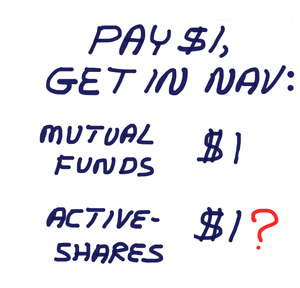
Precidian intends to launch nontransparent active ETFs, branded ActiveShares. These are ETFs whose assets will only be disclosed on a quarterly basis. In contrast, ETFs currently disclose their holdings daily. Daily disclosure has been a hurdle for many active managers who fear having traders jump ahead of their trading decisions if their portfolios are made known.
Most mutual funds only disclose their holdings on a quarterly basis. Shares of mutual funds are bought and sold based on the end-of-day value of their underlying holdings. When you spend $1 to buy a share (or a partial share) of a mutual fund, you get $1 of assets based on their end-of-day value. This is not the case with nontransparent ETFs, which trade throughout the day. When you spend $1 on a nontransparent ETF, you may get $1 worth of assets, you may get more than $1 worth of assets or you may get less than $1 worth of assets. You simply won’t know.
The reason why has to do with how ETFs are different than mutual funds. When you buy or sell mutual fund shares, the money goes into/flows out of the mutual fund’s assets. Shares of ETFs are bought and sold among investors on the open market; the money does not go into or out of the ETF itself. An intermediary, known as an authorized participant (AP), corrects imbalances by not only trading in the open market, but also by transacting in creation units with ETF providers. Creation units are blocks of generally 50,000 shares that can be exchanged for a basket of the underlying securities and cash. The exchange of creation units is enabled by the daily disclosure of an ETF’s holdings. APs can identify what is held by the fund and, based on that information, determine whether the ETF’s shares are trading at a premium or a discount. This transparency allows most ETFs to trade close to their net asset value (NAV) under normal market conditions. (ETFs investing in less frequently traded assets and/or following more esoteric strategies may still trade at premiums or discounts to their NAV even with full transparency.)
In the case of Precidian’s ActiveShares, rather than knowing what the ETFs actually hold, the APs will confidentially be informed of a “verified intraday indicative value,” or “VIIV.” In its SEC filing, Precidian asserted that the “VIIV will be an accurate representation of the value of a fund’s portfolio securities.” Though updated every second, it’s not the NAV of the fund nor is it clear how accurate the VIIV will be in practice. Reuters say the SEC twice rejected Precidian’s proposals before accepting this revised version.
If some of you are thinking this all sounds familiar, it’s because Precidian is not the first firm to push nontransparent ETFs. Eaton Vance’s NextShares previously received the green light to launch nontransparent ETFs. So far, their funds have not attracted much in the way of investor dollars. Thirteen of the 14 NextShares funds currently in existence have less than $15 million in assets under management (AUM). This is a very small number. Even transparent actively managed ETFs have mostly failed to attract much investor attention. There a few exceptions, such as PIMCO Active Bond ETF (BOND) with its $2.1 billion in AUM, but they are the outliers.
There is also the record of active management to take into account. After fees are considered, the majority of active managers don’t beat their index. Though some do, picking which ones will do so in advance is very difficult.
While much is made about the advantages of being a first-mover, there is often a disadvantage to being one. The ActiveShares ETFs are one such case where patience is the better strategy. These are new types of funds and it is very uncertain how they will actually perform in the real world. The reward from good investments occurs over time, not at launch.

-
Why Aren’t There More Active ETFs? – I discussed why there haven’t been many active ETFs launched and how NextShares’ ETFs differ from Precidian’s ActiveShares in this 2015 AAII Journal article.
-
An Inside Look at Exchange-Traded Funds – Those of you desiring a more thorough explanation of how ETFs are created and how they differ from mutual funds may find this article helpful.
Pessimism about the short-term direction of the stock market fell to an unusually low level in this week’s AAII Sentiment Survey. Optimism rose above its historical average for the first time in six weeks, while neutral sentiment is at the upper end of its recent range.
Bullish sentiment, expectations that stock prices will rise over the next six months, jumped 5.3 percentage points to 40.3%. Optimism was last higher on February 27, 2019 (41.6%). This is the first time bullish sentiment is above its historical average of 38.5% in six weeks.
Neutral sentiment, expectations that stock prices will stay essentially unchanged over the next six months, rebounded by 2.6 percentage points to 39.3%. The increase extends the streak of range-bound readings (35.3% to 39.8%) to 11 consecutive weeks. Neutral sentiment remains above its historical average of 31.0% for the 12th time in 14 weeks.
Bearish sentiment, expectations that stock prices will fall over the next six months, plunged 7.9 percentage points to 20.4%. Pessimism was last lower on February 27, 2019 (20.0%). This is the ninth time in 10 weeks that bearish sentiment is below its historical average of 30.5%.
Bearish sentiment readings below 20.7% are unusually low. Historically, the S&P 500 index has realized lower-than-average (3.8% versus 4.5%) and lower-than-median (4.2% versus 5.2%) six-month returns following such readings. The market has only declined 27% of the time following an unusually low bearish sentiment reading since the survey started in 1987.
Neutral sentiment is near the upper end of its typical range (22.9% to 40.0%). Bullish sentiment is well within its typical range.
This year’s rebound in stock prices has encouraged some individual investors, though others have concerns about its sustainability. Many individual investors are monitoring trade negotiations, though the impact varies by investor. Also having an influence are Washington politics (including President Trump and Democratic control of the House of Representatives), corporate earnings, the Federal Reserve, valuations and concerns about the pace of economic growth.
This week’s special question asked AAII members how, if at all, gasoline prices are impacting their outlook for stock prices. The majority of respondents (58%) say gas prices aren’t influencing their expectations for the stock market. Several of these respondents view gas prices as moving independently of stock prices. An additional 5% say gas prices have not risen enough to affect stock prices, while another 4% say prices usually rise as summer approaches. Slightly more than 6% say rising gasoline prices hurt consumer spending.
Here is a sampling of the responses:
- “Gasoline prices are not impacting my outlook for the market.”
- “I don’t foresee gasoline prices having a significant impact on the overall stock market.”
- “I think as long as gasoline prices stay within a fairly broad range, there will not be a great effect.”
- “Poor timing for the summer vacation season.”
- “I suspect they will not go up high enough to make a major difference in the economy.”

Bullish: 40.3%, up 5.3 points
Neutral: 39.3%, up 2.6 points
Bearish: 20.4%, down 7.9 points
Bullish: 38.5%
Neutral: 31.0%
Bearish: 30.5%
April 4, 2019 Five Concepts Financially Literate Investors Understand
March 28, 2019 The Yield Curve Inverted (But Don't Fear a Recession)
March 21, 2019 Managing the Five Big Types of Investing Risk
March 14, 2019 Stock Screens Can Help You to Beat the Market

Discussion
george richardson from TX posted over 7 years ago:
Has anyone looked at Jeremy Grantham’s global warming fund/ideas? His Boston based investment firm is called G.M.O. Saw a couple paragraphs about him in last Sunday’s NYT’s Magazine called the climate issue. Makes me want to ditch my oil companies and buy some of his fund as a hedge .
You need to log in as a registered AAII user before commenting.
Create an account