

Are Any of the Nifty 50 Stocks Still Nifty?
by Charles Rotblut | May 23, 2019
Back in the early 1970s, there was a group of stocks that institutional investors—and likely many individual investors—flocked to. Known as the “Nifty 50,” they were stocks viewed as being the preeminent stocks to own. University of Pennsylvania professor Jeremy Siegel described them as often being called “one-decision stocks: buy and never sell.”
These stocks had several traits in common during the early 1970s. They were growing both earnings and dividends. Their market capitalizations were large. Their prospects were assumed to be bright. As such, investors ignored their valuations and happily paid significant premiums to own them. As those of you familiar with market history already know, the excitement about these stocks ended when their share prices plummeted during the 1973–1974 bear market. 
Siegel wrote about the Nifty 50 stocks in the October 1998 AAII Journal. Some of you may have seen his article as part of our Top 40 series. In celebration of the AAII Journal’s 40th anniversary, we’re sharing 40 influential investment articles hand-picked from our archives. When we featured Siegel’s article last week, I mentioned to my colleague Wayne Thorp that it would be interesting to find out how many of these companies still exist and whether they are still nifty. So, I looked at all 50.
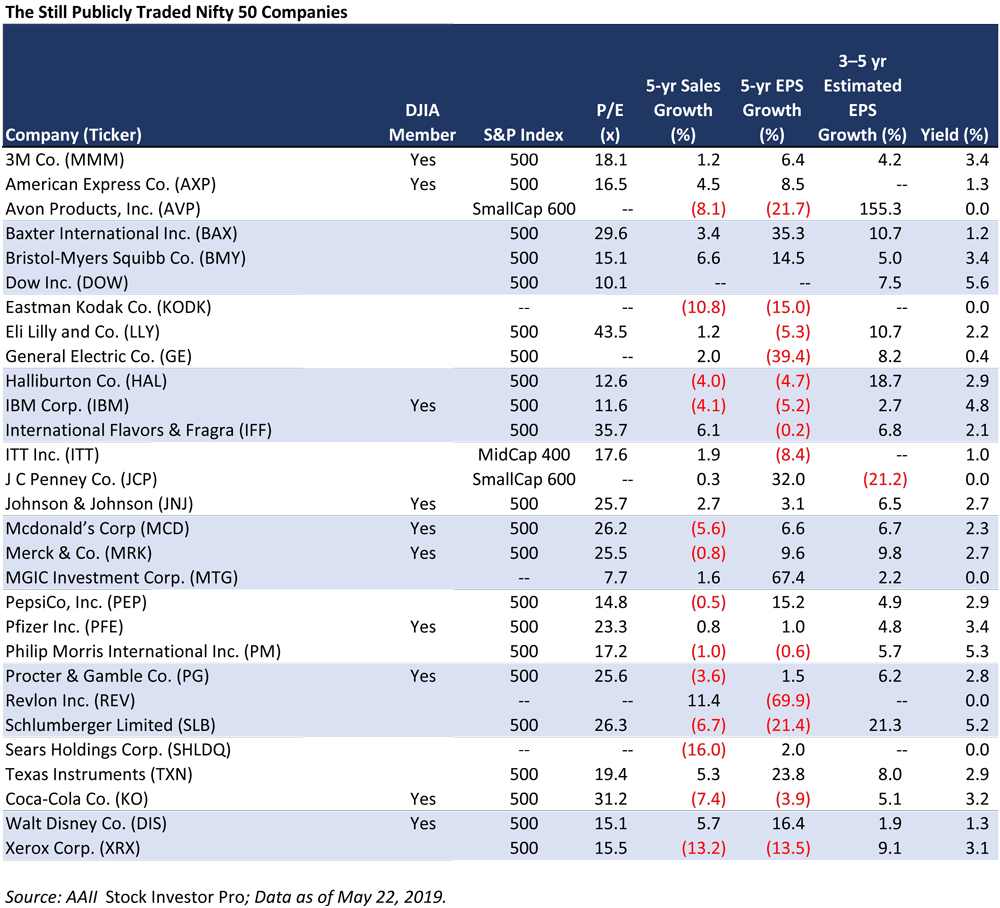
Of the 50 companies listed by Siegel, 29 are still publicly traded while 21 are not. The ones that are publicly traded are listed in the table at the end of this commentary along with data about their growth rates and valuations.
Most of the former Nifty 50 companies that are no longer publicly traded have been acquired, including Anheuser-Busch, Black & Decker Corp., Gillette and Lubrizol Corp. Emery Worldwide and Polaroid are no longer in business (though Polaroid’s name lives on). S. S. Kresge Corp. (aka Kmart Corp.) is part of beleaguered Sears Holding Corp. (SHLDQ) and the combined company remains on thin ice.
Avon Products Inc. (AVP) may be the latest Nifty 50 stock to cease being an independent company. Yesterday, Avon agreed to be acquired by Brazil’s Natura SA. The merger is projected to close early next year.
Among the Nifty 50 members to still be publicly traded, 10 are current Dow Jones industrial average components. They are 3M Co. (MMM), American Express Co. (AXP), IBM Corp. (IBM), Johnson & Johnson (JNJ), McDonald’s Corp. (MCD), Merck & Co. (MRK), Pfizer Inc. (PFE), Procter & Gamble Co. (PG), Coca-Cola Co. (KO) and Walt Disney Co. (DIS). In total, 22 of the 29 surviving Nifty 50 companies are members of the S&P 500, implying that they remain large-cap stocks. Three are not in any of the major S&P indexes: Eastman Kodak Co. (KODK), Revlon Inc. (REV) and Sears.
Valuations vary but are generally reasonable given the current market environment. The median price-earnings ratio for those with enough earnings to calculate the ratio is 17.9. The range is 7.7 to 43.5, with MGIC Investment Corp. (MTG) at the low end and Eli Lilly and Co. (LLY) at the high end.
Growth rates vary widely, though analysts expect most of the companies to grow earnings over the next three to five years. Historical sales and earnings growth also vary; for many of these companies, they aren’t so nifty.
What the data does show is that “buy and never sell” is not a good investment strategy. While long-term investing is a good strategy for individual investors, the characteristics of investments change over time. Some stocks can be held for a significantly long period of time, but others need to be parted with. Being a discerning buyer with preestablished rules for selling can help you adhere to a happy medium of not overpaying, buying with the intent of holding for a lengthy period and always knowing where the exit doors are.

-
Valuing Growth Stocks: Revisiting the Nifty Fifty – In the October 1998 AAII Journal, Jeremy Siegel revisited these glamour stocks to determine whether their popularity in the early 1970s was warranted.
-
Understanding Asset Bubbles and How to React to Them – The Nifty 50 was a bubble. The stories that were used to justify the lofty valuations were not unusual. As Nobel laureate Robert Shiller explains, stories commonly develop to justify asset bubbles.
The percentage of individual investors describing their short-term outlook for stocks as “neutral” rebounded strongly. The latest AAII Sentiment Survey also shows declines in both optimism and pessimism.
Bullish sentiment, expectations that stock prices will rise over the next six months, fell 5.1 percentage points to 24.7%. Optimism was last lower on December 12, 2018 (20.9%). This is the 14th time this year that optimism is below its historical average of 38.5%.
Neutral sentiment, expectations that stock prices will stay essentially unchanged over the next six months, rose 8.3 percentage points to 39.2%. The increase puts neutral sentiment back above its historical average of 31.0% for the 16th time in 17 weeks.
Bearish sentiment, expectations that stock prices will fall over the next six months, pulled back by 3.2 percentage points. Even with the decrease, pessimism is above its historical average of 30.5% on back-to-back weeks for the first time since January.
Since setting a 2019 high of 43.1% two weeks ago, bullish sentiment has fallen by a cumulative 18.4 percentage points. At its current level, optimism is at an unusually low level. Such readings have historically been followed by higher-than-median six- and 12-month returns in the S&P 500 index.
Many individual investors have been monitoring trade negotiations, particularly between the U.S. and China. We’ve also heard from AAII members who are concerned about a drop in stock prices occurring, though there are other members who have been encouraged by this year’s upward run in stock prices. Also having an influence are monetary policy, Washington politics (including President Trump), geopolitics, valuations, corporate earnings and the pace of economic growth.
This week’s special question asked AAII members how, given the recent U.S.-China headlines, trade issues are influencing their outlook for stocks. Responses varied, though most respondents view the trade impasse as a near-term negative for stocks.
Nearly a quarter of all respondents (24%) say they expect stock prices to fall if the impasse continues. Just under 17% of respondents describe themselves as being more cautious or are otherwise postponing buying more stocks until there is more clarity. About 9% anticipate more uncertainty, while a similar proportion of respondents think trade issues will contribute to further volatility in the stock market. Slightly more than 12% expect the stocks to rise once a deal is reached, though many of these respondents say the stocks could be under pressure until then. Approximately 14% say trade issues are not influencing how they invest.
Here is a sampling of the responses:
- “Definitely affecting it. I will continue to be cautious with new acquisitions until the issue is resolved.”
- “The lack of a trade agreement and imposition of tariffs will likely result in a drop in the stock market.”
- “I believe they will work something out, although in the short term there could be some slowing in the economy.”
- “I am taking advantage of the volatility; buying the dips and selling the peaks.”
- “They make my outlook for stocks definitely bearish. Without the trade war, my outlook would be neutral to slightly bullish.”

Bullish: 24.7%, down 5.1 points
Neutral: 39.2%, up 8.3 points
Bearish: 36.1%, down 3.2 points
Bullish: 38.5%
Neutral: 31.0%
Bearish: 30.5%
May 16, 2019 Good Strategies Aren’t Always Intuitive, Plus Other Morningstar Conference Notes
May 9, 2019 A Weekend at the Berkshire Hathaway Shareholder Meeting
May 2, 2019 The Latest Enhancements to AAII.com
April 25, 2019 My Personal Portfolio Four Months After Correction

Discussion
Czmola from PA posted over 7 years ago:
Regarding the Nifty-Fifty,it would be great to see the annual return on such a 50-stock portfolio since 1970 or so.
Michael Daillak, CPA from CA posted over 7 years ago:
I easily had data available for 19 of the 29, regarding what the current dividend would yield, if each of the 19 had been purchased in Feb 1981. Three of those 19 were among the six on your list that have a "0.0%" current dividend yield. In totaling the current yield for my 19 held more than 30 years I added 3 zeros. The average current yield for the 19 was 52.8% (still EVERY YEAR, YEAR AFTER YEAR, think about what that means in terms of "cost payback" !!). If I increase the population of my sample to 22 by adding the other 3 zero current dividend yields, the average is still a respectable 45.6%. If you decide to answer Czmola's question above, you might want to look into, and present, the perspective I'm presenting. You can find more information concerning this subject in the About Us at www.BuySellDoNothing.com
Longtime Member from Various posted over 7 years ago:
Mr. Rotblut, with all due respect, I don't think it's appropriate to say: "What the data does show is that “buy and never sell” is not a good investment strategy." The date you show merely show selected CURRENT data. What they doesn't show would be (among other data): Purchase Price, and, for example, Dividends Paid Out Over Holding Period. One of the statistics I use in my investment portfolios is what I call "Basis Yield." It can be incredible to compare the Current Yield with Basis Yield with stocks paying rising dividends and held over a long period. What your data also doesn't show are possible stock splits, tax-free spin-offs, and takeover prices at "sale" date. Today, fewer companies are splitting their stock. This is a shame, but alas a sign of the times. It is likely that many of the stocks split many times when these stock were popular. It was way to encourage individual investor participation when "round lots" were necessary to keep brokerage costs reasonable. I won't get into other advantages of not having to pay $100s of dollars for 1 share of stock but there is an expression "trees don't grow to the sky." While it is unlikely that many individual investors had the wherewithall to buy round lots of all 50, and none would be smart to buy them all at the same time. But I'm willing to bet that IF an investor had purchased each of these 50 stocks at "opportune times" her INITIAL 5,000 share portfolio would have many times over 5,000 shares in remaining companies, MORE dividend income many times over her initial investments, and even if she never sold one share of stock; no doubt was forced to sell when many companies were taken over at nice gains (this is what I tell my clients are "home runs" and just like in baseball, you can't predict who'll hit one and when). There's also a good chance there were surviving spin-offs that continue to live on in the portfolio.
Charles Rotblut from IL posted over 7 years ago:
Hi Longtime Member, There are certainly some companies that have rewarded shareholders for holding onto them. There are also many others, such as Sears and General Motors, that warranted selling. Companies evolve, sometimes for the better and sometimes for the worse. Even Warren Buffett--who openly advocates for long-term investing--sells stocks. -Charles
Longtime Member from various posted over 7 years ago:
It's been my experience that Registered Reps HATE to see "losers" in "their" portfolios; and, of course, selling means cash into the account, which is something else brokers don't like to see. To the extent you don't have many in a portfolio, who's clairvoyant enough to know when to sell? Many companies have cyclical ups and downs. If they have a decent franchise and pay a dividend, do I know more about the business to know when it will be out of business? Especially if I bought shares during one of their downs. You only bank a loss when you sell (incurring a cost) and if the company goes under, you get next to nothing (less after trading cost). BUT you now have a potential capital loss that can be banked against current or future capital gains. Just keep it in the portfolio until you need it - it's already (technically) "worthless" but not to the investor. Having a procedure for "getting in" is a LOT more important than "getting out." Let the market "get out for you" with takeovers OR let the clunkers sit there until you can use them. The best two ways I know to "sell." It reduces transactions cost and it takes emotions out of the game. Just like taxes, losses are a small price to pay for success. Leave them there til you need them, it's humbling to know you can't "pick 'em all." Naturally you can't benefit from netting losses in a tax-deferred account, but even so, it shows you yourTh "batting average." Best to concentrate on putting as much money into the portfolio and putting it to work DISPERSING across many companies, rather than fuss about a few losses. I wasn't going to mention this, but I consider three good reasons to sell, the third is when an issue has doubled. Sell 1/2 and let the balance run. It's amazing how this pays off over time. No emotion here, you literally can't lose because you got back your initial investment. If it goes under, no biggy. But left to run - who knows? I don't, and don't care. I agree that certain selling can be useful, but having a discipline for it should be part of the equation. In addition to "Basis Yield" I track "0 Basis" positions. These can be very gratifying statistics.
Michael Daillak, CPA from CA posted over 7 years ago:
Thanks "Longtime Member" I agree with all of your very insightful observations. Warren Buffet does provide insightful "commentary" for "individual investors"; however, he lives in a different world. And I don't recall any "comments" direct to "individual investors" regarding when to sell? As far as his "actions" they are those of someone who isn't an "individual investor". Please Mr. Rotblut, remember AAII's ostensible intended audience.
Michael Daillak, CPA from CA posted over 7 years ago:
Mr. Rotblut, I truly believe that you should have someone do the necessary research to show total return from buying and holding, without ever selling, the "Nifty-Fifty" from 1971 to date (i.e. the 5000 share portfolio "Longtime Member" suggests; however a more informative result would come from "equal-weight" investing, even with "odd lot" commissions). I believe you will be very impressed with the annual average compounded ROI, reflected by the current total value. I'm absolutely certain that would be the case if such a portfolio had been purchased in February 1981.
longtime investor from confusion posted over 7 years ago:
Thanks for the kind words Michael. I hear your point about trying to look back and retro the data. But you can start at point A and stop at point B in any simulated scenario and get the answer you want (or don't). That's one of the problems with "scholarly papers." Investing is very dynamic though, and the academic research is not likely to be trying to simulate a "Objectives Based Investment/Retirement Portfolio," and/or modeling it for the growing income while working, the current lifestyle cost, and the expected retirement income needed to support it 30 to 40 years later. Here's the problem I see: our "education system" doesn't provide young people with any financial education. IF you graduate from high school and find a job, then what? Just spend it and you have years to worry about "retirement." AND the financial community is complicit because they have all these products they need to sell and or commissions they need to make. HEY, we all need to make a living, but at the end of the day, we have a situation where people retiring either are on welfare or they have a "nest egg" they worry they will outlive. The gold watch and defined benefit pension is out. We now have, at best, 401(k) defined contribution plans, IF we take advantage of them AND of course Social Security, which is essentially bankrupt. But the biggest problem is the regulatory structure and the "Star System of investing." The financial regulatory system protects the peddlers NOT investors. Sure it may find some crooks AFTER THEY HAVE PERPETRATED THEIR CRIME, but it keeps out helpful potential EXPERIENCED advisers who can't or don't feel like dealing with all the onerous regulations. Also the industry is full of pundits who write books, hold dinner seminars, get their name in print, and end up on the "A List" of pundits. Sure, some of the message may be useful, but what an investor needs to do is develop a strategy for HER expectations for the future and THEN come up with the tactical decision making to accomplish it. Investing isn't rocket science, and it doesn't even require a whole lot of time in the day, week, or month. It requires a plan, discipline, and common sense. Today, people are waking up to find they have a lump sum of X from their 401(k) plan plus Social Security - NOW WHAT? Is it enough? Will it last? Questions they should have been asking themselves decades ago. But wait, we have software that will use Monte Carlo simulations???? More products and services that will lead to annuities, no doubt. I guess I better stop now. I knew I should have let this topic alone. People need education, not product. And a LOT of "pundit formulae" are essentially product. I once wrote a client letter called "Watching the Grass Grow" that likened strategic investing to it. Take an hour a week to review possible buys; and take a look at the portfolio about quarterly. Simple. OH, I forgot I was going to rant and rave about ETFs (the train wreck that will kill any semblance of what it is to invest in companies that make things and remove any "ownership" that exists in common stock. There's another saying: follow the herd and you could end at the bottom of a cliff. Stick a fork in me.
Michael Daillak, CPA from CA posted over 7 years ago:
Longtime member we are in complete agreement – and I really appreciate you commenting on “ETF”s and throwing in annuities. The only area I feel you left out was “stock buybacks”. Here are some excerpts of my recent thoughts on that subject: I own stock in more than 80 companies, many who have done stock buybacks in recent years, why is it that I have NEVER received an offer to buyback my shares? That is why I prefer the dividend – and its effect on my payback (cost-recovery) period – since exactly the same accounting entry is made for the funds which have now been removed, forever, from the company in which I’m a shareholder!!! Furthermore, I have serious concerns when a company such as CSX in 2018 has a buyback of 4+ billion dollars and also has no increase in their fixed assets, but has a 3+ billion dollar increase in their long-term debt (1.5 bl in 30 yr + 2 bl in 20 yr notes, all at interest rates of 4.25 to 4.75%) . Assuming this financing was used for the buybacks then the ultimate net cost including interest (to CSX continuing shareholders) will be two to three times the price paid per share. Clearly accounting standards need to be changed to require any stock buybacks in any year that can be imputed to possibly have been related to any annual increase in long-term debt, to instead of being charged to Retained Earnings, be charged to an “Other Asset – share repurchases” and the cost basis of that Other Asset be increased annually by the related annual interest cost (and then that investment in CSX’s stock be further accounted for annually as any other investment in stock is required to be accounted for) – and additionally a footnote should be required in order that the wisdom, or self-serving error, of management in making share repurchases with “debt” can clearly be identified by historical analysis reflecting their cumulative effect on shareholder equity. Ultimately, my real concern is the potential for the next economic “Depression” implicit in a world economic reaction (think 2008! or 1929) causing the majority of setforth-as-pending stock buybacks to occur and remove from the majority of listed companies the cash-reserves and net-equity, which would have otherwise been available to help them survive a Depression. If such a situation should occur, added to the tragedy would be a multi-generational disconnection from investing in stocks. Yes, there would be government “bail-outs” (some causing the common stockholders to lose everything, think GM in 2008), and after-the-fact reaction from the SEC, but the damage to the United States’ economy and its currency could have an element of permanence that is beyond anyone’s ability to predict.
Fred Brockman from FL posted over 7 years ago:
Really dumb question here. In the The Still Publicly Traded Nifty 50 Companies chart above what are the red values enclosed in parenthesis? I would assume they are negative values but it's hard to imagine KO, LLY, MCD, MRK, PEP, etc. having negative growth. Is this actually true or am I missing something else completely? Thanks.
You need to log in as a registered AAII user before commenting.
Create an account