

What to Do With the Stimulus Check
by Charles Rotblut | April 16, 2020
Many of you likely have received your stimulus check. I explained the qualifications for receiving these tax rebates—technically tax credits—in last week’s Investor Update. (I also answered several questions in the comments section.) If you qualify and have not received it, you can check the status of the stimulus check and fix any errors on the IRS’ website.
This week, I’m going to build on last week’s commentary by talking about what to do with the stimulus check if you—or someone you know—are among the many already having received or expecting to receive the tax rebate.
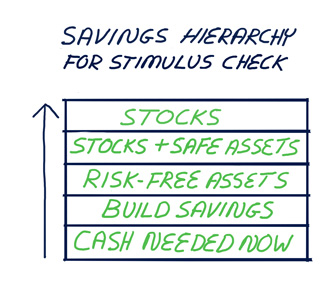
I’m bringing this topic up because it ties into a broader project we’re working on at AAII: helping you to create a comprehensive plan that guides your investing decisions. A personal investment policy statement serves as a much-needed guide when the financial markets are experiencing high levels of volatility, as has been the case since late February. It also helps you make decisions about what to do when “sky money” lands in your lap (a reference to money falling from the sky).
Among the basic premises underlying such a plan is the answer to a key question: When do you need the cash? If you view the stimulus check from a modified form of Maslow’s Hierarchy of Needs, the decision about what to do with it becomes clearer. (The same exercise can also be applied to your entire portfolio to determine what your financial tolerance for risk is.) Let’s walk through the broad stages you or someone you know might be in.
Little or No Emergency Savings—Many recipients of the stimulus check will, unfortunately, need to spend the money on basic needs such as housing, food, medicine, health insurance, etc. Those caught in this tough financial situation have no choice but to spend the money.
Others matching this profile may not need the money immediately but also may not have much in the way of emergency savings. A 2019 Federal Reserve study found that four in 10 adults could not cover a $400 emergency expense with savings. And while the average AAII member is affluent, many of you may know someone who isn’t. Encouraging them to use the stimulus check to start building (or add to insufficient) emergency savings is a good step. (It’s also timely since April is Financial Literacy Month.)
Likely Will Need the Money Within Five Years—If there is a known or expected need for the cash within the next five years, putting the stimulus check into a savings account, money market fund or something similar also makes sense. While stock prices currently remain well below February’s record highs, timing risk remains high for such a short period of time. Even if the stimulus check won’t cover the full expense (e.g., you anticipate replacing your car or making an expensive repair to your house), keeping it in cash or cash equivalents (e.g., money market funds) can reduce the amount you will need to withdraw from your investments.
Likely Will Need the Money Within Five to 10 Years—This time period creates some options. The odds of losing money over a 10-year period by holding a diversified portfolio of stocks are historically low, but a bad sequence of returns is still a risk. A balanced allocation like 60% stocks and 40% bonds can provide a cushion. An alternative would be a barbell approach, which combines stocks with very conservative assets. If avoiding any loss of capital is your top priority, you could build a ladder of short- and intermediate-term bonds and certificates of deposit (CDs). By doing so, you would incur the risk of inflation eroding the value of what you have saved.
Keep in mind that with this time frame you’re likely looking at spending more than you received from the stimulus check and will have to make similar decisions with the other dollars you’re planning on allocating toward the same goal. Allocating the stimulus check to a traditional or Roth IRA also makes sense here for those who have earned income and would not otherwise max out their contributions.
Won’t Need for at Least 10 Years—If you won’t need the money for an extended period of time, then a strong argument for putting it all in stocks can be made. Your lengthy time horizon allows you to financially withstand short-term volatility in order to achieve long-term growth in wealth. Additionally, inflation becomes a much greater risk than unfavorable sequences of return. Traditional and Roth IRA contributions make sense here too.
There is, of course, another option beyond those mentioned: giving the tax rebate away to charity. The CARES Act incentivizes charitable giving during the 2020 calendar year with a $300 deduction available regardless of whether the standard deduction is taken, plus the removal of the 60% cap on charitable deductions for those who itemize. So long as your taxable income equals or exceeds the donation (and the stimulus is not taxable income), you could effectively claim a deduction on donations equal to part of or even all of the stimulus check. Consider it a reward for being charitable.

-
Analyzing Your Financial Health Using Personal Financial Ratios – The three ratios discussed in this 2006 AAII Journal article can help you objectively judge your financial health.
-
Creating and Following a Real Financial Plan – Financial planner Carl Richards explained how understanding why money is important can improve the financial decisions you make.
The percentage of individual investors describing their six-month outlook for stocks as “neutral” is above 20% for the first time since early March. The latest AAII Sentiment Survey also shows a continued decline in pessimism and a pullback in optimism.
Bullish sentiment, expectations that stock prices will rise over the next six months, fell 1.7 percentage points to 34.9%. Optimism is below its historical average of 38.0% for the sixth consecutive week and the 11th week this year.
Neutral sentiment, expectations that stock prices will stay essentially unchanged over the next six months, rose 3.7 percentage points to 22.4%. Neutral sentiment was last above 20% on March 4, 2020 (21.6%), and last higher on February 26, 2020 (30.4%). Neutral sentiment remains below its historical average of 31.5% for the 13th time in 14 weeks.
Bearish sentiment, expectations that stock prices will fall over the next six months, pulled back by 1.9 percentage points to 42.7%. Pessimism remains above its historical average of 30.5% for the eighth consecutive week.
Even though neutral sentiment has now risen for four consecutive weeks, it still remains at an unusually low level. Pessimism, on the other hand, continues to be at an unusually high level.
As earnings season kicks off, this week’s special question asked AAII members what information they will be looking for companies to provide when they report first-quarter earnings. More than one out of three respondents (36%) say that they will specifically be looking for 2020 guidance. Many within this group note that a number of companies have retracted previously issued guidance and they are anticipating that these same companies will issue updated expectations for the year. About 25% of respondents will be looking for updates on how the coronavirus pandemic is impacting each company’s business and what response they will have. Other information that AAII members will be looking for includes debt levels/overall balance sheet health (named by 15% of respondents), solid levels of free cash flow (12%) and dividend stability (11%).
Here is a sampling of the responses:
- “Besides obvious financials and earnings forecasts, what percent of their workforce is idled and when they expect to be back at full operations.”
- “A lot of focus on balance sheet health and adequacy of cash reserves, including dividend protection. Additionally, the expected outlook for the second half of the year.”
- “Some will actually have earnings while others will need to talk about how they plan to get through to the other side. It will be interesting to hear the comments from management about how confident they are going forward.”
- “None. Until we get past this situation, reports are just additional noise. It will be hard to discern anything from the reports. And as soon as things get closer to normal, it will all change.”

Bullish: 34.9%, down 1.7 points
Neutral: 22.4%, up 3.7 points
Bearish: 42.7%, down 1.9 points
Bullish: 38.5%
Neutral: 31.0%
Bearish: 30.5%
April 9, 2020 The CARES Act and Tax Rule Changes
April 2, 2020 Measuring Companies’ Financial Strength Amid Spike in Borrowing
March 26, 2020 Helpful Financial Planning Actions You Can Do While Sheltering in Place
March 19, 2020 The Berserk Financial Markets Provide Opportunities for Tax-Saving Tactics

Discussion
vic smyth from Illinois posted over 6 years ago:
I agree with Steve Wolf and Bill Davidson: If you are fortunate enough that you haven't been financially impacted by the crisis, donate it to benefit someone less fortunate, like your local food pantry. You can also support a distressed local business by buying a product or service that you wouldn't normally purchase.
Jim Isaacson from Utah posted over 6 years ago:
In addition to the remarks above, please also remember to tip restaurants when getting takeout at this time. Their servers rely on tips for a large portion of their income, which has been lost without anyone dining in.
Ruth Cahn from New York posted over 6 years ago:
I agree with the voices above who recommend a philanthropic donation of the money. A food pantry, a tip to a grocery store worker, a gift to hospitals, etc..any gift that shows appreciation for others. One of the messages from the pandemic is to do more with less and consider carefully how we can "downsize" our lives to protect the next generation and our world. Many more lessons to come as we all consider the messages of this pandemic.
keith chamberlin from california posted over 6 years ago:
I did not need nor want the check. Therefore I am buying take-out from my favorite diners/dives and tipping like the money is burning a hole in my shorts.
Steve Wolf from Tennessee posted over 6 years ago:
A couple of weeks ago I was taken by a comment by David Brooks, that after the flu epidemic 100 years ago nobody talked about it because we were all so embarrassed about how we treated one another. I am retired and do not need the stimulus money, for you see I am blessed. There are many in our community who are not so blessed. Perhaps those of us who know how blessed we are can just give it away.
Bill Davidson from Wisconsin posted over 6 years ago:
If you don't need this money now till the next few months, please donate this money to someone who does, especially those who are laid off due to no fault of their own. Or maybe you can tip heavily to those brave people who are delivering to you while you safely shelter.
You need to log in as a registered AAII user before commenting.
Create an account