

Related

Financial Planning
Thinking about how your allocation will be implemented and who is going to manage your portfolio will help you to develop management rules for your portfolio.

Charles Rotblut leads a class in AAII's new Essential Investing Video Course. Go to https://www.aaii.com/ves for more information and to subscribe.
As you work through the Individual Investor Wealth-Building Process (previously code-named “The AAII Way”), it is helpful for you to decide how your allocation will be implemented and who is going to manage your portfolio.
For dyed-in-the-wool do-it-yourself (DIY) investors, the answer is obvious: They want to make all of the decisions—including specifically selecting the investments they will hold. Others take comfort in having a professional manage their portfolio—be it a fund manager or even a financial planner. In between, there is a wide spectrum.
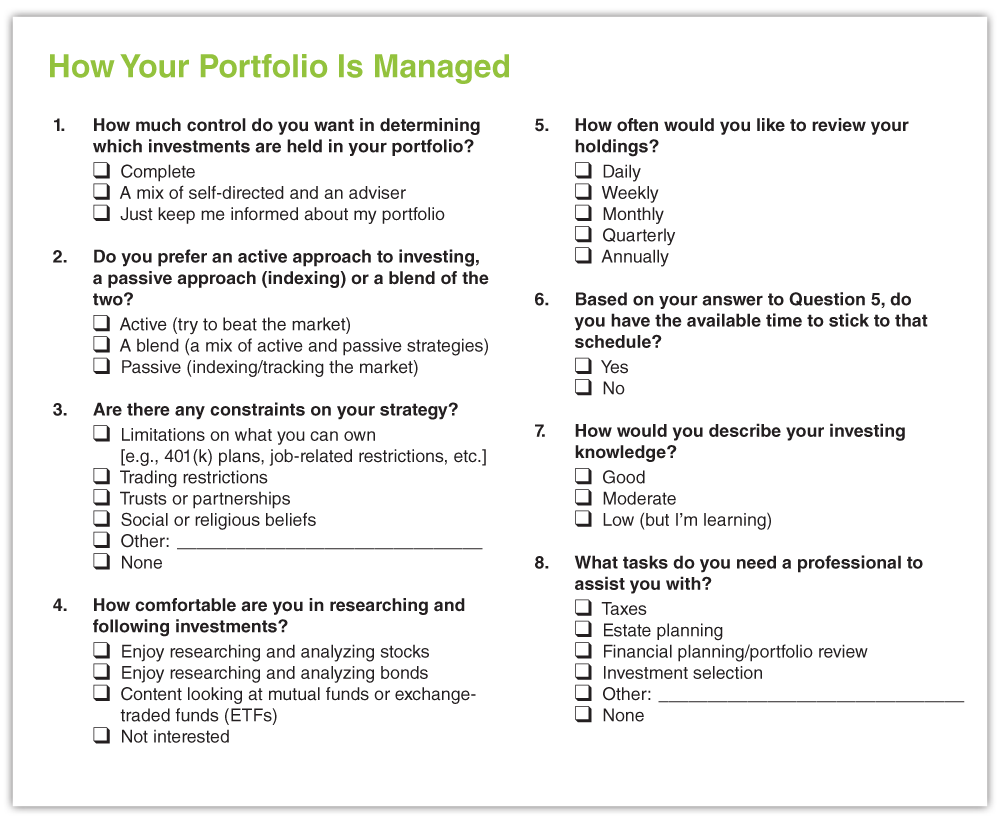
The worksheet shown to the right will help you think through the various considerations. You may view yourself as being a true DIYer, only to realize that your 401(k) requires you to cede some control to mutual fund managers. Alternatively, you may not need a traditional adviser but rather could be comfortable holding index funds and periodically meeting with a fee-only planner.
After filling out the worksheet, read through the descriptions below and select the one that best describes you. If you find parts of different categorizations applying to you, take note of those characteristics.
You can then use the descriptions to write down how you will implement your allocation (e.g., by picking investments, using index funds, etc.). This exercise will help you to develop management rules for your portfolio as we move forward with the Individual Investor Wealth-Building Process.
The fully hands-on investor seeks a high level of control over their investing decisions. They have time and enjoy researching individual securities. They also have a moderate-to-high level of investing knowledge. They tend to hold individual stocks and individual bonds.
The partially hands-on investor combines holding individual securities with mutual funds, exchange-traded funds (ETFs) or closed-end funds. This investor owns both individual securities (most commonly individual stocks) and funds. They have at least a moderate level of knowledge but are comfortable ceding control over part of their portfolio to either a mutual fund or ETF manager. Active investors who lack enough time or interest to research every security in their portfolio may fall into this category.
The index investor prefers index mutual funds and ETFs over individual securities. While potentially having a high level of investing knowledge, they view passive strategies as advantageous and are happy to cede control of picking individual securities to keep costs low and avoid underperforming the market. Trading restrictions, or a lack of available time or knowledge to research individual securities, may also lead someone to be an index investor.
The fund investor is similar to the index investor with the exception that they consider owning actively managed funds. This type of investor is hoping to outperform the market and/or takes comfort in knowing that a professional portfolio manager is choosing the investments and potentially the allocation.
The combo hands-on/works with a planner investor combines using a fee-only planner with personal control of investments. This type of investor hires a financial professional—such as a financial planner—to provide assistance with carrying out their investment strategy. The planner might be used on a periodic basis to assist with the portfolio review process to ensure that the allocation strategy chosen matches current goals, or to simply provide objective feedback and consultation. Alternatively, a portion of the portfolio might be given to a robo-adviser to be managed, while part of the portfolio is self-managed. This type of approach works best for those who want some personalized assistance while still making their own investing decisions.
A twist on this combo is a bolt-on approach. This involves working with specialists to address specific tasks. For instance, a life insurance agent could be contacted for the purchase and management of policies. Alternatively, a tax professional or estate attorney may be warranted. A good fee-only financial planner may be able to serve as a hub for providing recommendations to these types of specialists and, for those with complex financial and estate-planning needs, coordinating their recommendations. Even fully hands-on investors may find themselves needing to consult with a specialist.
The adviser investor hires a professional to carry out their allocation strategy. This investor outsources the process of implementing and managing their allocation and investment strategy. It can make sense for those who lack confidence, knowledge and/or the time to make their own investing decisions—including the selection of mutual funds or ETFs. As one ages, turning over management of investment decisions can be a prudent decision, though the selection of an adviser (or a trusted family member) should be done well before cognitive issues evolve. Robo-advisers would be a consideration for those with moderate levels of wealth and those who don’t require much one-on-one communication. A traditional adviser is most suited to those who have complex financial and/or estate planning needs requiring a higher level of personal service.
We want what we’re creating to be useful to you. Fill out the worksheet and let us know what you think. Then go to www.aaii.com/AAIIWay for additional worksheets and content we’re developing as part of the Individual Investor Wealth-Building Process. If you have feedback you’d like to share, email us at journal@aaii.com or post a comment at the end of this article online. ▪
Try out The AAII Way worksheets we’ve created so far and give us your feedback in the comments section for each. We want them to be useful to you.
1. Identifying and Prioritizing Your Financial Goals Worksheet
2. Our Revised Risk Tolerance Worksheet
3. A Worksheet for Determining How Your Portfolio Is Managed
4. Financial Account Inventory Worksheet
5. Investment Expense Tracking Worksheet
Financial Planning

Portfolio Strategies

Financial Planning

No comments have been added yet. Add your thoughts to the discussion!
You need to log in as a registered AAII user before commenting.
Log InCreate an account