


Related

Small Cap Value Investing
After conducting the quarterly review of the Model Shadow Stock Portfolio, two stocks were removed and two new stocks were added.
by John Bajkowski | April 2021
Value stocks are outperforming growth stocks for the first two months of this year. It is the first time that value has outperformed growth at this stage of the year since 2016. The outperformance is the strongest seen since 2001, which coincided with the bursting of the dot-com bubble. In the large-cap segment, growth stocks are down 0.5% for the year, while large-cap value stocks are up 4.2% year to date.
Small-company stocks are also outperforming large-company stocks at the start 2021. The Vanguard Small Cap Index fund  (NAESX) is up 8.5% compared to a gain of 1.7% for the Vanguard S&P 500 Index fund (VFINX). The technology and health care-heavy Nasdaq composite is up 2.5% for the year.
We are also seeing a dramatic shift in sector performance during 2021. The energy sector, which lost 33.7% during 2020, is up 27.3% year to date. Financials also posted strong gains, up 16.4% for the first two months of 2021 after giving up 1.8% during 2020. The market looks to be rotating money into segments hurt by the pandemic last year as expectations of increased activity and higher inflation take hold. The interest-rate sensitive utilities are down 6.9% for the year. Other sectors in the red for the year include consumer staples (down 6.5%), health care (down 0.7%) and consumer discretionary (down 0.5%).
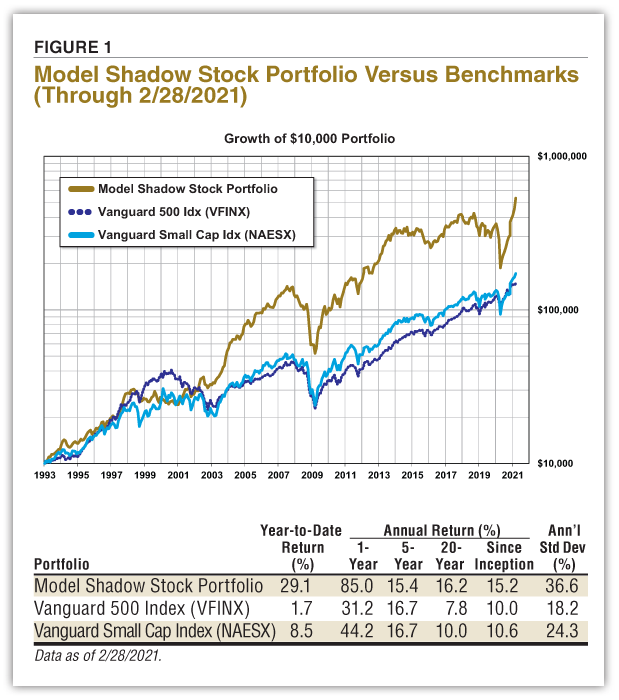
The Model Shadow Stock Portfolio continued its strong run and is up 29.1% for the first two months of the year. The S&P 500 index as measured by the performance the Vanguard 500 Index fund is up 1.7% year to date. The Vanguard Small Cap Index fund is up 8.5% for the year, while the DFA U.S. Micro Cap fund (DFSCX) is up 16.0% for the year.
Since its inception in 1993, the AAII Model Shadow Stock Portfolio has a compound annual average return of 15.2% versus the Vanguard 500 Index fund’s gain of 10.0% per year on average over the same period. Over the same period, the Vanguard Small Cap Index fund posted an average annual gain of 10.6%. Figure 1 summarizes the performance over longer periods.
The Model Shadow Stock Portfolio is reviewed quarterly to determine stock sales and additions, a practice put in place since the portfolio’s inception in 1993. The quarterly portfolio review cycle is tied to the standard reporting cycle of most publicly traded firms. Companies are examined for violating the earnings, valuation, size and age rules of the Model Shadow Stock Portfolio.
The primary Model Shadow Stock Portfolio selection criteria target the intersection of the smallest 10% of domestic stocks as measured by market capitalization, along with the “cheapest” 10% of domestic stocks as measured by the price-to-book (P/B) ratio. These decile breakpoints are determined by examining domestic companies that are listed on the New York Stock Exchange (NYSE) and change over time.
When the quarterly review was conducted at the start of March, the NYSE price-to-book-value cutoff for the lowest decile was 1.02, near the portfolio’s current maximum initial price-to-book ratio of 1.00. Therefore, the maximum price-to-book ratio was left unchanged at 1.00 for initial inclusion and 3.00 (three times the initial criterion) as the maximum level for a stock held in the portfolio at the time of a quarterly portfolio review.
The NYSE market-cap cutoff for the lowest decile was $370 million at the start of March, compared to the portfolio’s $300 million maximum in December, so the size cutoff was adjusted for the Model Shadow Stock Portfolio during the quarterly review from $300 million to $400 million. The maximum market cap for inclusion in the Model Shadow Stock Portfolio is now $400 million, and holdings are sold if their market cap goes above three times the initial criterion at the time of the quarterly review: $1.2 billion.
The other major factor that leads to portfolio turnover is tied to negative earnings. If a company reports trailing 12-month earnings from continuing operations that are negative, the stock is placed on probation; if a subsequent quarter has negative earnings prior to trailing 12-month earnings becoming positive, the stock is sold. When available, adjusted (non-GAAP) earnings are used to put stocks on probation or sell them. These are earnings that have been adjusted to eliminate the impact of nonrecurring events such as markdown of inventory or goodwill. These are earnings reported in the media and firms reporting consensus estimates. The I/B/E/S adjusted earnings reported in Stock Investor Pro are used for Model Shadow Stock Portfolio decisions when they are available.
A stock can also be sold if it has been held over four years if it also no longer meets the initial rules for qualifying and has not gained at least 10% annually from its purchase price and there is a new qualifying stock to replace it.
The detailed Model Shadow Stock Portfolio purchase and sell rules, along with portfolio management tips, are available here.
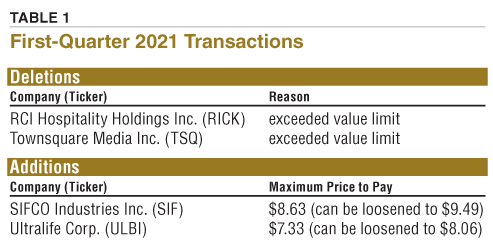
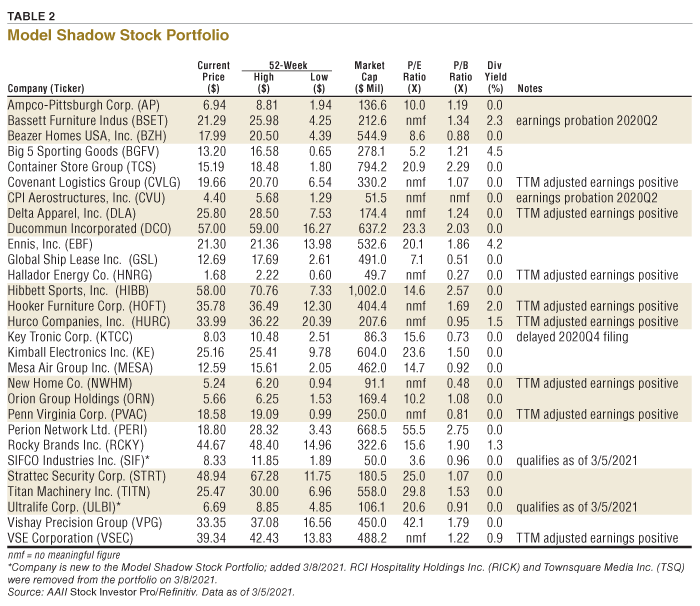
After conducting the quarterly review of the Model Shadow Stock Portfolio, RCI Hospitality Holdings Inc. (RICK) and Townsquare Media Inc. (TSQ) were removed from the model portfolio. With the proceeds from these two sales, as well as the cash held in the portfolio, two new stocks were added to the Model Shadow Stock Portfolio. SIFCO Industries Inc. (SIF) and Ultralife Corp. (ULBI) were added to the model portfolio. Table 1 summarizes the changes. Table 2 shows the current stocks that make up the Model Shadow Stock Portfolio.
Approaching Size Limit: Stocks are sold if their market capitalization goes above three times the initial maximum criterion and there is a stock to replace it. The current market capitalization maximum for initial screening is $400 million. Stocks are marked “approaching size limit” if their current market cap exceeds 2½ times the initial criterion, or $1.0 billion.
Approaching Value Limit: Stocks are sold once their price-to-book-value ratio goes above three times the initial criterion and there is a stock to replace it. The current initial price-to-book ceiling is 1.00. Stocks are marked “approaching value limit” if their current price-to-book-value ratio exceeds 2½ times the initial criterion, or 2.50.
Earnings Probation: If last 12 months’ earnings are negative, the stock is put on probation; if a subsequent quarter has negative earnings prior to 12-month earnings becoming positive, the stock is sold. When available, adjusted (non-GAAP) earnings are used to put stocks on probation or sell them. Otherwise, earnings from continuing operations are used. The date is the fiscal quarter during which the company first reported negative trailing 12-month earnings.
Qualifies as of: Stock still qualified as a buy when the screen was run with current data. Stocks that don’t currently qualify as a buy are held until they meet one of the sell rules.
TTM Adjusted Earnings Positive: Trailing four-quarter GAAP earnings are negative, resulting in no meaningful figure for the price-earnings ratio. However, adjusted earnings for the period are positive.
See the Shadow Stocks area of AAII.com for more information.
(RICK)RCI Hospitality Holdings owns and operates upscale gentlemen’s clubs and sports bars and restaurants. The company owns and operates over 40 establishments under multiple brands throughout the nation. The company had seen its price increase 248.5% over the last 52 weeks as of early March, pushing up its price-to-book ratio.
When conducting the quarterly review with data as of March 5, 2021, RCI Hospitality Holdings exceeded the price-to-book ratio sell cutoff of 3.00 with a price-to-book ratio of 3.67. It is the strategy of the Model Shadow Stock Portfolio to sell a stock if its price-to-book-value ratio exceeds three times the initial purchase limit, which is currently 1.00.
(TSQ)Townsquare Media is a media, entertainment and digital marketing solutions company principally focused on small and mid-sized markets across the U.S. Its price-to-book ratio has risen due to a combination of rising share price and declining book value per share. Townsquare Media’s price increased 123.6% over the last 26 weeks, but negative GAAP earnings have contributed to a decline in retained earnings, pushing up its price-to-book ratio.
When conducting the quarterly review with data as of March 5, 2021, Townsquare Media exceeded the price-to-book ratio sell cutoff of 3.00 with a price-to-book ratio of 3.10.
As of March 5, five stocks met the initial selection criteria for the Model Shadow Stock Portfolio, down from 10 stocks one month ago. Surging interest in small caps has resulted in a decline in the number of qualifying companies. AAII members can see and research which companies are currently passing the initial selection criteria in the Shadow Stock Ideas table at www.aaii.com/model-portfolios.
One of the qualifying stocks was already held in the model portfolio: Key Tronic Corp. (KTCC). The remaining four stocks were examined to ensure adequate liquidity, timely financial filings and appropriate industry and foreign considerations. For example, the Shadow Stock Portfolio Rules currently exclude companies based in China or firms in the rental and leasing industry. Price momentum is used as the tiebreaker among qualifying stocks. Stocks were ranked using the weighted relative strength ranking, which looks at price performance over the last year but places more weight on the most recent quarterly price performance.
(SIF)SIFCO Industries is engaged in the production of forgings and machined components for the aerospace, defense and energy markets. SIFCO Industries supplies flight-critical forged components and machined assemblies to all of the leading aircraft and engine manufacturers. These components are used on commercial and military fixed-wing aircraft as well as helicopters and business jets. SIFCO products are also supplied to the leading steam and gas turbine manufacturers and oil producers serving the energy sector. No analysts are currently following the company, placing it in the shadows of Wall Street.
SIFCO Industries has a book value per share of $8.63 as of December 31, 2020. If you wish to stay within the 1.00 price-to-book-value maximum, you should pay no more than $8.63 per share. However, if the stock price has moved up after being added to the portfolio, you can still purchase the stock unless the price-to-book ratio goes above 1.10, which equates to a price of $9.49 per share. To calculate the maximum purchase price based on the maximum desired price-to-book ratio, multiply the current book value per share ($8.63 for SIFCO) by the maximum price-to-book ratio to be considered for the Model Shadow Stock Portfolio (currently 1.00, or 1.10 for loosened consideration).
(ULBI)Ultralife offers products and services ranging from power solutions to communications and electronics systems to customers across the globe in the government and defense; medical, safety and security; energy; industrial and robotics sectors. The company designs and manufactures power and communications systems, including rechargeable and non-rechargeable batteries, charging systems, communications and electronics systems and accessories and custom engineered systems. There are no analysts currently following the company.
Ultralife has a book value per share of $7.33 as of December 31, 2020. If you wish to stay within the 1.00 price-to-book-value maximum, you should pay no more than $7.33 per share. However, if the stock price has moved up after being added to the portfolio, you can still purchase the stock unless the price-to-book ratio goes above 1.10, which equates to a price of $8.06 per share.
The next quarterly review of the Model Shadow Stock Portfolio will take place following the end of May 2021. In the meantime, you can follow the portfolio in the Shadow Stocks area on AAII.com. To receive monthly email updates along with alerts to any changes made to the portfolio, please sign up at www.aaii.com/email.
Small Cap Value Investing

AAII Model Portfolios

AAII Model Portfolios

VAIDY B from CAN posted over 5 years ago:
BRUCE G from SC posted over 5 years ago:
JEAN H from IL posted over 5 years ago:
You need to log in as a registered AAII user before commenting.
Log InCreate an account