


Related

AAII Stock Ideas
Which are the better dividend-paying stocks: stocks with a lower initial yield but with a high dividend growth rate, or stocks with a low dividend growth rate but with a higher initial yield?

Derek Hageman leads a class in AAII's new Essential Investing Video Course. Go to https://www.aaii.com/ves for more information and to subscribe.
Nothing brings out a dividend investor’s passion like a lively debate over the better dividend strategy. Which are the better dividend-paying stocks: stocks with a lower initial yield but with a high dividend growth rate, or stocks with a low dividend growth rate but with a higher initial yield?
There are investors who invest in both high yield and high dividend growth strategies, but there are others who definitely prefer one style over the other. It may help you to think of a continuum with high yield on one end, high dividend growth on the other end and different blends of the two strategies in the middle.
We will let you decide which strategy works best for your specific situation and financial goals but for our purposes we would like you to be aware of each strategy’s benefits and challenges.
The high yield strategy seeks high-yielding stocks. Due to the higher-than-average yield, the market often perceives these stocks as riskier compared to high dividend growth stocks. The high yield signals higher risk and may indicate weak growth prospects. One of the biggest dangers that income investors face is being seduced by high-yielding but higher-risk stocks. Income investors need to be careful of overreaching for yield.
There are three types of high-yielding stocks:
For the long-term dividend investor, dividend safety is paramount. High-yield dividend investors should seek quality companies from either of the first two categories. Sadly, there won’t be many quality companies in the third category, only unrealistic and unsustainable promises.
In the article “What’s the Difference Between Dividend Yield and Dividend Growth Stocks?” Morningstar’s director of investor education Karen Wallace notes that “Unfortunately, it’s not always the case that the stocks yielding the most are the healthiest ones with the most cash on hand to return to shareholders. Simply choosing stocks with the highest dividend yield can often result in the purchase of highly risky stocks that are priced low relative to their dividends, due to potential financial distress.”
Wallace also reiterates that when investing in dividend yielders, your investment criteria should consider more than just the yield. In order to determine if a company can continue to pay out a high dividend yield, make sure you focus on stocks of companies that are financially healthy enough to sustain and even grow their dividend.
The high dividend growth strategy seeks growing dividends. The market perceives dividend growth stocks as less risky due to better growth prospects. Dividend growth stocks have a lower absolute yield when compared to the high-yield approach.
Companies whose cash flows have translated into a rising payout are known as dividend-growers. The high dividend growth strategy seeks financially strong companies that are healthy enough to sustain and even grow their dividend. These are companies that have competitive advantages that will allow them to continue to earn above-average profits and sustain their dividends for years.
Companies that are focused on growing dividends tend to be higher-quality, cash-rich businesses that hold up well in down markets, participate in up markets and are capable of excess returns over a full market cycle. In addition to being core, defensive holdings, companies that are growing their dividends provide some protection from inflation: A rising dividend is fundamental to investors’ ability to preserve purchasing power through their equity portfolio.
High dividend growth stocks are not always among the highest-yielding securities in the market; investors seeking current income might not be satisfied with the yield of a dividend growth portfolio.
In many ways dividend strategies are built upon value investing principles: buying stocks that the market is pricing below their historical norm and are therefore currently out of favor. These stocks are then sold as they become too popular and are priced expensively relative to their past normal level. High-quality, dividend-paying growth stocks are also attractive for their potential to provide a steady flow of cash dividend payments, high dividend growth and stock price appreciation for high total returns.
To help you evaluate which dividend strategy works best for your specific situation and financial goals, AAII members can find the information necessary to assess the current dividend yield and five-year dividend growth rate in the Stock Evaluator. Simply type a company’s name or ticker symbol into the search box located at the top of any page on AAII.com, and then select the company name from the drop-down list that appears.
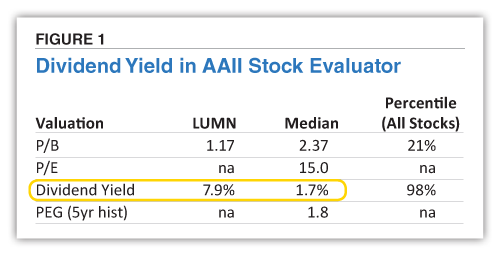
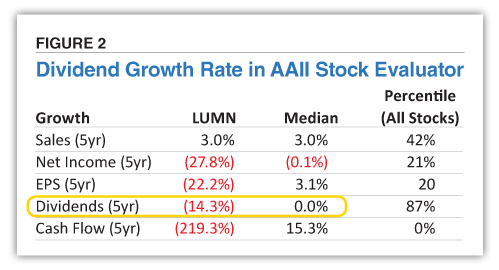
On the right side of the evaluator’s snapshot page, you will find the current yield located with the valuation data, along with a comparison to its industry median and percentile ranking compared to all stocks (Figure 1). On the left side of the snapshot page, you will find the company’s five-year annualized growth rate for sales, net income, earnings per share, dividends and cash flow located with the growth data (Figure 2).
To illustrate the danger that income investors face in being seduced by high-yielding but higher-risk stocks, we look at Lumen Technologies Inc.  (LUMN), an integrated communications company, as an example in Figures 1 and 2. It has a yield of 7.9% which ranks in the 98th percentile of all stocks in AAII’s Stock Investor Pro fundamental stock screening and research database. But its five-year annualized dividend growth rate is negative 14.3%, indicating that its dividend has been cut at least once during the past five years.
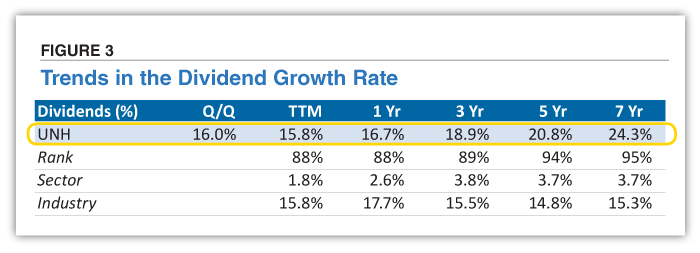
Figure 3 shows data from the Growth tab of the Stock Evaluator for UnitedHealth Group Inc. (UNH). This tab is accessible to A+ Investor subscribers and illustrates UnitedHealth Group’s strong history of dividend growth.
Our illustrations only showed a few select data points in isolation. To get a more complete understanding of a company’s financial situation, analysis would usually include measures such as free-cash-flow payout ratio and relative valuation, among others.
AAII’s Dividend Investing (DI) strategy seeks higher-than-market yields and dividend growth at a reasonable price. The Dividend Investing approach would be categorized as a hybrid strategy that lies closer to the high dividend growth end of the spectrum. We think AAII’s Dividend Investing strategy delivers the best elements of both dividend strategies.
AAII Stock Ideas

Investor Professor

LOUIS S from FL posted over 5 years ago:
HOWARD F from MA posted over 5 years ago:
Thomas K from WI posted over 4 years ago:
MITCH B from MD posted over 4 years ago:
You need to log in as a registered AAII user before commenting.
Log InCreate an account