

Related

AAII How-To
The cost of owning mutual funds and exchange-traded funds (ETFs) continues to decrease.
by Adam Scheg | October 2021

The cost of owning mutual funds and exchange-traded funds (ETFs) continues to decrease.
On an asset-weighted basis, the average fee was 0.41% in 2020. This marked a 7% decrease from 2019. Morningstar described the reductions as being “the third-largest year-over-year decline we have recorded dating back to 1991.”
Last year’s decline also marked the continuation of a longer-term trend. The average asset-weighted fee is now less than half of what it was in 2000: 0.93%.
Fees fell in 2020 for both actively and passively managed funds. A three-basis-point drop was observed in active funds, with the asset-weighted average expense ratio falling from 0.65% to 0.62%. For passively managed funds, the asset-weighted average expense ratio declined from 0.13% to 0.12%.
In both cases, the deceases were driven by large net outflows from expensive funds and share classes and flows into cheaper ones. The cheapest 20% of funds received $445 billion in net inflows last year. Most of that went to the cheapest 5% of funds, which received $412 billion in inflows. In comparison, the remaining 80% of funds incurred $293 billion of outflows last year.
Differences in fees charged are narrowing. The cheapest 10% of funds charge an average asset-weighted expense ratio of 0.36%, versus the 0.90% charged by the median fund, a 540-basis-point difference. In 2005, the difference was 700 basis points (0.61% versus 1.31%). According to Morningstar, the “cheap funds have gotten significantly cheaper” while “fees for the most expensive funds remain stubbornly high.”
Even though several fund companies have reduced expenses, Vanguard remains the lowest-cost fund family. Its asset-weighted average expense ratio was just 0.09% in 2020.
The trend of lower fees is attributable to a combination of factors. Investors have become more aware of how high costs hurt their returns. Competition has put downward pressure on fees, particularly with the growth of ETFs. The adoption of fee-based models among financial advisers instead of commission-based compensation is also shifting investment dollars toward lower-cost options.
One area where investors are paying more is sustainable funds. The average asset-weighted expense ratio charged by these funds last year was 0.61%. This was 200 basis points higher than the 0.41% charged by their traditional peers. Morningstar called this difference a “greenium.”
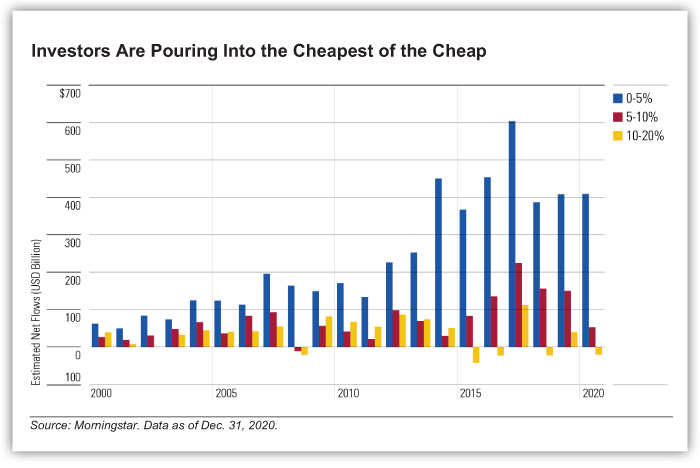
Source: “2020 U.S. Fund Fee Study,” by Ben Johnson and Gabrielle DiBenedetto; Morningstar, August 2021.
AAII How-To

First Cut Mutual Funds

Mutual Funds

DEAN D from CA posted over 4 years ago:
You need to log in as a registered AAII user before commenting.
Log InCreate an account