


Charles Rotblut leads a class in AAII's new Essential Investing Video Course. Go to https://www.aaii.com/ves for more information and to subscribe.
This is just the second time that the S&P 500 index is in a bear market since I became editor of the AAII Journal in 2010. A bear market is defined as a drop of at least 20%.
S&P Dow Jones Indices defines a bear market “as a 20% decline in the S&P 500 index from its previous peak.” Bear markets end “when the index reaches its low and subsequently rises by 20%.” This 20% rebound starts a new bull market, which lasts until the S&P 500 “reaches its high and subsequently declines by 20%.”
Bear markets are a normal part of investing. Large- and small-company stocks wouldn’t have long-term annualized returns of 12% and 16%, respectively, if there wasn’t the risk of incurring a loss of capital. But then again, any decision you make about what to do with your savings—including holding them in cash—involves some type of risk.
We individual investors can’t control what types of market conditions will exist over our lifetimes. We can control the decisions we make and align our decisions with our goals (aka the PRISM Wealth-Building Process). Long-term goals require the growth of capital that stocks provide. Short-term expenditures require cash to preserve capital. In between, bonds provide both income and a counterbalance against the volatility of stocks.
Still, when the current market will bottom is “the $64,000 question” many of you likely have.
It’s a tough question to answer in the AAII Journal because it will be almost two weeks before this issue is made available on AAII.com at the beginning of the month, and even longer before print copies arrive in mailboxes. Any market prediction I make here may look silly by the time you read it.
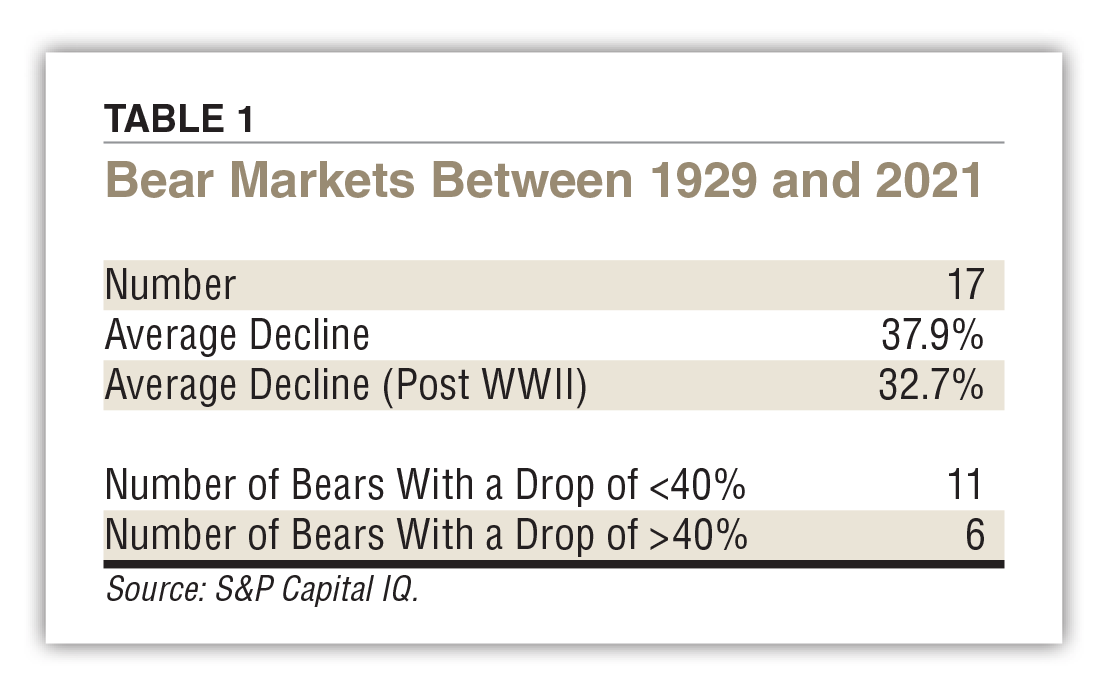
Timing aside, data from CFRA Research shows an average bear market decline in the S&P 500 of 37.9% for the past 17 bear markets. Sam Stovall at CFRA calculates the post–World War II average as a drop of 32.7%. Nearly two-thirds of all bears since 1929 have incurred total drops of less than 40%. The average decline of these “garden variety” bears is 27.7%. While no one has a working crystal ball, these numbers should help you to set some expectations.
Dividend-paying stocks can help cushion the blow of bear markets and protect a portfolio against inflation. The Weiss Blue Chip Dividend Yield screen has been a great way to find attractive dividend stocks. This AAII screen—which is available to all AAII members on AAII.com—is based on Geraldine Weiss’ 1988 book “Dividends Don’t Lie.” The Weiss screen has the 10th lowest risk index out of the 60 AAII stock screens, yet it has beaten the S&P 500 since its inception in 1988 (9.4% versus 5.9% annualized through May 31, 2022).
The “grande dame of dividends” died in late April 2022 at the age of 96. Weiss was both a successful investor and a trailblazer. As Mark Hulbert explained on MarketWatch several years ago, she first penned her newsletter Investment Quality Trends under the name of G. Weiss in 1966. It wasn’t until she appeared on “Wall Street Week with Louis Rukeyser” in 1977 that subscribers found out “G.” stood for Geraldine and not, say, Gerald or George. In honor of Weiss, we are featuring our screen based on her investing strategy in this issue.
Our 60 screens—including the AAII Graham Defensive Investor Utility and AAII Graham Defensive Investor Non-Utility screens featured this month—are a benefit available to all AAII members. Use the AAII screens to find stocks whose valuations may be lower than they should be. To access the screens, go to www.aaii.com/screening.
For those of you reading this in print, consider switching to digital delivery of the AAII Journal while you are on AAII.com. You get the latest issue sooner, you can save your favorite articles and you can view related video content. To make the switch, go to My Account on AAII.com, scroll down to My Subscriptions and click “Opt Out” by AAII Journal. You can also switch from print to digital delivery by contacting Member Services at members@aaii.com or 312-676-4307.
Wishing you prosperity and good health,

Discussion
FREE REPORT

ROBERT A from NC posted over 4 years ago:
JARED B from WI posted over 4 years ago:
You need to log in as a registered AAII user before commenting.
Log InCreate an account