

Related


Financial Planning
The Importance of Considering Marginal Taxes When Taking Withdrawals

Portfolio Strategies
Morningstar’s study of retirement income showed a higher safe withdrawal rate in 2023 than previous years due to stronger fixed-income yields.
by Grace Malone | March 2024

Morningstar’s study of retirement income showed a higher safe withdrawal rate in 2023 than previous years due to stronger fixed-income yields.
For the annual study, Morningstar Investment Management develops forward-looking asset class return assumptions as well as assumptions about the expected volatility of each asset class and future inflation levels. Thirty-year forecasts are then extrapolated based on the assumptions.
The current highest safe withdrawal rate for a diversified portfolio over 30 years is 4% for portfolios with equity allocations of 20%–40%. The highest safe withdrawal rate was found to be 3.3% in 2021 and 3.8% in 2022. The research set 90% as the target success rate for the base case.
The “right” withdrawal rate depends on three key factors: the market environment of the retiree’s withdrawal period, the length of the withdrawal period and the asset allocation of the portfolio. Generally, portfolios that had a higher allocation to equity delivered higher returns, resulting in higher withdrawal rates than more conservative portfolios. However, the results varied widely depending on different market environments.
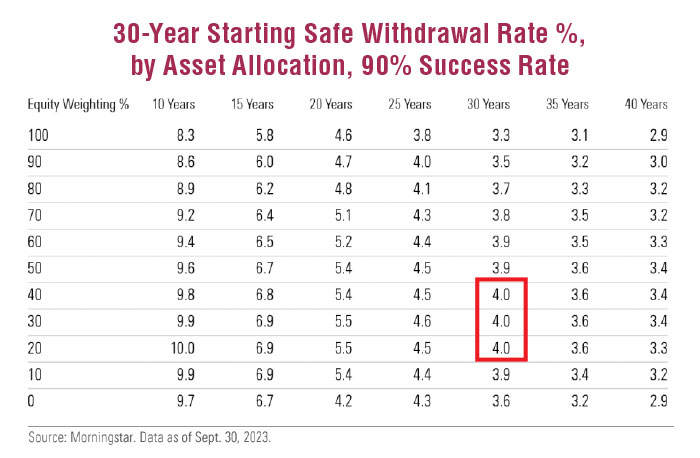
These results underscore the point that the model’s base portfolio is conservatively created. However, the base case assumes that the investor’s spending needs are inflexible, steering the model toward fixed-income investments. Conservative asset mixes improve the starting safe withdrawal rates, although at the cost of future wealth: Lower equity portfolios recorded lower median returns at year 30 than portfolios with more equity exposure.
Source: “State of Retirement Income: 2023,” by Amy C. Arnott, Christine Benz and John Rekenthaler; Morningstar Portfolio Planning and Research, November 13, 2023.
Financial Planning
Portfolio Strategies

JOHN C from MA posted over 2 years ago:
ROBERT A from NC posted over 2 years ago:
JOHN L from NJ posted over 2 years ago:
You need to log in as a registered AAII user before commenting.
Log InCreate an account