

Related

Feature
The Social Security Administration is demanding repayment of benefits it erroneously overpaid over the years, with little recourse available to recipients.

Charles Rotblut leads a class in AAII's new Essential Investing Video Course. Go to https://www.aaii.com/ves for more information and to subscribe.

Terry Savage writes a weekly personal finance column syndicated in major newspapers. She has also authored several books. Her latest book, coauthored with Laurence J. Kotlikoff, is “Social Security Horror Stories: Protect Yourself from the System and Avoid Clawbacks.” Cynthia McLaughlin and I spoke to Savage about the Social Security Administration’s “clawback” letters and what individuals can do to protect themselves for the AAII Journal. We also discussed Social Security survivor benefits and claiming strategies for AAII Retirement Investing.
—Charles Rotblut, CFA
Update: On March 20, the Social Security Administration announced that it was officially making changes to address the overpayment issues, including switching from withholding 100% of benefits to a default of withholding 10% and shifting the burden of proof away from the claimant in determining who is at fault. For more, see the SSA’s press release here.
Charles Rotblut (CR): Could you briefly explain what the Social Security clawback problem is?
Terry Savage: Imagine getting a letter in the mail from the Social Security Administration (SSA) demanding you repay as much as $35,000—or more—within 30 days or it will stop sending your benefits. That’s what’s happening to millions of seniors and disabled people who depend on those benefits to pay their monthly bills.
It’s called a clawback—and it comes as a result of years of miscalculation of benefits by the SSA. The clawback demand comes with little explanation. It’s almost impossible to speak with a representative, and if you claim a waiver, it’s most likely to be denied. The panic among the oldest and weakest of our citizens is staggering.
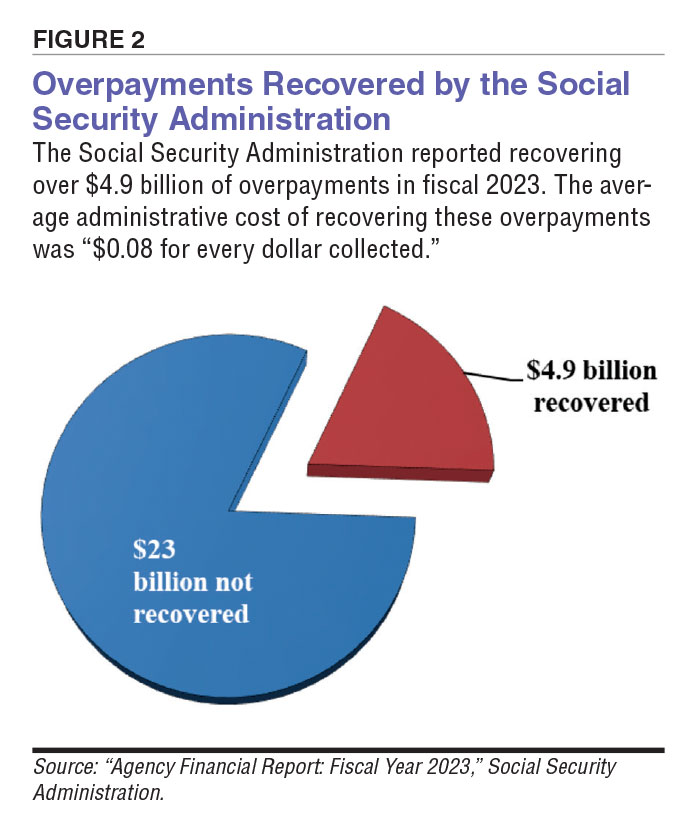
Every year, Americans come to the SSA trusting that it will calculate the correct benefits based on the money that’s been taken out of their paychecks and paid in by their employers. But recently, it has come to light that the SSA has a recordkeeping system that is so messed up that it has made $23 billion in incorrect payments.
The SSA is now in the process of clawing back that money from elderly people who are retired, may have little or no other income and could have only a home or a few thousand dollars in the bank as their sole asset. Disabled people are getting the same letters too.
The SSA is going back as far as 35 or even 40 years. It is demanding repayment within 30 days without giving people any documentation or background. The amounts my coauthor Laurence (“Larry”) Kotlikoff and I have seen range from $35 and $175 to as high as $304,000. The worst part of these clawback demand letters is the power the SSA has: It immediately threatens that if you do not repay these amounts, it will stop your future benefits.
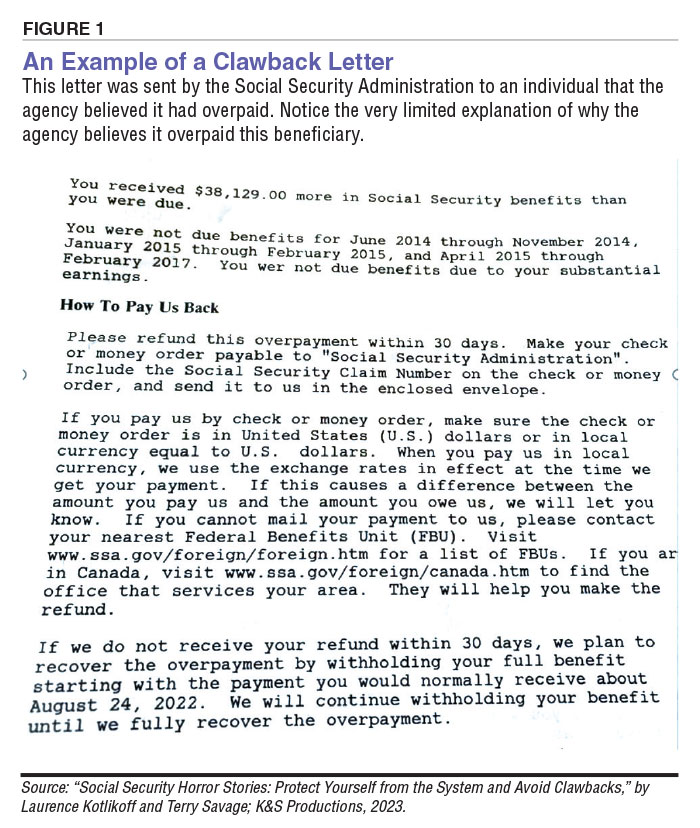
Cynthia McLaughlin (CM): We are sharing the clawback letter example you have in your book (Figure 1). But to provide greater understanding, does the amount withheld in response to a clawback letter just reduce a person’s monthly benefit?
The SSA threatens to—and often does—stop your monthly benefit in full to make up the difference. It can also garnish your wages, withhold your tax refund and outright sue you to take away your assets.
Say you’re getting $1,142 per month and you owe the $38,129 stated in the example letter. You could get zero benefits starting the month after the letter was issued. What’s worse, if you had your payment for Medicare Part B of $175 taken out of your Social Security check, you won’t have Medicare Part B anymore since you now don’t have a monthly benefit for the premium to be deducted from. If you want to keep your Medicare, you have to find another source of money to pay for it. This is horrific for many retirees. I’ve received hundreds of letters from people in this situation.
CR: How did you find out about this problem?
This whole story started when a woman wrote me saying, “I’m a widow, I had triple bypass surgery. All I have is Social Security and they just wrote me a letter demanding $35,000 in 30 days.” This woman said, “I don’t want to die of a heart attack. How will I pay my rent?”
I wrote that column and immediately heard from hundreds and hundreds of people from around the country telling me similar stories, older and alone without any power.
The SSA does not keep track of your past contacts. You never talk to the same person twice. It’s impossible to meet with someone in person. The SSA sends you running from one physical office to another if you do try to meet with a representative. It rarely justifies its claims; rather it only says, “We have recalculated. We want the money back.”
Very few people come to Social Security with any idea of what their monthly benefit will be. And the SSA’s online calculators are often wrong and misleading if people do try to find the correct benefit. So, this is not people ripping off Social Security and getting demands for a clawback. This is the SSA making $21.6 billion worth of mistakes impacting millions of Americans.
Although it is making headlines now, thanks to the “60 Minutes” story we did, it has been going on for years—the SSA has been clawing back benefits because of its own mistakes! Generally, this has been done with zero proof that the SSA did, indeed, overpay you. [Editor’s Note: The “60 Minutes” segment aired on November 5, 2023.]
Worse yet, if you file a request for a waiver, saying, “I don’t know where this came from, you haven’t told me. I’m old, I’m poor, I’m disabled. I don’t have this money, I use the benefits to live on,” etc., the waiver decision is still left completely up to the SSA bureaucrats at the lowest levels. And for no reason, the person who receives your appeal will almost always decide to turn you down. That’s the system’s culture: “Our mistake is your mistake.” This is a tragedy of huge proportions.
CR: In 2016, the U.S. Government Accountability Office (GAO) found that the SSA gave applicants incomplete, not enough and, in a few instances, incorrect information. (“Social Security Administration Accused of Giving Incomplete Information,” November 2016 AAII Journal Dispatches).
It’s worse than that. There’s no higher-level review. There’s no due process. There are people in the SSA who are not being held accountable yet have the power to suddenly suspend a person’s benefits. And they have been doing that.
CR: Have you and Kotlikoff been able to do anything to fix the problem?
Since we appeared on “60 Minutes” last November, Kotlikoff and I have worked with the U.S. Department of the Treasury, which has ultimate responsibility for Social Security. There is a new SSA commissioner, Martin O’Malley. We are asking the SSA to do a few basic things:
The changes announced by O’Malley in March 2024 are either the same or similar to these. It is wonderful that the millions of voiceless seniors have now been heard!
CR: In the meantime, what can recipients do?
Here’s our advice to those who are claiming Social Security benefits: 1) Do not trust the dollar amount that the SSA gives you; and 2) do not trust the advice that any Social Security representative gives you about when and how you should structure your own initial benefit claim, if you’re married. This is especially the case if you have questions related to claiming benefits with your spouse or questions related to an offset for having a public employee pension.
You simply cannot ask the SSA what you should be receiving. Instead, you have to do the work to find out yourself. [Editor’s Note: Kotlikoff created the https://maximizemysocialsecurity.com website. It charges $39 to calculate your correct benefit and help you strategize to get the maximum benefits. There are also other third-party calculators.]
You should also be careful when you claim. An example we call the widow scam demonstrates why. A widow calls up and asks whether she should claim her benefits or her spouse’s benefits. The SSA form asks if a person wants to collect all benefits for which they are eligible. Of course, the common response is “yes.” But what a widow really should have done is wait until age 70 to collect her benefits while immediately only collecting her spouse’s benefits.
However, by checking the box on the form, or having someone do it for you as you apply over the phone, you are “conned” into immediately collecting your own and your spouse’s benefit, whichever is higher. This causes you to forever lose the opportunity to delay collecting your own benefit until age 70.
Additionally, understand that the SSA computer program does not track any conversation you’ve had with a representative. So be sure to record any conversation you have with the SSA. Doing so is within your rights. And be sure to keep track of the dates as well as the name of the person to whom you spoke.
CM: Is it helpful to contact your local congressional representative?
They can’t get through either. The Social Security Subcommittee of the House Committee on Ways and Means is starting to ask questions as a result of our book. Previously, nobody was asking questions until this came out of the woodwork—first in my columns, and then, of course, the “60 Minutes” segment.
CR: If somebody receives a clawback letter for a mistake they didn’t make, what do they do?
They write to me. Right now, there is nothing I can do. It’s very, very upsetting. All I can say is that we are working on it. There is a process for appeal, but few lawyers will help. And the administrative law judges that hear those appeals are paid by the SSA. Their actions imply that their incentive is to collect all the money.
CR: You’ve written a syndicated personal finance column for a long time. It sounds like you haven’t seen a horror story like this before, even though you’ve heard from many readers who have been victims of financial fraud.
I’ve seen bear markets where the market lost 50%. I’ve seen scams where people were taken for everything by their church or by a con man who said he was a financial adviser. What makes this different is that it is Social Security, which you paid into all your life.
CR: Are you seeing any similarities among those who receive the clawback letters?
One of them is working as a public employee. The Windfall Elimination Provision (WEP) reduces your Social Security benefit. It is complex. Basically, you’re supposed to notify the SSA if you are starting to receive a pension. Even if you have a 403(b) plan from which you are not yet withdrawing, you are supposed to notify the SSA of the 403(b)’s total balance at the time you claim Social Security benefits so it can calculate the WEP.
Say you’re 73 and you’re getting a pension from Cook County in Illinois. Cook County sends you and the Internal Revenue Service (IRS) a Form 1099 saying that you are receiving $36,000 in pension benefits.
The SSA isn’t made aware, however. It doesn’t get a copy of your 1099 from the pension or the IRS. So, a big chunk of these clawbacks is because the SSA never bothered to do the calculations when people notified the agency that they were starting to receive a pension.
The SSA has started cross-checking and gone back over the years to anybody who is currently getting a public pension benefit. It has gone back 17 years, 19 years, 20 years … sending out a letter saying you received an extra $600 per month for 14 years or whatever the period is.
Those who received the clawback letter didn’t get any previous notice about being given too much in benefits or that the SSA made a mistake calculating the WEP. They reported the pensions to the SSA but the agency doesn’t track the conversations or documentation.
There are also a lot of disability-related clawback letters. Parents who have children receiving disability benefits may earn more than the small amount that they’re allowed to. Then many years later, when these children are adults, the SSA tracks them down and demands repayment of money sent to their parents when they were toddlers!
It all comes about because SSA computer systems are a mess. It’s a complex situation with no obvious rules and you can never track what’s happening at the agency. I have more confidence in Wayfair or Amazon being able to track my orders, returns and conversations. The SSA keeps no records of its interactions with you, and you have no idea who you spoke to before.
[Editor’s Note: More of our conversation with Terry Savage will be included in the April 2024 Retirement Investing newsletter.]
Feature

Financial Planning
Financial Planning

JAMES M from NM posted over 2 years ago:
CHARLES R from IL posted over 2 years ago:
LARS T from AZ posted over 2 years ago:
BARRY J from TX posted over 2 years ago:
ROBERT A from NC posted over 2 years ago:
Don P from USA posted over 2 years ago:
STEPHANIE G from VA posted over 2 years ago:
STEPHANIE G from VA posted over 2 years ago:
FRED T from NV posted over 2 years ago:
ROBERT R from AZ posted over 2 years ago:
FRANKLIN M from GA posted over 2 years ago:
DIANE M from OH posted over 2 years ago:
ROBERT R from AZ posted over 2 years ago:
DAVID H from NV posted over 2 years ago:
You need to log in as a registered AAII user before commenting.
Log InCreate an account