


Related

ETFs and Mutual Funds
To achieve above-average returns, investors need to be better at interpreting information than the average investor.
by Brian Haughey | June 2024

Investors are often advised to invest passively by sticking to index mutual funds or exchange-traded funds (ETFs) rather than engage in active investing by attempting to pick individual stocks. A frequent rationale is that the stock market is efficient. The efficient market hypothesis (EMH) holds that an investor cannot hope to consistently outperform the market because any information they obtain is already incorporated into the stock price, as I discussed in “Be a Wiser Investor Than the Crowd” (March 2022 AAII Journal).
The hypothesis has three levels, or forms, each relating to a particular type of information. The weak form suggests that paying attention to historical price data provides no advantage. The semi-strong form posits that examining financial statements to gain an investing edge is a fruitless exercise. The strong form suggests that even the use of inside information would offer no informational advantage.
Is this advice to stick to index mutual funds and ETFs sound? Are the markets truly efficient, or can an investor consistently outperform?
One point that some finance commentators appear to overlook is that the efficient market hypothesis is not some underlying rule of finance that dictates the movement of asset prices. Rather, market efficiency is a consequence of the behavior of individuals whose decisions are influenced by information as it becomes available to them. As they buy or sell, prices move. From that perspective, one can argue that the efficient market hypothesis is as much a sociological or behavioral theory as it is financial.
In his 1987 Financial Analysts Journal article “Market Efficiency and the Bean Jar Experiment,” noted finance professor Jack Treynor wrote that “market efficiency is a premise, not a conclusion.” My view is that market efficiency, when it exists, is a consequence of the actions of rational investors buying and selling mispriced stocks to take advantage of perceived mispricings.
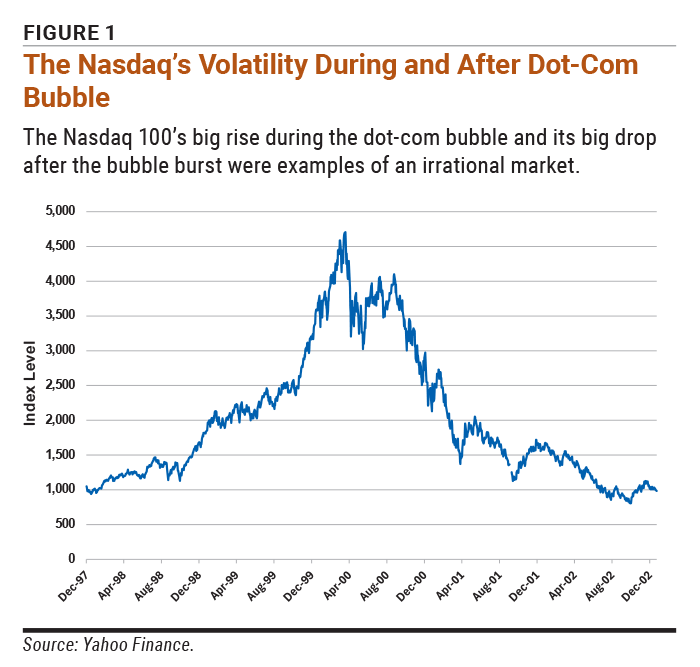
However, history shows us that markets can often be inefficient. During the dot-com bubble of the late 1990s, for instance, the Nasdaq 100 index rose almost 400% in two years before collapsing 80% in the following two years (Figure 1).
The performance of individual stocks such as ViacomCBS—now Paramount Global  (PARA)—can also reveal significant market inefficiency, as shown in Figure 2. In early January 2021, the company had a market capitalization of close to $25 billion and a stock price of $40. By March 22, 2021, the stock price had risen to $100 and the company’s market cap had grown to $62 billion. In the following four days, however, the company’s market cap plummeted by 50%.
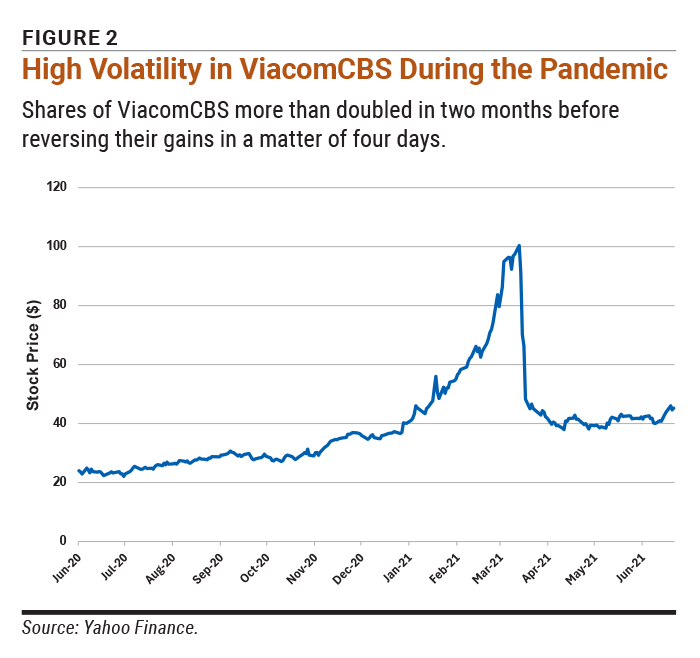
In a rational and efficient market, one would not expect a large-cap company like this to exhibit such a degree of price volatility.
Because the efficient market hypothesis postulates that all information is reflected in stock prices, proponents argue that stocks are correctly priced and trade at their fair value. This argument has several weaknesses.
First, the “correct” price of a firm’s stock is typically unknowable. The value of any financial asset, including stock, is the present value of its future expected cash flows. However, because we cannot precisely predict a firm’s future earnings, there will be a range of current values. Those values are predicated on differing expectations, the accuracy of which can only be known retrospectively. Furthermore, the calculation of a stock’s present value depends on the discount factor assumed in the valuation. Because investors may assess and price risk differently, their choice of a discount rate can vary. This, in turn, leads to differing valuations for the same firm. [Editor’s note: The discount rate is the implied rate of return investors demand today in exchange for future cash flows, including the perceived risk of those cash flows not being realized.]
A second weakness is that investors often do not behave rationally, but instead are influenced by cognitive and emotional biases. These biases can sometimes lead them to abandon their valuation and risk assumptions and act emotionally. Investors might invest in a stock simply because its price has been rising, even though it is becoming a riskier investment. Conversely, a declining stock price can lead investors to sell in desperation, even as the stock may be becoming a safer prospect. Figure 3 shows a representation of the well-known emotional roller coaster experienced by many investors.
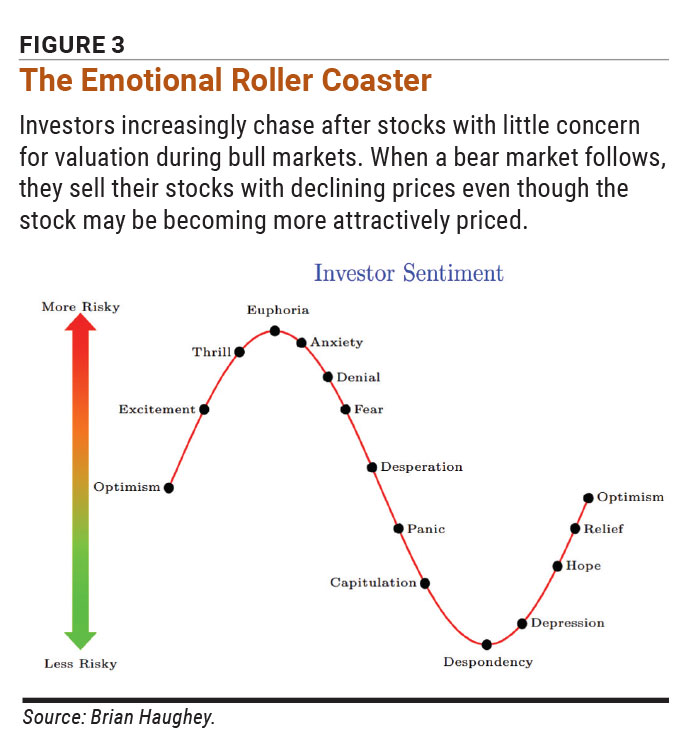
It has long been recognized that investors sometimes act irrationally. Their investing behavior can cause market prices to be based on emotion rather than information and therefore become inefficient.
Cognitive biases that influence investor behavior include loss aversion (which can lead to a reluctance to sell stocks that have declined in price), overconfidence (which can lead to excessive risk-taking), the endowment effect (which can lead to investors highly valuing an asset simply because they own it) and herding (whereby investors act together, sometimes leading to bubbles and crashes). Many of us are unaware of our own biases and faulty thinking, and that sometimes our initial conclusions are incorrect.
Ironically, acting on a belief in market efficiency can lead to markets becoming less efficient. Investors who believe that it is impossible to beat the market by selecting stocks will often instead opt for an index fund such as the large-cap SPDR S&P 500 ETF Trust (SPY) or the small-cap Vanguard Russell 2000 ETF (VTWO). However, as investment dollars flow into or out of these funds, their managers must buy or sell all the stocks in the fund based on their proportional index weights.
The result, ignoring other influences, is that stock correlations will increase. Stocks in the index will rise or fall together, regardless of their comparative intrinsic valuations, with fund inflows causing some stocks to become comparatively overpriced.
Similarly, neglected stocks not in the index will become cheaper relative to the index stocks, which will become more expensive in contrast. Therefore, as more money flows into index funds, the opportunities for stock pickers become better.
The weak, or most basic, form of the efficient market hypothesis suggests that an investor cannot gain an advantage by looking at historical prices because this information is already known and incorporated into prices, and so there is no benefit to be derived from technical analysis. However, as my high school physics teacher once told us in a moment of unintentional profoundness, “any moving object will continue to move until it stops.”
Stock prices tend to be serially autocorrelated, meaning that they exhibit momentum. In the absence of external factors, a stock that has been rising is more likely to continue to rise than it is to fall. While the price will almost certainly fall at some point in the future, on any given day the trend is more likely to continue than not.
This trend-following phenomenon was employed in the commodity markets by Richard Dennis and his team of neophyte turtle traders, described in various books including Michael Covel’s “The Complete TurtleTrader” (Harper Business, 2009). In academia, Mark Carhart recognized the importance of momentum, incorporating it as a fourth factor in Eugene Fama and Kenneth French’s three-factor asset pricing model. This implicitly rejected the weak form of the efficient market hypothesis.
Similarly, the semi-strong form can be discounted by examining the track record of noted investors such as Peter Lynch and Warren Buffett. The semi-strong form holds that because all publicly available information is already reflected in stock prices, there is no advantage to be gained from fundamental analysis of a firm’s financials.
Meanwhile, the strong form—which holds that even the use of material, nonpublic insider information would not allow for superior returns—has been shown to be invalid, even in limited cases involving corporate insiders that did not entail illegal activity.
Advocates of passively managed funds point to the relative scarcity of active managers who consistently beat the market as justification for their position. However, they tend to gloss over several important points.
First, unlike in Garrison Keillor’s Lake Wobegon where “all the children are above average,” only a minority of fund managers (weighted by assets) can mathematically outperform the average, particularly over a sustained period. Yet, as I noted in my March 2022 article, some chess players can consistently outperform, so why not managers? Furthermore, for a true evaluation, one should look at the long-term record of a manager rather than an arbitrary period such as one year.
If, as I suggest, these managers do exist, the difficulty for an investor, of course, can be in identifying them in advance. One fund that has outperformed since inception in 2017 is the Baron Durable Advantage fund (BDAFX), as shown in Figure 4.

It is also important to note that critics of active management often do not correctly evaluate performance. The simple analyses usually offered tend to only compare fund performance to that of the index. This ignores the fund’s actual risk exposure. Critics also fall short of a performance attribution analysis that can reveal how good a job the manager did in stock selection and asset allocation. For instance, as I mentioned in my March 2021 AAII Journal article “Viewing the Sector Exposure of Dividend Stocks Through the Aristocrats,” the Dividend Aristocrats have underperformed the broad market recently due, in part, to their reduced exposure to technology. Therefore, a simple performance comparison can be unfair and misleading.
There is no doubt that it is hard to beat the market, as reflected in an index. One reason is that active mutual funds typically hold a portion of their assets in cash, reducing performance in a bull market. Another is that the index is not a real portfolio. A manager investing in a stock after other managers already have can be at a disadvantage relative to the index.
Furthermore, many purported active managers are, in fact, “closet indexers” for reasons that can be explained by game theory. An active manager who expects to gain a modest bonus for beating the index but fears losing their job if the fund underperforms has an incentive not to actively pick stocks but instead to simply mimic the index.
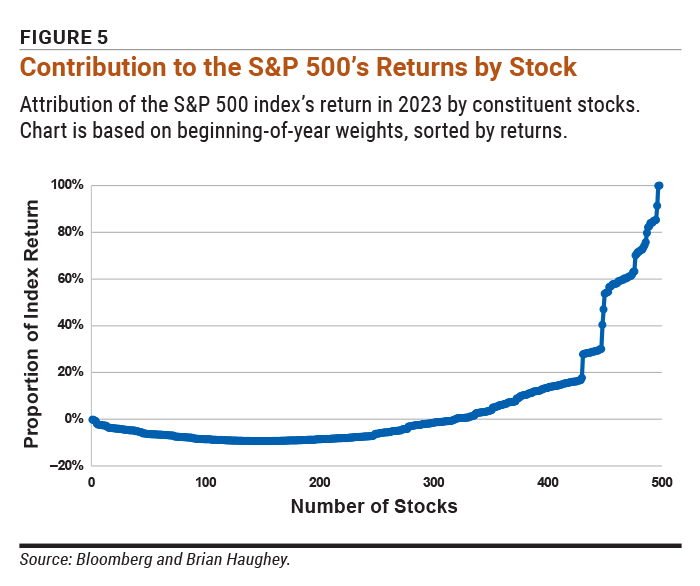
Another difficulty is that index returns typically are concentrated in a handful of stocks. The Pareto principle, also known as the 80%/20% rule, states that in many situations roughly 80% of the effects come from 20% of the causes. This has been observed over the long run in the stock market. Even in the short term, a similar effect can be seen.
For example, in 2023, the S&P 500 index returned 26.3% even though 60% of the stocks in the index exhibited negative returns, as shown in Figure 5. Because the bulk of returns come from a small number of stocks, an active manager with a small portfolio choosing stocks randomly is therefore unlikely to hold the stocks that performed best.
The efficiency or inefficiency of the stock market is a consequence of the actions of investors who may have unrealistically optimistic or pessimistic expectations about a firm’s future earnings. Yes, investors can beat the market, but to achieve above-average returns, they need to be better at interpreting information than the average investor or they need to identify a fund manager who can do so.
A successful active investor will be one who is not a slave to conventional wisdom, can think outside the box and can make inferences from other companies, industries and sectors. It is important to understand the psychological and behavioral finance components. It is also helpful to recognize that insights into the likely behavior of other investors can be gleaned from technical analysis.
ETFs and Mutual Funds

Portfolio Strategies

Trading Strategies

JOHN L from NJ posted over 2 years ago:
MAX C from CA posted over 2 years ago:
BARRY J from TX posted over 2 years ago:
ROBERT A from NC posted over 2 years ago:
ROBERT A from NC posted over 2 years ago:
JIM L from MI posted over 2 years ago:
JAMES M from MT posted over 2 years ago:
DAVE D from CA posted over 2 years ago:
William D from GA posted over 2 years ago:
STEPHEN H from WY posted over 2 years ago:
You need to log in as a registered AAII user before commenting.
Log InCreate an account