

Related

AAII Stock Ideas
Tweaking Benjamin Graham's Enterprising Investor Screen

Dispatches
The Treasury bond’s yield was approaching a full percentage point above the earnings yield for the S&P 500 index as of early May 2024.
by Charles Rotblut | June 2024

Charles Rotblut leads a class in AAII's new Essential Investing Video Course. Go to https://www.aaii.com/ves for more information and to subscribe.
On a yield basis, bonds have become more attractive relative to stocks. The benchmark Treasury bond’s yield was approaching a full percentage point above the earnings yield for the S&P 500 index.
Earnings are divided by price (E/P) to calculate the earnings yield. It is the inverse of the price-earnings (P/E) ratio, which divides price by earnings. The earnings yield near the start of May 2024 was 3.75%. In comparison, 10-year Treasury bonds yielded 4.63%.
Comparing the earnings yield to bond yields has been a long-used method for assessing relative valuations. Warren Buffett’s mentor Benjamin Graham did this, as have many others throughout the years.
The chart below is an update to one we published around one year ago in the April 2023 AAII Journal (“Stock and Bond Yields Are Converging”). We continue to use a January 2020 starting date to illustrate how the comparative yields have evolved during and after the coronavirus pandemic. Bond yields have risen significantly from their pandemic lows and were approaching their 2023 highs at the start of May.
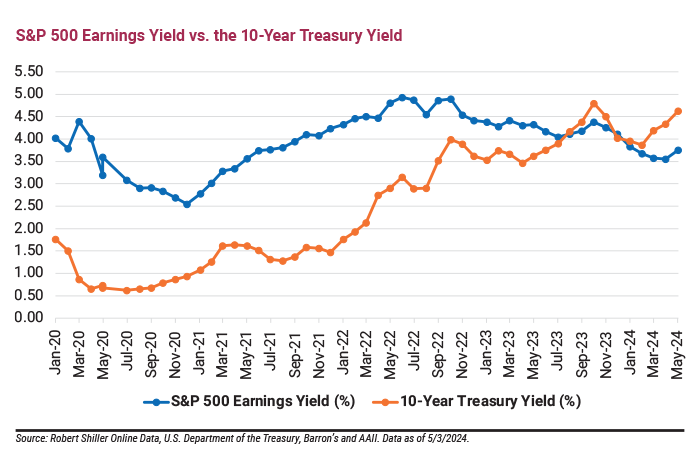
The updated chart calculates the earnings yield based on data from Nobel laureate Robert Shiller for the years 2020 through 2023. Earning yields for 2024 are from Barron’s since Shiller’s website did not yet have earnings data for the current year. Yields for the 10-year Treasury bond yield are from the U.S. Department of the Treasury.
Trailing 12-month earnings are used for the chart. Variations exist. The so-called Fed model, for instance, uses estimated earnings for the next 12 months. In his famous book “The Intelligent Investor,” Graham used average earnings for the last three years as an example.
Regardless of which earnings number is employed, the cheaper asset class is the one with the higher yield since yields and valuations are inversely related. The model is just one metric, however. It only tells us that bond valuations are comparatively more attractive than stock valuations.
AAII Stock Ideas
Dispatches


JOHN L from NJ posted over 2 years ago:
A I from CA posted over 2 years ago:
You need to log in as a registered AAII user before commenting.
Log InCreate an account