

Related

Financial Planning
Certain circumstances may allow you to improve your retirement prospects by changing a prior Social Security claiming decision.

Both married and single households should be aware of opportunities they have to redo a prior Social Security claiming decision when such a change would improve their retirement prospects. In this article, three redo options that are available for many Social Security households are looked at: withdrawal of application, suspending retirement benefits and filing for retroactive benefits.
Expected real (i.e., inflation-adjusted) lifetime benefits of competing claiming strategies are used in this analysis. Suppose a single individual’s monthly benefits are $2,100 the first year. Since cost-of-living adjustments (COLAs) are designed to keep the (pretax) purchasing power of Social Security benefits constant, the analyses assume this person will receive a constant real benefit of $2,100 per month for the rest of their life. I then compare the real lifetime benefits from competing claiming strategies.
The first of these redo strategies is an application withdrawal.
Consider Martha, a single individual who was born November 2, 1960. She has a primary insurance amount (PIA) of $2,500 and a full retirement age (FRA) for retirement benefits of 67. She files for her retirement benefits—that is, benefits based on her earnings record—in November 2022 at age 62 of $1,750 per month (70% × $2,500). She then learns, due to her estimated life expectancy of 90 years, that she would increase her expected real lifetime benefits by delaying her Social Security benefits until age 70.
If less than 12 months have passed since she started her benefits, she has the one-time right to entirely redo her prior Social Security claiming decision. To be precise, she could withdraw her application for retirement benefits through November 30, 2023.
If she withdraws her application, then she must pay back all prior benefits received based on her earnings record including, if any, spousal or children’s benefits that are based on her record. (An exception is that Martha would not have to repay an ex-spouse’s spousal benefits if the divorce occurred at least two years prior.) Also, anyone receiving benefits based on her earnings record (except the ex-spouse of at least two years) must consent in writing to the withdrawal. However, there would be no interest due on those repayments.
Using Social Security terminology, Martha may withdraw her claim for retirement benefits by completing Form SSA-521, Request for Withdrawal of Application. For additional information, see www.ssa.gov/planners/retire/withdrawal.html.
To understand why this redo strategy may be appropriate, suppose Martha lives to age 90, as expected. If she does not withdraw her application, then her real lifetime benefits would be $588,000 [$1,750 per month × 12 months × (90 – 62 years)], as shown in Strategy 1 in Table 1. If she withdraws her application, files for retirement benefits at age 70 and lives to 90, then her real lifetime benefits would be $744,000 [$3,100 per month × 12 months × (90 – 70 years). The $3,100 benefit reflects three years of delayed retirement credits at 8% of the primary insurance amount per year [($2,500 × 1.24) in Strategy 2 in Table 1.
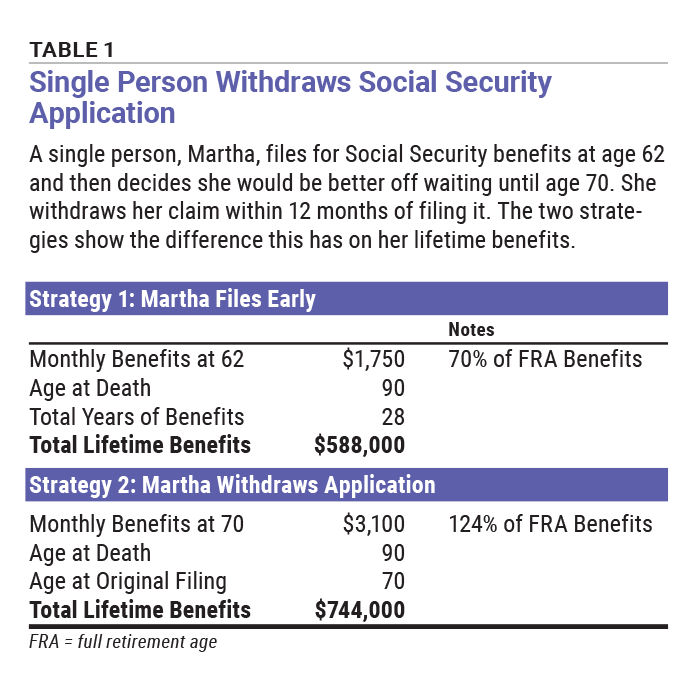
By withdrawing her application, Martha would increase her expected real lifetime benefits by $156,000. Furthermore, the higher monthly benefit from delaying the start of benefits until age 70 will continue for the rest of her life. Thus, this application withdrawal option would reduce her longevity risk (that is, the risk that she will outlive her financial resources) if she lives longer than expected.
Jose and Maria are married. Jose has a primary insurance amount of $2,600, full retirement age of 67 and life expectancy of 73 years. Maria is three years younger, has a primary insurance amount of $1,500 and a life expectancy of 88 years. Jose began his retirement benefits at age 62 of $1,820 per month (70% × $2,600), which he thought was the right decision because of his relatively short life expectancy. Before 12 months have passed, he learns that filing for his retirement benefits early will permanently reduce Maria’s survivor benefits, if he predeceases her. Benefits based on Jose’s earnings record will last until the second spouse dies. Based on their life expectancies, this would be when Jose is 91.
To maximize their expected joint real lifetime benefits, Jose should withdraw his application and repay prior benefits. At 70, he should begin his retirement benefits of $3,224 per month, ($2,600 × 1.24), which reflects three years of delayed retirement credits. If both Jose and Maria live to their life expectancies, then this couple’s real lifetime benefits based on Jose’s earnings record will be $812,448, [$3,224 per month × 12 months × (91 – 70 years)]. See Strategy 2 in Table 2.
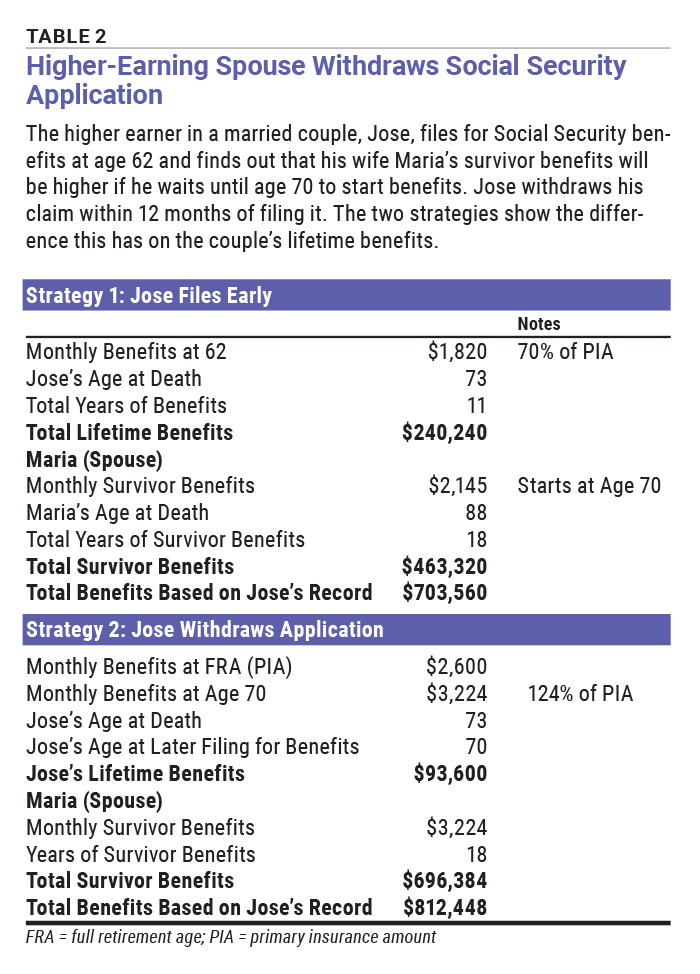
In contrast, if Jose continues his age 62 benefits and dies at 73, he would receive $1,820 in real monthly benefits for 11 years and then Maria would receive survivor benefits based on his earnings record of $2,145 per month for 18 years until her death. Maria’s monthly survivor benefits after Jose’s death is calculated as the larger of his real retirement benefits of $1,820 or 82.5% of his primary insurance amount, which is $2,145 per month. The total real lifetime benefit based on Jose’s earnings record would be $703,560 as shown in Strategy 1 in Table 2. By withdrawing his application for retirement benefits, expected real lifetime benefits based on Jose’s earnings record would be $108,888 larger.
The lesson is that, in general, the higher earner should base their starting date on the age they would be when the second spouse is expected to die. In this example, even though Jose has a relatively short life expectancy, he should withdraw his application, repay his benefits and delay his benefits until age 70. In contrast, since benefits based on the lower earner’s record will only last until the first spouse dies, when Maria would be 70 based on their life expectancies, she should file for her retirement benefits at age 62 (or as soon as possible, if she is older than 62).
In this example, since the lower earner’s primary insurance amount is at least half as large as the higher earner’s primary insurance amount, neither spouse can receive spousal benefits based on the other spouse’s earnings record. In contrast, suppose Maria’s primary insurance amount was $1,000, that is, less than half of Jose’s primary insurance amount. In this case, Jose’s filing age would not only affect his retirement benefits and her survivor benefits, but it would also affect her spousal benefits. Thus, he should consider how his starting age would affect both 1) his retirement and her survivor benefits and 2) her spousal benefits. This stuff can be complex, but the software at www.socialsecuritysolutions.com, which is available at T. Rowe Price, would identify their expected lifetime maximizing strategy.
This second strategy applies to people who began retirement benefits and more than 12 months have passed since they began benefits. Those who match this description cannot withdraw their application for benefits, as previously described. However, they can increase their monthly benefits by suspending their retirement benefits at their full retirement age or later and restarting their retirement benefits at a later date (probably at 70) to earn delayed retirement credits.
When benefits are suspended, prior benefits—including benefits received by a spouse or child based on the earnings record of the person suspending benefits—do not need to be repaid. However, anyone receiving benefits based on the earnings record of the person suspending benefits (except an ex-spouse) will lose those benefits until the suspended benefits have begun anew. Furthermore, the person who suspended their retirement benefits cannot receive spousal benefits during the suspension period. For additional information, see www.ssa.gov/planners/retire/suspend.html.
To demonstrate, I present one example for a single person and one for a married couple.
Consider Lisa. She is single, has a full retirement age of 67 and a primary insurance amount of $2,400.
In Strategy 1, she files for her retirement benefits at age 63 of $1,800 per month (75% × $2,400) and continues these benefits until her death. If she dies at age 90, as expected, then her real lifetime benefits will be $583,200, [$1,800 per month × 12 months × (90 – 63 years)] as shown in Strategy 1 in Table 3.
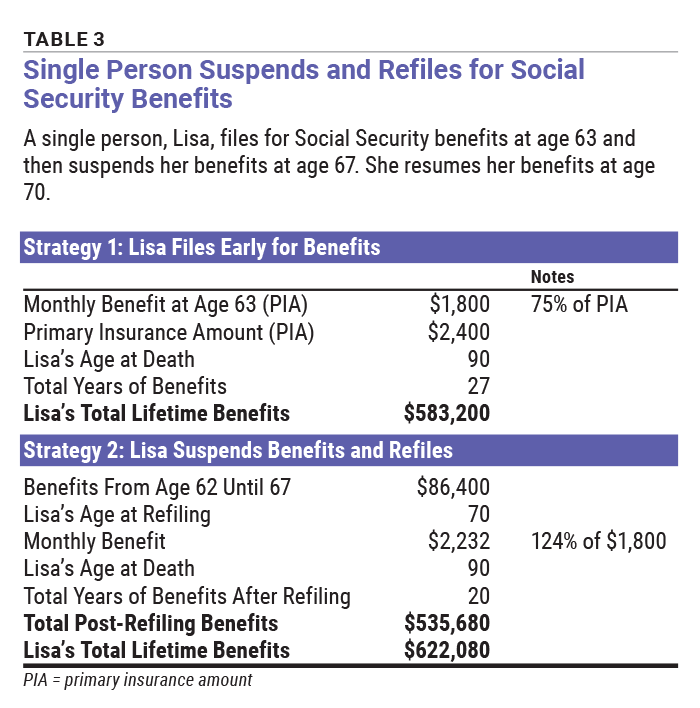
In Strategy 2, she filed for her retirement benefits at 63, but more than 12 months have passed since she filed for her retirement benefits. So, she cannot withdraw her application. At her full retirement age, she could suspend her benefits and refile for her retirement benefits at 70. These benefits would be $2,232 per month in real (inflation-adjusted) terms ($1,800 × 1.24). The higher benefit reflects three years of delayed retirement credits. She receives real benefits of $1,800 per month from age 63 until 67, plus $2,232 per month from age 70 until 90 for total real benefits of $622,080. This amount, shown in Strategy 2 in Table 3, is $38,880 more than her lifetime benefits in Strategy 1.
If Lisa lives past age 82½, then the lifetime benefits in Strategy 2 would exceed her lifetime benefits in Strategy 1. As shown in the book I coauthored with William Meyer, “Social Security Strategies: How to Optimize Retirement Benefits” (Fourth Edition, 2022), the break-even age between starting real retirement benefits at the full retirement age or age 70 is 82½ years whether the full retirement age is 66, 66½ or 67.
Mike and Paula were born in the same month, have full retirement ages for all benefits of 67 and primary insurance amounts of $2,400 and $1,000, respectively. Mike has a short life expectancy of 72 years, while Paula has a life expectancy of 90.
In the first example, they both file for benefits at age 64. Mike files for his retirement benefits of $1,920 (80% × $2,400) and Paula files for her retirement plus spousal benefits totaling $950 [retirement benefits of 80% × $1,000 plus spousal benefits of 75% × (half of $2,400 – $1,000)]. They continue these benefits until Mike dies at age 72. After his death, Paula receives real survivor benefits of $1,980 per month until her death at age 90. Since Paula begins survivor benefits after attaining her full retirement age for survivor benefits, she gets the larger of Mike’s $1,920 monthly real benefit level at his death or 82.5% of his primary insurance amount, which is $1,980. Their expected joint real lifetime benefits, calculated in Strategy 1 in Table 4, total $703,200.
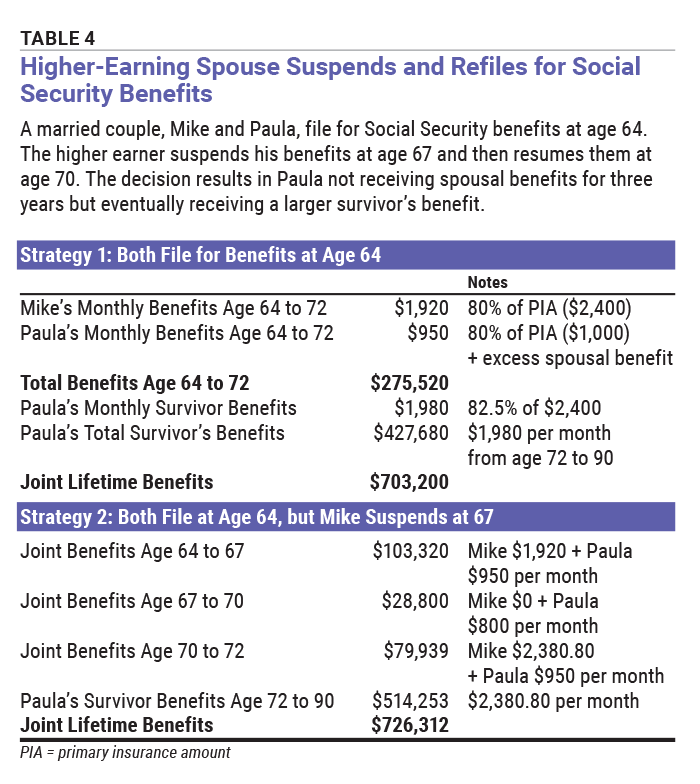
In Strategy 2, as before, they both file for benefits at age 64 (see Strategy 2 in Table 4). However, at the full retirement age of 67, Mike suspends his retirement benefits. So, for three years, he receives no benefits, while Paula continues her retirement benefits of $800 per month. At 70, Mike resumes his retirement benefits of $2,380.80 per month, ($1,920 × 1.24, which reflects three years of delayed retirement credits), and Paula receives her retirement plus spousal benefits of $950 per month. If Mike dies at 72, as expected, then Paula would receive real survivor benefits of $2,380.80 per month—that is, Mike’s retirement benefits—until her death at age 90.
If Paula lives to age 90, as expected, then Strategy 2 would provide $23,112 more in real lifetime benefits than Strategy 1. Strategy 2 beats Strategy 1 if Paula lives to at least age 85 and three months. This break-even age is longer than the break-even age of 82½ years for Paula for two reasons. First, when Mike suspended his benefits in Strategy 2, Paula lost $150 per month of spousal benefits for three years. Second, Paula’s survivor benefits in Strategy 1 exceeded Mike’s benefits at his death. In short, there are complications that caused this couple’s break-even age to be longer. Again, this stuff can be complex, but the software at www.socialsecuritysolutions.com will identify their lifetime maximizing strategy.
Someone can file for retroactive retirement or spousal benefits up to six months prior if that filing date does not move their beginning benefits date to before their full retirement age for retirement and spousal benefits.
Single John has a full retirement age of 67 and primary insurance amount of $2,800. He planned to file for retirement benefits at 70. However, now at age 68, he is diagnosed with a terminal illness with a life expectancy of age 72. He should apply today for retroactive benefits beginning at age 67½ of $2,912 per month [$2,800 × 1.04, which reflects six months of delayed retirement credits].

If he lives to age 72, by filing for retroactive benefits he would receive real benefits of $2,912 per month for four and a half years, which totals $157,248 in real lifetime benefits (Strategy 2 in Table 5). If he files today for his age 68 benefits of $3,024 per month and lives to age 72, then his real lifetime benefits would be $145,152, which is $12,096 less than if he files for retroactive benefits. Retroactive filing can be viewed as a redo strategy, because it is something different than the usual claiming strategy of filing today for retirement benefits.
Financial Planning

Financial Planning
Financial Planning

J W from KS posted over 2 years ago:
DAVID P from FL posted over 2 years ago:
KEVIN V from NC posted over 2 years ago:
BARRY J from TX posted over 2 years ago:
HAROLD F from WA posted over 2 years ago:
CHARLES M from NY posted over 2 years ago:
You need to log in as a registered AAII user before commenting.
Log InCreate an account