


Charles Rotblut leads a class in AAII's new Essential Investing Video Course. Go to https://www.aaii.com/ves for more information and to subscribe.
- Review your asset allocation targets
- Check position sizes and sell rules
- Compare savings contributions to your goal
Midyear portfolio reviews provide the opportunity to give your portfolio a checkup without the daily noise of the financial markets. When done right, they are fairly quick but provide useful feedback.
In this article, we go over the six steps of midyear portfolio reviews. A midyear review differs from both the daily look you may give your portfolio and the more comprehensive annual review that is part of the PRISM Wealth-Building Process. Midyear reviews are a check to see if any corrections are needed.
1. Ensure Your Allocation Is Reasonably Close to Target
The first half of 2024 has been favorable to individual investors. Large-cap stocks have set new record highs. Yields on cash equivalents—money market accounts, certificates of deposit (CDs), etc.—remain juicy. The economy continues to expand. S&P 500 index companies are reporting growth in both revenue and earnings.
It’s easy to get lulled into complacency. Successful investors take steps to prevent this from happening.
A simple exercise is to ask whether your current allocation is reasonably close to your target or if it has strayed off course. Vanguard suggests semiannual or annual rebalancing when one or more of your allocations to an asset class or asset class group are more than five or 10 percentage points off target.
If you’ve purposely raised your allocation to CDs, short-term Treasury bills, money market funds, etc., because of the higher yields, ask yourself if this fits into your long-term plan. If your long-term plan calls for allocating more to equities and bonds, create a strategy for rebalancing out of cash and into those assets.
2. Check the Relative Position Sizes of Your Investments
We believe in letting winners run within preset limits. When a particular stock or another investment like a sector/industry exchange-traded fund (ETF) in your portfolio has realized stellar gains, it may be time to pare it.
The key is determining whether the investment meets any of your sell rules. If it doesn’t, then determine whether the investment accounts for too large of a position in your portfolio. The strategies followed by the model portfolios for both AAII’s Stock Superstars Report (SSR) and VMQ Stocks consider trimming positions that have grown to 2.5 times more than the average position size for the entire portfolio. (Average position size is calculated by dividing the portfolio’s total dollar value by the number of positions held. Your threshold can be larger or smaller than 2.5 times the average.)
AAII’s My Portfolio tool can assist you with this process. For all members, it shows the percentage weight of each investment in your portfolio, as shown in Figure 1. A+ Investor subscribers can further use the Diversification Analyzer to determine if their portfolio allocations have strayed too far off track.

3. Use Your Sell Rules to Determine If an Investment Should Be Sold
Investments evolve over time. Those that evolve in a way that does not match your strategy are candidates for removal.
For stocks, your sell rules might include a minimum amount of earnings growth, an upper limit on valuation, a certain level of relative strength or meeting certain standards for fundamental strength. (The A+ Investor Stock Grades can help you track all of these.) Here are benchmarks that may help you:
- Price-Earnings (P/E) Ratio—most expensive 20%: 40.0 and above
- 12-Month Sales Growth—lowest 20%: –10.0% or below
- Return on Assets—50th percentile: 0.2%
For relative strength, a simple rule used by many AAII model portfolios is to compare a stock’s return against a benchmark. If the stock has been held for a few years (two to four years, depending on the portfolio) and has underperformed, it is removed. This simple rule indicates the market doesn’t agree that the stock is attractive. (Exceptions may be made if the stock currently meets the portfolio’s addition rules.)
Mutual funds and ETFs should be compared against their peers. While we don’t encourage selling a fund based on its six-month performance, giving your fund holdings a quick overview may alert you to longer-term trends that are developing.
AAII members can view current grades on a mutual fund or ETF’s Evaluator page. Type a fund’s name or ticker symbol into the search box at the top-left corner of pages on AAII.com. Grades for mutual funds and ETFs tell you how the fund ranks compared to other funds in the same category.
4. Assess Your Tax Situation
Looking at your tax liabilities and deductions now gives you time to make any adjustments.
A good place to start is with your brokerage statements. Have you claimed any losses so far this year? What about capital gains? Excess losses can provide the opportunity to offset any capital gains realized later in the year. If you have excess capital gains, see if there are any losses you are carrying forward from past years. Those carryforward losses can be applied against capital gains realized this year up to a net maximum of $3,000.
If retired, check to see if you have taken your full required minimum distribution (RMD) yet. If not, ensure that an automatic withdrawal is set up for later in the year. Alternatively, make sure that a calendar reminder is set up. The Internal Revenue Service (IRS) extended the waiver on RMDs from inherited individual retirement accounts (IRAs) through the end of 2024.
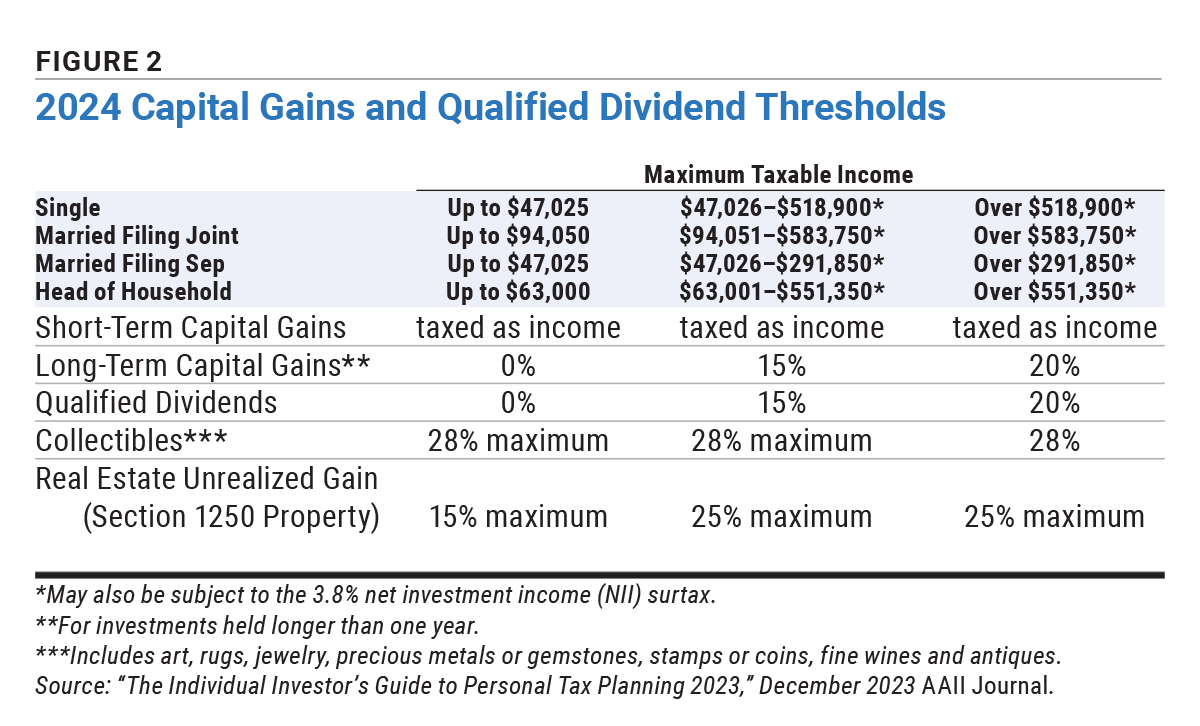
Then look at your income, deductions and, if applicable, estimated tax payments. Has there been a change in income that would move you to a different tax bracket, increase how much of your Social Security benefits will be taxed or increase what you will pay in future Medicare premiums? (See our tax guide for more information.) Have your deductible expenses been higher or lower than expected? Have your estimated tax payments been too low or too high? Consider whether there are opportunities to act before year-end if the answer to any of these questions is “yes.” Figure 2 shows the current income breakpoints for tax on capital gains and qualified dividends.
5. Give Your Savings Contributions and Spending a Once-Over
If you are saving for retirement or another goal, compare your actual savings contributions to your plan. Are you meeting your goals? If not, see if there is a way to get back on track.
This year, you can contribute up to $7,000 to a traditional IRA or Roth IRA. The limit for 401(k), 403(b) and 457(b) plan contributions is $23,000. Those who are age 50 or older have the higher limits of $8,000 and $30,500, respectively.
Retirees should check how much they are withdrawing. Basing your withdrawals solely on the RMD will ensure you don’t outlive your savings but will also lead to greater fluctuations in how much you can withdraw each year. If you adjusted your annual withdrawal amount for inflation, run a quick calculation to ensure that it isn’t creating strain on your portfolio.
6. Adjust for Any Life-Stage Changes
Finally, take a moment to consider what has happened in your life over the last six months. Is there anything that affects your financial situation, goals or beneficiary information? If so, make the appropriate adjustments.
Once you have completed this process, add a calendar reminder to conduct a more thorough review on or near New Year’s Day.

Related

Portfolio Strategies
Tilting AAII's Asset Allocation Models to Match Your Growth or Value Style
Related

PRISM Wealth-Building Process
Portfolio Monitoring for Progress of Goals and Life Stage Changes
Discussion
FREE REPORT

Get your free copy of our special
report analyzing the tech stocks
most likely to outperform the
market.
ROBERT A from NC posted over 2 years ago:
ROBERT A from NC posted over 2 years ago:
JOHN L from NJ posted over 2 years ago:
BARRY J from TX posted over 2 years ago:
BARRY J from TX posted over 2 years ago:
BARRY J from TX posted over 2 years ago:
You need to log in as a registered AAII user before commenting.
Log InCreate an account