

Related

PRISM Wealth-Building Process
Taking advantage of your workplace retirement plan can make a big difference in your end balance and spending capacity.

Between now and January, millions of Americans will make pivotal financial decisions as they enroll in or adjust their retirement plans. Among other things, they’ll decide how to save, invest and automate. How impactful are these choices? More than you might think. Even the “20-minute” solution of accepting the most common employer defaults could double an investor’s lifetime spending power.
 Those defaults typically start with small automatic paycheck deductions invested in a target-date fund. Then, they are scaled up over time until total savings rates, including company matches, are 10% or more of the employee’s salary. Slightly more complex approaches that shift 10% to 20% of the retirement savings to a small-cap value fund have historically done even better. And these approaches aren’t just relevant to the young; they can also improve portfolio safe-withdrawal rates in retirement.
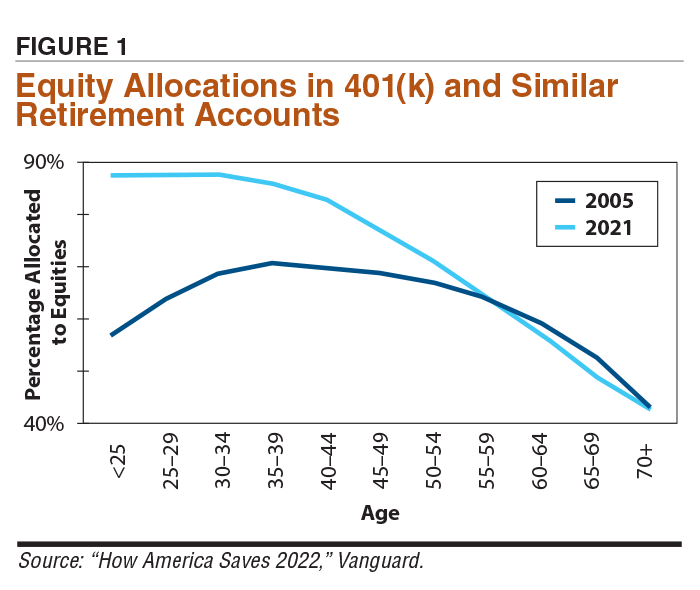
Over the past 20 years, retirement savings and investing underwent a revolution. We see this in the asset allocation trend data from the latest Vanguard “How America Saves” study.
From 2005 to 2021, the average equity allocation for those under age 30 increased from below 60% to near 90% (Figure 1). Why did it change? Almost certainly because of the widespread adoption of default automatic allocations to target-date funds.
The benefit of this change is hard to overstate. The expected return of young investor portfolios increased by between 2% and 3% per year. Yes, it came with more risk, but there are two reasons that risk is more bearable for young investors. First, they have decades to recover from market downturns. And second, the relatively large regular contributions they make to their accounts mask the perceived impact of those downturns. The average young investor who invests in a target-date fund will likely do very well.
We’ll use the most common plan attributes from Vanguard’s report to show just how well a young investor could do. Those attributes start with auto-enrolling new employees at a 3% savings rate with a 50% employer match up to the first $6,000 contributed per year. Contributions would then automatically increase by 1% per year for seven years until they reach a maximum of 10% of salary. The nearly universal default investment is a target-date fund.
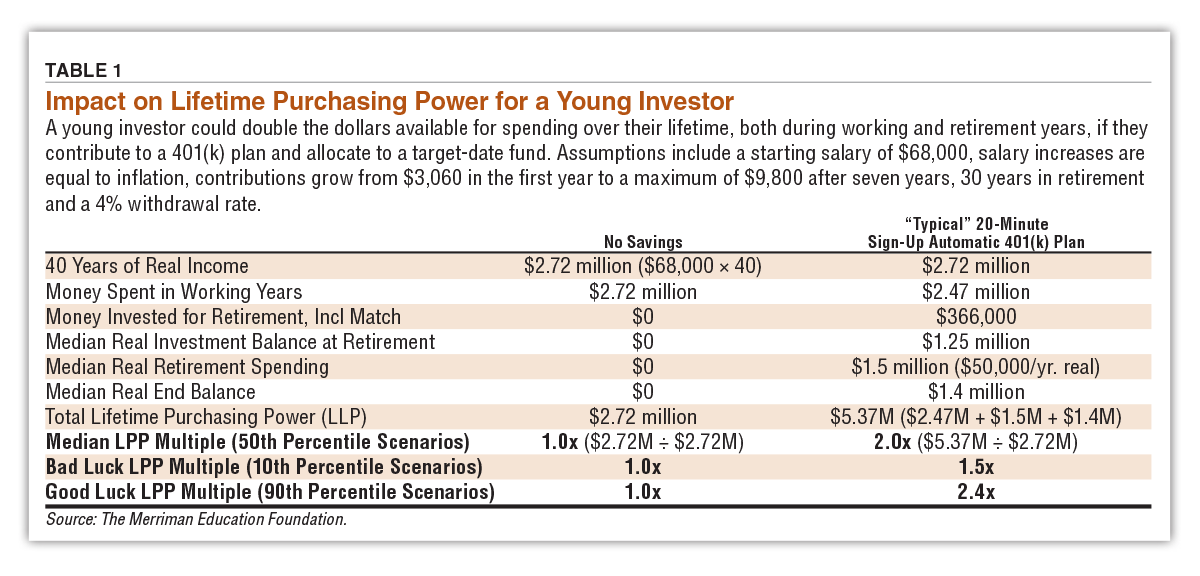
Given that the median salary in Vanguard’s study was $68,000 per year, our “typical” plan participant would contribute $2,040 in the first year and get a $1,020 match, for a total of $3,060 invested. If we conservatively assume that salary increases just keep up with inflation, salary remains constant on a real (inflation-adjusted) basis. That means real contributions will grow over the next seven years to reach $9,800 per year (10% of $68,000 plus the maximum match of $3,000) and stay at that rate until retirement. Accepting these defaults is the 20-minute solution. It’s the easiest thing the typical retirement plan participant could do. So, what’s the expected result?
I simulated this experience by modeling cash flows, the dynamic asset allocations of Vanguard target-date funds, the best approximation of returns from 1928 through 2021, and over 1,000 possible starting months. The scenarios are allowed to loop from 2021 to 1928 when necessary to avoid oversampling the middle years.
I’ve summarized the outcomes as a lifetime purchasing power multiplier (LPPM), calculated by dividing the lifetime spend plus money left over at the end by the total money earned. The investor lifetime assumptions are 40 years of accumulation followed by 30 years in retirement. Retirement withdrawals are “fixed” at 4% in real terms because they get set at retirement and then adjusted for inflation year by year. I’ve used real historical returns to avoid overstating results due to inflation. Finally, I’ve included bad luck (10th percentile), average luck (50th percentile) and good luck (90th percentile) results.
Table 1 shows an astounding story. Today’s “typical” default 401(k) retirement plan is likely to multiply real lifetime spending power by 1.5x to 2.4x compared to the person who doesn’t save and invest.
How can that be? How can saving only thousands of dollars per year amount to millions of dollars of benefit? Many readers will know that the answer lies in the power of compounding, but the magnitude of this example warrants elaboration. Let’s look at the real contributions, withdrawals and median real investment returns by decade.
Notice that it takes less than 20 years for the median returns to exceed contributions. Nearing retirement, median investment returns are nearly four times larger than the contributions. And even though returns start to decline around retirement with the increasing bond allocation, they are still a powerful force in the early retirement years. In the first decade of retirement, investment returns still exceeded portfolio withdrawals. Since safe withdrawal rates are based on historical worst-case scenarios, they are conservative. More typically, investors will see their nest egg continue growing into retirement.
As good as this is, some investors may want to try to do better. Two target-date fund weaknesses suggest ways to improve.
First, many target-date funds hold bonds early in an investor’s career. Although there are years and even decades when this could be advantageous, the overall effect is to lower long-term expected returns.
The second weakness of most target-date funds is that they have no meaningful exposure to the small and value parts of the market, which have historically had higher expected long-term returns.
One way to compensate for the weaknesses of target-date funds is to allocate a small portion of retirement savings to a second investment in a small-cap value fund. Given that many investors won’t have access to a small-cap value fund in their retirement savings account, we’ll assume they invest this portion of the retirement savings in a second IRA account without rebalancing in accumulation.
We’ll use “nudge” withdrawals to keep things simple in retirement. Nudge withdrawals take the entire annual withdrawal from whichever fund is bigger than its target allocation, thereby nudging the portfolio back toward its desired allocations. For example, if the small-cap value fund in the IRA is 12% of the portfolio when the target allocation is 10%, we’ll take the entire annual withdrawal from that fund. If the target-date fund exceeds its target allocation, we will take the annual withdrawal from it instead.
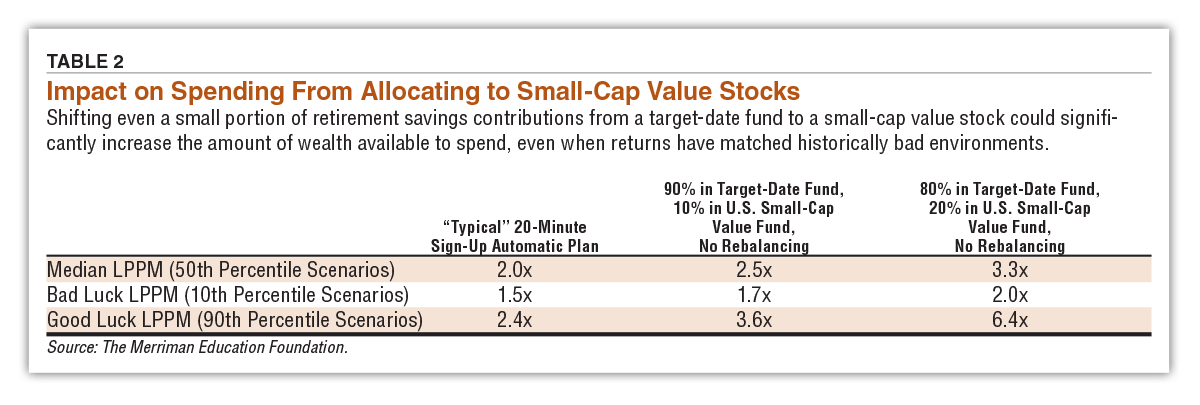
Table 2 shows the lifetime purchasing power results for shifting 10% and 20% of the retirement savings contributions to a second U.S. small-cap value fund using the same scenario assumptions as our previous analysis.
It’s hard to see how these changes wouldn’t have helped a young target-date fund investor. The 10th percentile (bad luck), median and 90th percentile (good luck) scenarios all improved. Even the “bad luck” 10th percentile lifetime purchasing power multiplier for the most aggressive 80% target-date fund/20% small-cap value approach was 2x. There are three reasons to be cautious, though:
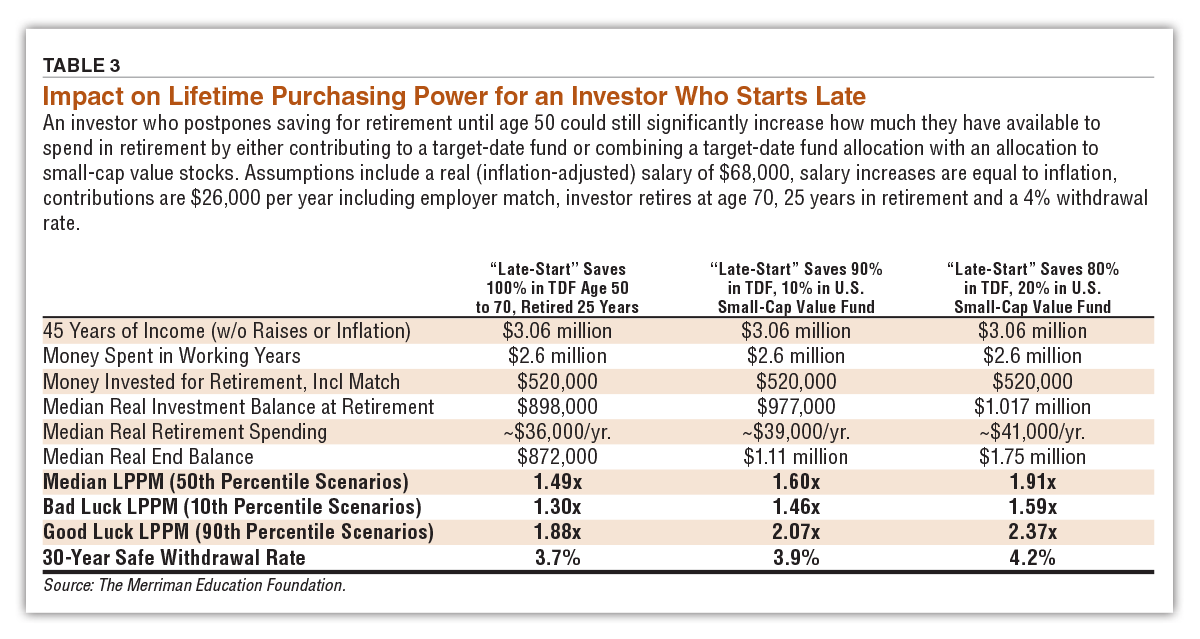
Now, let’s consider someone with the same $68,000 per year real salary (increases with inflation for constant purchasing power) who starts later, works longer, saves more for a shorter time and is retired for fewer years. We’ll assume they begin working at age 25 but don’t start saving and investing until age 50. To make up for the late start, they work until age 70 and save the maximum allowable amount, including catch-up contributions. With the $3,000 per year employer match, that’s $26,000 per year (using figures from the study). Would this extremely aggressive savings rate have been enough to make up for their late start?
As you can see in Table 3, even though our late-start investor invests 42% more real dollars ($520,000 versus $366,000) than the younger investor in our early-start examples, it’s not enough to catch up. The retirement spending numbers and lifetime purchasing power multipliers are much lower. There are fewer years for compounding to work and fewer dollars to be compounded. The resulting retirement withdrawals of around $36,000 to $41,000 per year could be uncomfortable for someone accustomed to living off $45,000 to $68,000 per year, likely necessitating greater reliance on Social Security to fill the gap.
Taking on more risk by investing 10% to 20% of retirement contributions in a U.S. small-cap value fund helped but still didn’t get the median retirement income level up to the pre-retirement spend rate of $45,000 per year or the early nonsaving spend rate of $68,000 per year. It did, however, increase the median lifetime purchasing power multiplier from 1.49 to 1.91, nearing the 2.0 multiple we saw earlier for the typical default young investor.
Adding some small-cap value also increased the safe withdrawal rate, which is an indication of portfolio resilience. Consequently, our late-start investor is less likely to run out of money if withdrawals are a little higher out of necessity. It also means they’re more likely to find their nest egg growing in retirement, which might enable a mid-course upward adjustment in retirement spending.
The target-date fund on its own is a balanced fund that combines U.S. and international equities market funds with bonds to produce something prudent for the broad investor market. Adding a less-correlated asset with higher expected returns—such as a small-cap value fund—increases portfolio diversification, expected returns and safe withdrawal rates. It also makes returns less like the market at large. For investors willing to be different with conviction, that can be a good trade-off. For investors lacking the knowledge and conviction to be different, sticking with a 100% target-date fund allocation is a better choice.
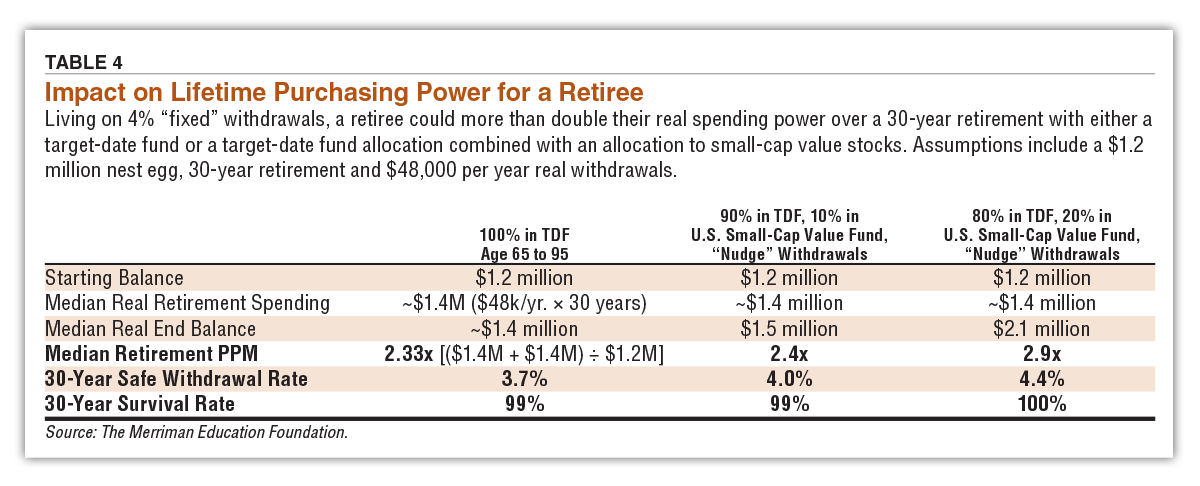
Let’s look at one final example. Consider a 65-year-old retiree who has just finished a career making a real income of $68,000 per year for 40 years and investing with the default automated enrollment and match. With median historical returns, their real nest egg would be worth $1.2 million. Assuming they can live on 4% “fixed” withdrawals, does it make sense to stick with the default target-date fund allocation? Or would they also benefit from including some small-cap value?
To find out, we ran these scenarios for 30-year retirements with $48,000 per year real withdrawals. And instead of a lifetime purchasing power multiplier, we calculated a retirement purchasing power multiplier (PPM), which is the median real end balance plus total real withdrawals divided by $1.2 million (the starting balance).
We see three options in Table 4 that are all great for this retiree, with nearly 100% portfolio survival rates in all cases. Because they can live off 4% withdrawals, the bulk of their nest egg is left to grow over time. Even the most conservative all-target-date-fund approach had a median retirement purchasing power multiple of 2.33, more than doubling their real spending power over a 30-year retirement. Shifting 10% of their retirement savings to a U.S. small-cap value fund makes a smaller difference here, increasing the retirement purchasing power multiplier to 2.4 and the 30-year safe withdrawal rate to 4.0%. Shifting 20% to small-cap value made a substantial difference, raising the retirement purchasing power multiplier to 2.9, and the 30-year safe withdrawal rate to 4.4%.
The downside is that this diversifying asset also added volatility in the early years of retirement. In the 1928–2021 history used for this analysis, the worst-case drawdown for the target-date fund at age 75 was about 39%. In contrast, the worst-case drawdown for the 80%/20% combination was about 50%. By age 85, the target-date fund investor and 80%/20% investor were both seeing about a 50% worst-case drawdown. By age 95, the worst-case scenario for the 100% target-date fund investor was a 100% drawdown since 1% of the scenarios didn’t survive, but the 80%/20% investor saw about a 50% worst-case drawdown and never ran out of money. The rewards were worthwhile for investors able to ride out the higher initial volatility. Investors who panic-sold during downturns wouldn’t have reaped the benefits and would have been served better by more conservative approaches. Rightsizing our risk is one of the most important things we do as investors.
Obviously, the allocations I’ve discussed here aren’t the only possible solutions. Some of you probably think, “I’m 100% stocks, and I’ll do better.” Others will favor a “Buffett” (90% S&P 500 index, 10% short-term Treasury bonds), “Boglehead” (total stock market plus bonds) or “Swedroe Barbell” (30% small-cap value funds, 70% bonds) approach. Some will be comfortable with value but not small-value funds. The principles we’ve covered still apply to these other approaches. Starting early, investing consistently and diversifying will almost certainly boost lifetime spending power, increase safe withdrawal rates and improve portfolio resilience in retirement.
So, if you’re lucky enough to be young and sitting down for the first time to consider your retirement savings options during this year’s open enrollment period, pause and remind yourself: The next 20 minutes could double your lifetime spending power. Take the time to learn about your employer’s plan. Read about the investment options available. Consider whether you can live with the defaults or would like to invest more. Consider whether you can tolerate more risk for more return by investing in a second fund. Then, to the extent possible, automate your savings and allocations and get on with work and living while your nest egg grows.
If you’re a mid-career employee just starting to save, congratulations! Today’s the day you trade financial headwinds for tailwinds. It may take time to feel their effect, but eventually, you’ll be glad you made the switch.
And if you’re just getting into retirement with some savings, congratulations too! It can be an exciting and nerve-racking time. Take comfort in knowing that a well-diversified portfolio has delivered safe withdrawal rates of 3% to 5% or higher over hundreds of overlapping periods of history. And you can create one of those with just a target-date fund and a small-cap value fund.
PRISM Wealth-Building Process

AAII InvestoGraphic

Portfolio Strategies

JIM L from MI posted over 4 years ago:
Chris P from CA posted over 4 years ago:
You need to log in as a registered AAII user before commenting.
Log InCreate an account