


Charles Rotblut leads a class in AAII's new Essential Investing Video Course. Go to https://www.aaii.com/ves for more information and to subscribe.
As we approached the end of December 2024, the Level3 withdrawal strategy called for retirees to withdraw from their equity holdings. The continuation of the normal model is due to the S&P 500 index’s nearly 60 new highs in 2024. Normal mode occurs when the large-cap index is within 5% of its previous record high.
The Level3 approach incorporates growth and defensive assets. Investors maintain a high allocation to growth assets like equities to allow a portfolio to grow at a rate faster than inflation. Defensive assets are those that are safe from the standpoint of a drop in actual value. Such assets include short-term Treasuries, certificates of deposits (CDs) and money market funds.
Investors establish a defensive allocation during the four years leading up to retirement. Each year the S&P 500 starts within 5% of its previous high, one year’s worth of expected withdrawals ($50,000 in the example below) is moved from equity to defensive assets.
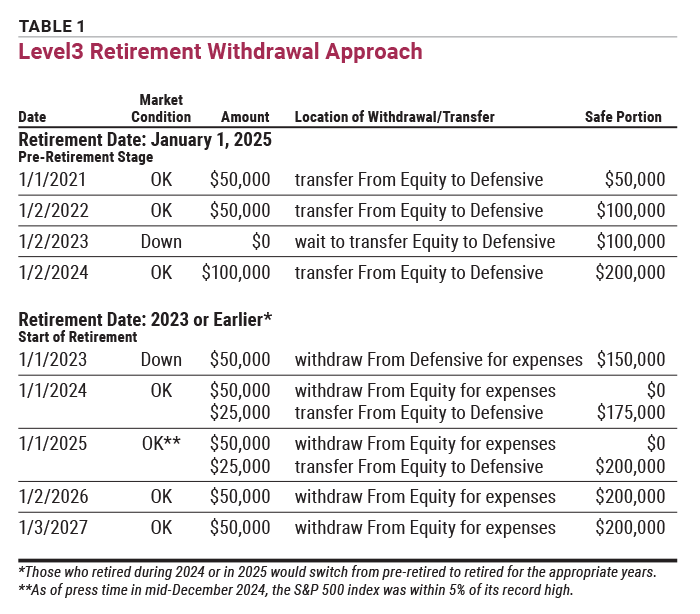
The bear market year of 2022 led to the Level3 withdrawal strategy being in defensive mode as 2023 began. Investors nearing retirement would have skipped transferring any amounts from growth assets to defensive assets at that time. When the strategy reversed back to normal mode in 2024, the equivalent of two years’ worth of transfers ($100,000 in the example here) would have been moved from equities to safe assets to finish filling the defensive bucket.
Investors who retired in 2023 or earlier would have taken withdrawals from their defensive assets in 2023. Then, in 2024, they would have switched to taking withdrawals from growth assets. In addition, they would have also transferred an amount equal to one-half of one year’s withdrawals ($25,000 in the example) to the defensive bucket. This second, smaller transfer began refilling the defensive bucket. The same steps would also be taken this year (2025), as shown in the table.
AAII founder James Cloonan recommended deciding to withdraw from equity or defensive assets on January 1 of each year due to the wide availability of year-end data.
As of press time, the S&P 500 was at a record high—a level we expect will keep the Level3 withdrawal strategy in normal mode on January 1, 2025. Retirees following this strategy should consider taking withdrawals from their growth assets and finish replenishing their defensive assets this year.



Discussion
FREE REPORT

JERRY J from IL posted over 1 year ago:
DAVE G from TX posted over 1 year ago:
You need to log in as a registered AAII user before commenting.
Log InCreate an account